
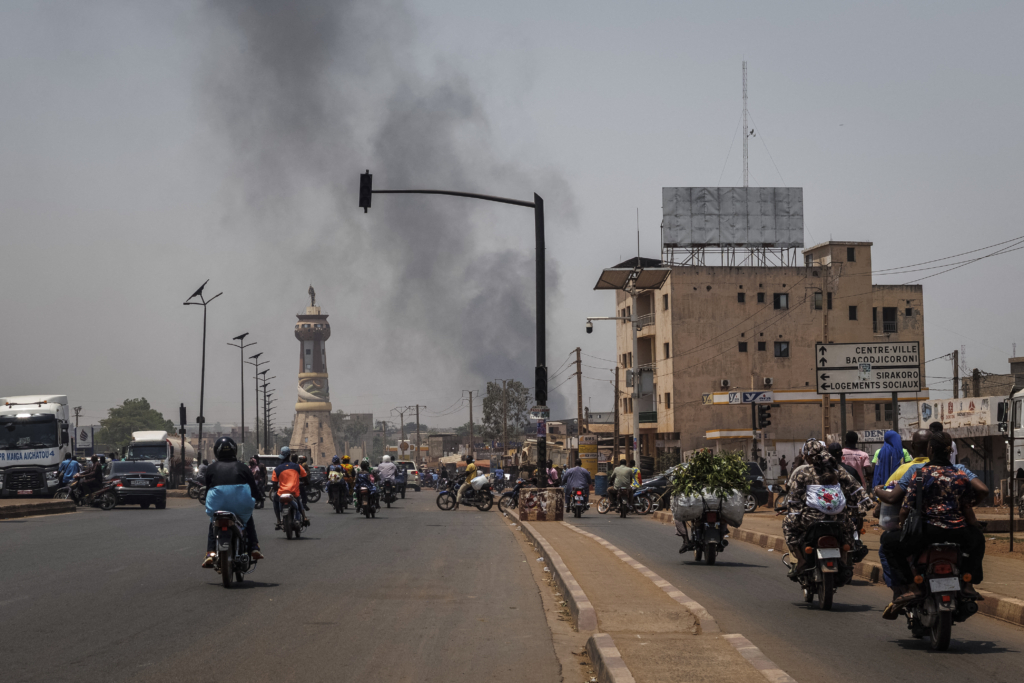
The ongoing blockade of Bamako is having devastating effects on civilian mobility and could lead to severe violations of their fundamental rights to food security, health, and life, warned a leading human rights organization today. The Groupe de soutien à l’islam et aux musulmans (GSIM), an armed group linked to Al-Qaïda, was urged to comply with international humanitarian law and ensure the safety of civilians.
Since April 28, three major routes into Bamako have been blocked after the GSIM declared a siege on the Malian capital. On May 6, the group launched an attack on a convoy of trucks carrying civilian goods—including fruits—between Bamako and Bougouni. According to verified reports, these vehicles were not military-escorted nor transporting weapons or personnel.
« Attacking civilian vehicles used for non-combat purposes is unlawful. Under international humanitarian law, all parties in an armed conflict must distinguish between civilians and combatants. Deliberate attacks against civilians or civilian infrastructure, including essential supply routes, are strictly prohibited », stated a regional director for the organization.
Sieges must not strip civilians of their economic and social rights.
Regional Director, West and Central Africa
Blockade violates warfare rules
The April 28 announcement by a GSIM spokesperson declared a total blockade of Bamako, unlike the previous September 2025 siege, which only targeted fuel tankers. The current restrictions appear to affect all commercial traffic entering the capital.
By May 15, at least three of the six primary routes linking Bamako to regional ports were disrupted, cutting off vital supply lines for essential goods. Residents and media sources reported a sharp rise in prices for basic necessities.
« Blockades must not infringe on civilians’ economic and social rights. The GSIM must uphold international humanitarian law, ensuring Bamako’s population continues to access clean water, food, and other critical supplies in sufficient quantities », the regional director emphasized.
On May 5, the UN Human Rights Office called for an immediate end to hostilities and urged all parties to respect international humanitarian and human rights law, particularly the protection of civilians and civilian infrastructure.
The GSIM announced a partial easing of the blockade on May 6, allowing medical emergencies to enter Bamako. However, the organization has not been able to verify the implementation of this measure.
Illegal and deadly GSIM attack on civilian convoy
An eyewitness account from a tanker driver targeted during the previous siege in September 2025 revealed the group’s escalating brutality. The GSIM had vowed to block and disrupt all fuel shipments to Bamako from regional ports, attacking trucks traveling from Dakar on the Kayes-Bamako route. By November, the group publicly declared truck drivers fair game, labeling them as combatants.
The GSIM must halt all attacks on civilians immediately, including indiscriminate violence.
Regional Director, West and Central Africa
On January 29, 2026, the driver was part of a military-escorted convoy of fuel tankers attacked between Diboli and Kayes. Several drivers and their assistants, caught fleeing, were executed. « Around twenty kilometers from Diboli, we were ambushed by over two hundred jihadists on motorcycles who opened fire on the convoy », the driver recounted under anonymity.
« Three military trucks arrived as reinforcements, but the soldiers on board were killed. The jihadists then set the trucks ablaze. At least twelve drivers and assistants were captured, held overnight, and forced to dig graves for fallen jihadists before their throats were slit », he added.
« International humanitarian law applies to all parties in this conflict. The GSIM must immediately cease attacks on civilians, including indiscriminate violence. The Malian authorities must investigate these potential war crimes. Victims and survivors of international crimes are entitled to truth, justice, and reparations », the regional director concluded.
Context
On April 25, the GSIM—also known as Jama’at Nusrat al-Islam wal-Muslimin (JNIM)—and the Azawad Liberation Front (FLA) launched coordinated attacks in Bamako, Kati, Mopti, Sévaré, Gao, and Kidal. Targets included military camps and residences of political and military figures. In Kati, the Defence Minister, Sadio Camara, and several family members were killed when an improvised explosive device detonated in a vehicle targeting their home.
On May 6, GSIM assailants struck the villages of Kori Kori and Gomassagou in central Mali, resulting in at least 40 deaths and numerous missing persons, according to local authorities and verified sources.