
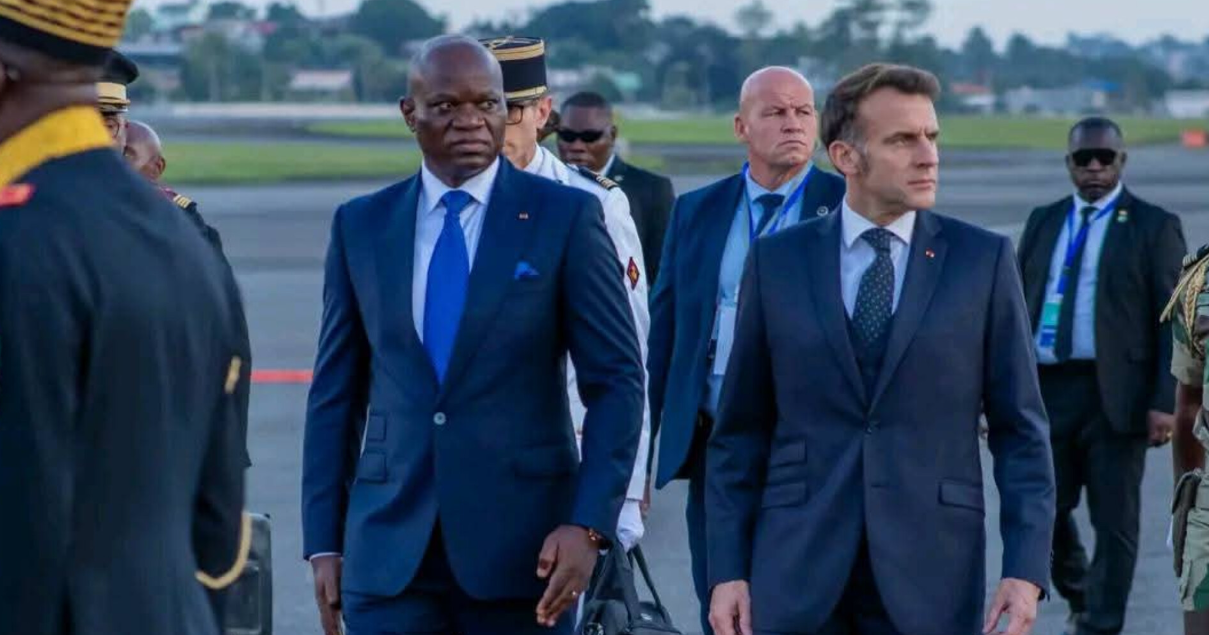
For three intense days, Gabonese President General Brice Clotaire Oligui Nguema embarked on a high-stakes state visit to France, where he redefined the future of bilateral ties. The core of discussions with President Emmanuel Macron centered on two pivotal issues: restructuring the Camp de Gaulle military base and accelerating local transformation of manganese—a mineral Gabon dominates as the world’s second-largest producer.
From military footprint to strategic partnership
The Camp de Gaulle—a historic symbol of French military presence in Central Africa—no longer fits the old blueprint. With France’s Africa-wide redeployment already underway, Gabon is not seeking a hasty ejection of foreign troops. Instead, Libreville is pursuing a carefully calibrated renegotiation to convert the site into a jointly managed training center or scale down France’s role to a minimal footprint focused solely on technical cooperation and counter-piracy operations in the Gulf of Guinea.
This approach reflects Gabon’s dual ambition: asserting national sovereignty without severing vital security channels. Meanwhile, Paris is eager to demonstrate adaptability, having witnessed the fallout from abrupt shifts in neighboring Sahel capitals.
Manganese transformation: a new economic covenant with France
The mining sector emerged as another flashpoint in the talks. Gabon, a global leader in manganese, has long exported the raw ore at minimal margins. Now, Libreville is pushing for an industrial overhaul: demanding on-site processing, equitable profit-sharing, and high-value job creation for Gabonese youth. The message to French conglomerate Eramet—via its Comilog subsidiary—was unambiguous: future cooperation hinges on local value addition and shared technological transfer.
This pivot aligns with Gabon’s broader strategy to leverage its mineral wealth amid the surging global demand for battery-grade manganese, positioning the country as a key player in the clean energy transition.
Libreville’s middle path: a lesson in pragmatic diplomacy
While Bamako, Niamey, and Ouagadougou have embraced shrill anti-Western rhetoric and abrupt alliances, Gabon is charting a different course. President Oligui Nguema’s method rejects the false dichotomy of either blind submission or explosive rupture. Instead, Libreville negotiates from strength: engaging Beijing, Ankara, and New Delhi for diversified partnerships while maintaining a firm but constructive dialogue with Paris.
This Realpolitik underscores a critical truth: asserting sovereignty does not require diplomatic self-sabotage. Gabon proves that a balanced, incremental approach can yield tangible gains—economic, military, and reputational—without triggering isolation or instability.
A shadow over openness: digital controls and democratic credibility
Yet the regime’s international image is complicated by domestic actions. Frequent internet shutdowns—ostensibly to curb misinformation—have drawn criticism from civil society and opposition voices, who warn of creeping authoritarianism. These restrictions risk undermining the very sovereignty narrative Gabon champions abroad.
Even as Macron’s team emphasized the importance of free expression during informal exchanges, Libreville faces a delicate balancing act: preserving internal stability while safeguarding the credibility of its democratic reforms.
The path forward: sovereignty without isolation
The state visit concluded with strategic clarity. By redefining military ties and anchoring manganese processing locally, Gabon has reinforced its vision of a sovereign yet cooperative foreign policy. Success now hinges on execution—translating these agreements into jobs, infrastructure, and economic growth—while ensuring that digital freedoms and civic space expand in tandem with national ambition.
In the end, Gabon’s experiment may redefine how African nations navigate great-power relations: not through ultimatums or withdrawal, but through negotiation, innovation, and unshaken self-determination.