
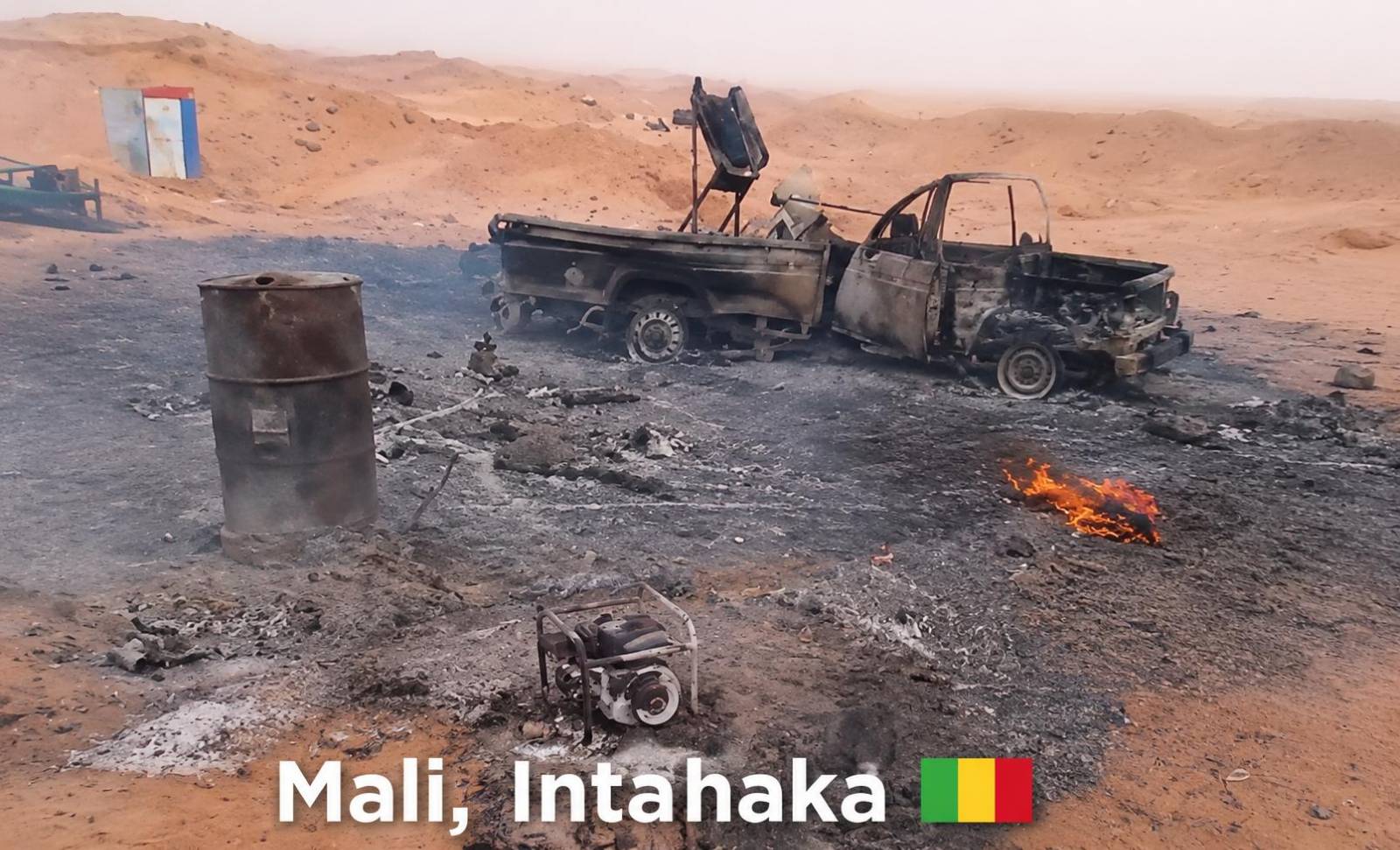
Early this past Monday, an unintended strike by a Malian Armed Forces drone in the northern mining hub of Intahaka, near Gao, claimed the lives of several fighters from the GATIA—a Tuareg self-defense group long allied with Bamako. What was initially framed as an anti-terror operation quickly exposed deep flaws in the military’s operational oversight, underscoring the widening gap between tactical claims and battlefield reality.
Intahaka’s tragedy: technology’s blind spots
The pre-dawn strike in Intahaka—the heart of Mali’s artisan gold mining sector—left GATIA’s convoy in ruins. While official narratives initially labeled the attack a success against insurgents, local testimonies confirmed the grim truth: a misidentification that erased allies instead of threats. This blunder highlights systemic issues in Mali’s drone-centric counterinsurgency strategy, where precision often takes a backseat to haste.
Critics point to a recurring pattern: drones dispatched by the junta, trained on coordinates provided by overstretched ground forces, frequently misfire. Recent months have seen similar incidents, including civilian casualties in San, eroding what little trust remains in Bamako’s security narrative. The Africa Corps’ Russian advisors, tasked with training Malian forces, have yet to curb these recurring failures, raising questions about the sustainability of this approach.
Gold and gunfire: the cost of instability
Intahaka’s goldfields are no ordinary battlefield. They fuel entire communities but also attract warlords, traffickers, and competing armed factions. The ongoing violence has paralyzed extraction activities, leaving thousands jobless and pushing food prices beyond reach for local families. Residents describe a suffocating cycle: blockaded roads by jihadists, soaring costs, and now, aerial bombardment from their supposed protectors.
« We’re trapped. Between terrorists blocking our paths and drones raining fire from above, there’s nowhere safe left. » This plea from a displaced miner in Gao encapsulates the despair gripping a region where economic survival hinges on fragile alliances—and fragile ceasefires.
A strategy adrift: allies turned casualties
The junta’s reliance on drones as a silver bullet has backfired spectacularly. Once a key partner in Bamako’s fight against jihadist groups, GATIA now faces existential threats—not from rebels, but from its own allies. The collapse of the 2015 peace accord and the junta’s unilateral military push have fractured fragile alliances, pushing even former supporters toward opposition.
Meanwhile, insurgent factions like the Permanent Strategic Framework—now rebranded as the Liberation Front of Azawad—and the Support Group for Islam and Muslims have exploited the chaos. Their coordinated offensives, coupled with their own drone and jamming technologies, have overrun government positions across northern and central Mali. The junta’s asymmetrical warfare, once touted as a game-changer, now appears increasingly obsolete against mobile, tech-savvy adversaries.
Bamako’s paradox: sovereignty lost in translation
The drone strike in Intahaka is more than a tactical misstep—it’s a metaphor for the junta’s broader disconnect. Promises of restored national sovereignty ring hollow as the state loses control over vast territories, and its own forces become inadvertent executioners of civilians and allies alike. Without a shift toward inclusive governance and realistic security coordination, Bamako risks not just alienating its last remaining partners but erasing any hope for lasting peace.