
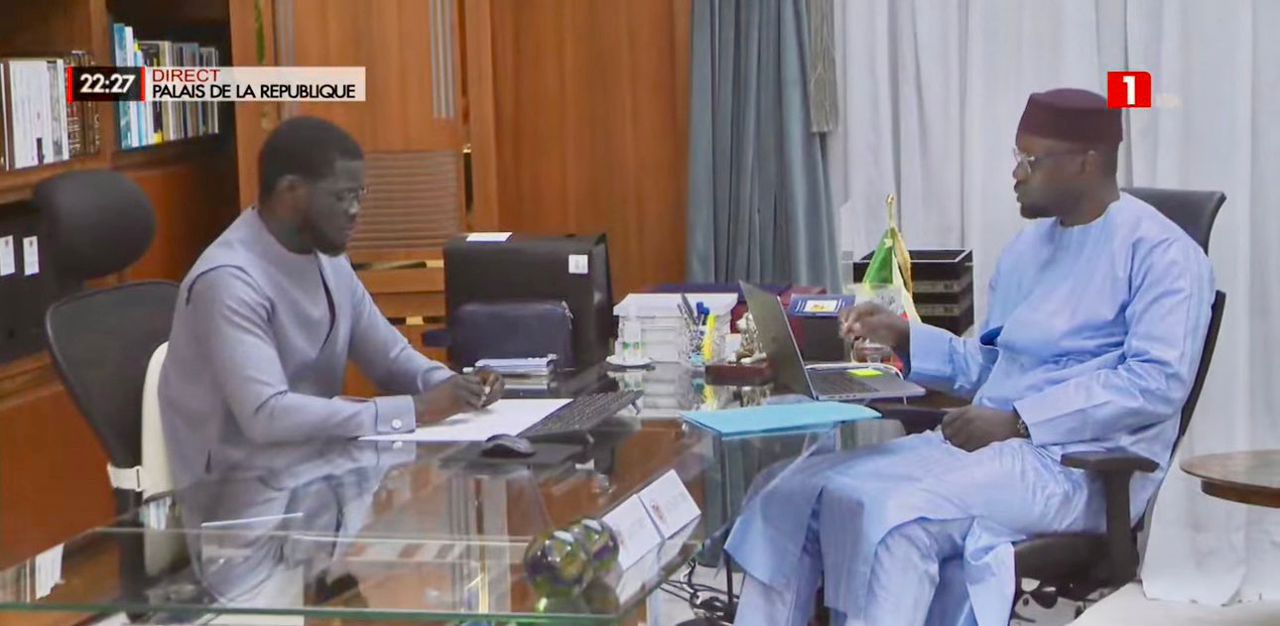
Tensions between Senegal’s political leadership and key figures in the ruling coalition have intensified following President Bassirou Diomaye Faye’s unexpected proposal to Ousmane Sonko. The former Prime Minister revealed exclusive details about the circumstances surrounding his removal from office, including a controversial request that was ultimately declined.
According to Sonko’s account, President Bassirou Diomaye Faye urged him to frame the government separation as a mutual decision—a suggestion Sonko firmly rejected. In a candid statement, he explained that the decision to dismiss him was made unilaterally, without prior discussion or agreement on how to publicly present the news.
Behind the scenes of a political split
Sonko described the immediate aftermath of his dismissal as chaotic, with the presidency moving forward to implement the change without consulting him on communication strategies. He claimed that while he was given a brief window—between 24 to 48 hours—to organize the transition, the process was accelerated without his input.
In his version of events, Sonko emphasized that he had always insisted on avoiding responsibility for the rupture, adhering to a principle of professional integrity. He returned home the same day and maintained a period of silence before any further engagement with the administration.
Unresolved questions linger
The former Prime Minister also shed light on the subsequent government formation process, alleging that consultations with outgoing ministers from the Pastef party were initiated without proper channels. He advised them not to respond, insisting that all discussions should go through official party structures. This stance reportedly deepened the rift between factions.
Days passed with no resolution until Sonko proposed a mediation meeting involving key political figures, including Birame Souleye Diop, El Malick Ndiaye, Alioune Sall, and Daouda Ngom. However, this effort did not yield any breakthrough. Later discussions were held with the new Prime Minister, Al Aminou Lo, but no consensus was reached on critical issues such as accountability, justice, and public debt management.
A political narrative in dispute
While Sonko framed his departure as a forced transition, he downplayed its political impact on him, calling it a form of relief. Yet the manner in which the decision was communicated and executed has raised eyebrows, fueling speculation about the state of internal party dynamics.