
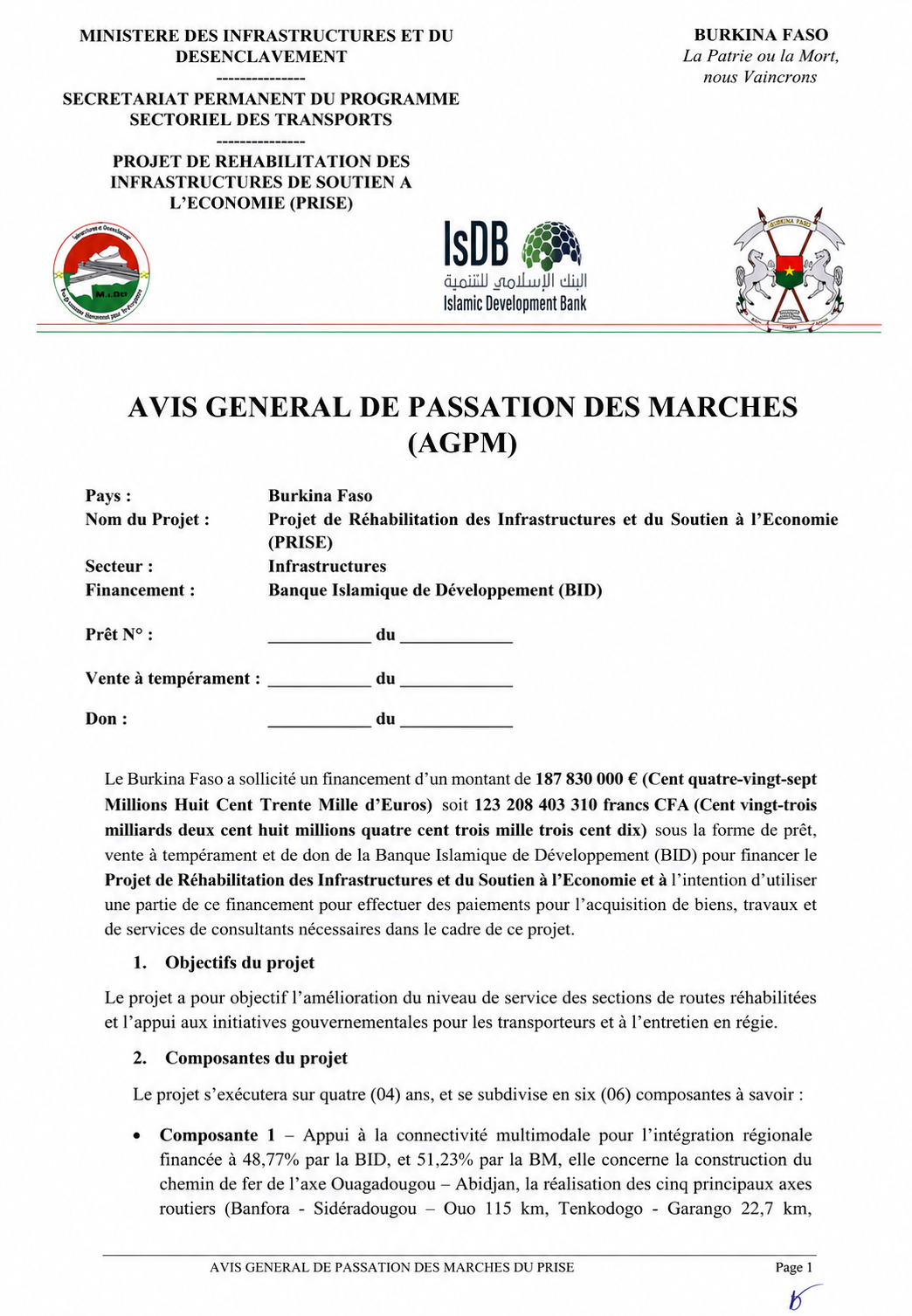
Since seizing power in Ouagadougou, military authorities led by Captain Ibrahim Traoré have promoted a bold narrative: the government claims to finance major infrastructure and development projects entirely through domestic resources, dismissing external borrowing with the slogan « Y’a pas crédit dedans »—roughly translated as “there’s no credit in this.”
This message, amplified across social media and by regime supporters, positions Burkina Faso as an economically self-sufficient nation, free from dependence on international lenders. Yet beneath the slogan lies a far more nuanced—and financially complex—reality.
From Political Slogan to Financial Reality
The pursuit of economic sovereignty is a legitimate goal for any nation. Strengthening internal revenue collection, reducing reliance on foreign aid, and fostering domestic capacity are objectives shared by policymakers worldwide. However, when official statements insist that every public investment is funded exclusively from national coffers, yet financial records and international agreements reveal otherwise, skepticism is warranted.
Recent agreements with the Islamic Development Bank (BID) to fund large-scale road construction projects, for instance, clearly involve external financing. These loans, even when concessional, represent obligations that will eventually require repayment. They are not grants or donations, but structured financial commitments recorded in the national budget. This raises a critical question: why insist on absolute self-financing when external credit remains a cornerstone of public investment?
Contradictions in Economic Messaging
The gap between rhetoric and reality is widening. On one side, authorities champion financial autonomy as a sign of renewed national pride and political legitimacy. On the other, Burkina Faso continues to engage with multilateral and bilateral partners to secure funds for essential infrastructure, security, and social programs.
This duality is not unique to Burkina Faso. Nations across Africa and beyond routinely combine domestic revenue with foreign borrowing to sustain development. What distinguishes this discourse is the insistence—despite evidence to the contrary—that no external credit is involved. Such a claim risks distorting public understanding and obscuring the true financial health of the state.
An Economy Under Strain
Burkina Faso faces immense economic and fiscal pressures. A prolonged security crisis has drained public resources, forcing increased defense spending and emergency expenditures. Displacements of civilians, weakened tax bases in conflict zones, and sluggish economic activity have further strained government finances. In such a context, financing multi-billion-franc infrastructure projects without external support is, for many economists, implausible.
Rather than rejecting borrowing outright, the focus should shift to responsible financial management. When used wisely, external credit can catalyze growth, improve connectivity, and enhance public services. The key lies in transparency: citizens deserve clarity on loan terms, interest rates, repayment schedules, and project priorities.
The Cost of Opacity
Governments that prioritize slogans over clear disclosure risk breeding distrust. Citizens have the right to know not only how public funds are spent, but how future generations will be impacted by today’s borrowing. Every loan contracted today will be repaid tomorrow—through taxes, reduced services, or deferred investments.
Transparency is not just a democratic ideal; it is a practical necessity. Without it, the promise of economic sovereignty rings hollow. A nation that conceals its debts cannot claim genuine independence—it only obscures the true cost of its development.
Beyond the Slogan: A Call for Accountability
True economic sovereignty is not measured by the absence of debt, but by the ability to manage it responsibly. It means:
- Publishing accurate, accessible budget data;
- Ensuring borrowed funds generate measurable returns;
- Balancing short-term needs with long-term fiscal sustainability;
- Holding leaders accountable for financial decisions.
In the end, Burkina Faso’s future will not be shaped by catchphrases, but by the choices made today about how to fund its development. Future generations will inherit both the benefits of today’s investments and the burden of today’s debts. The question is not whether to borrow, but how to borrow wisely—and how to ensure the public knows the truth behind every franc spent.
Until then, the slogan « Y’a pas crédit dedans » remains more a political assertion than a financial fact.