
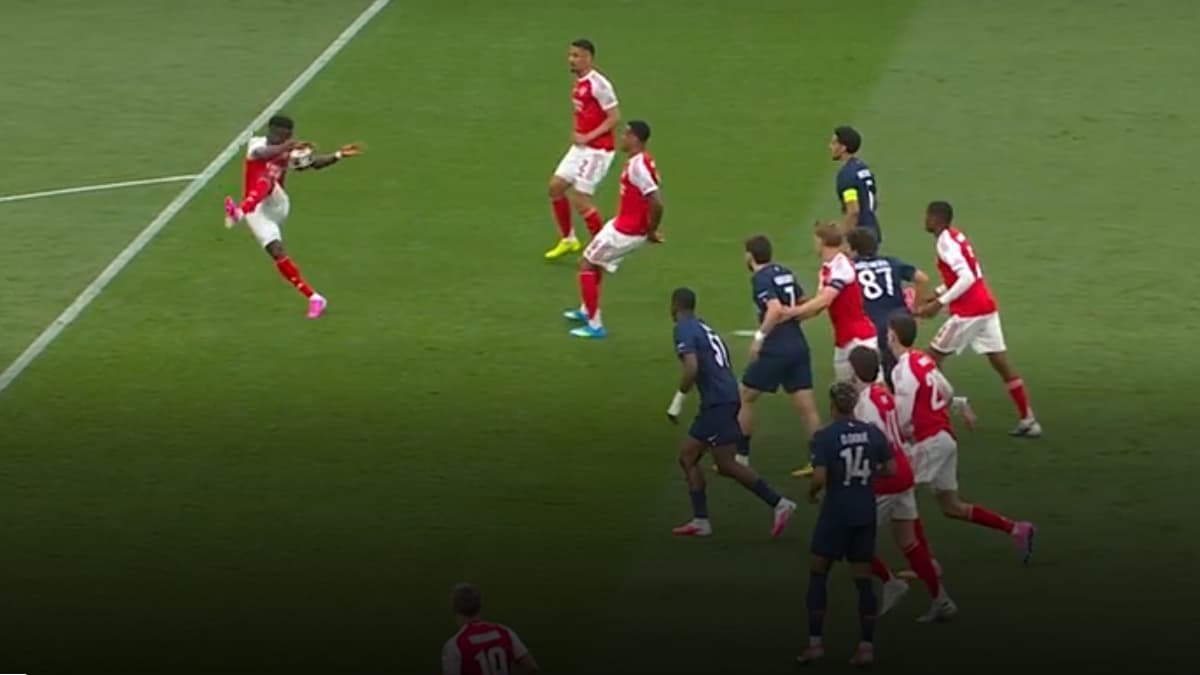
The opening minutes of the Champions League final between PSG and Arsenal proved chaotic, with the French side denied a potential penalty despite strong claims from their players. Just after the 15-minute mark, the match’s intensity boiled over when Bukayo Saka’s arm made contact with the ball in Arsenal’s penalty area.
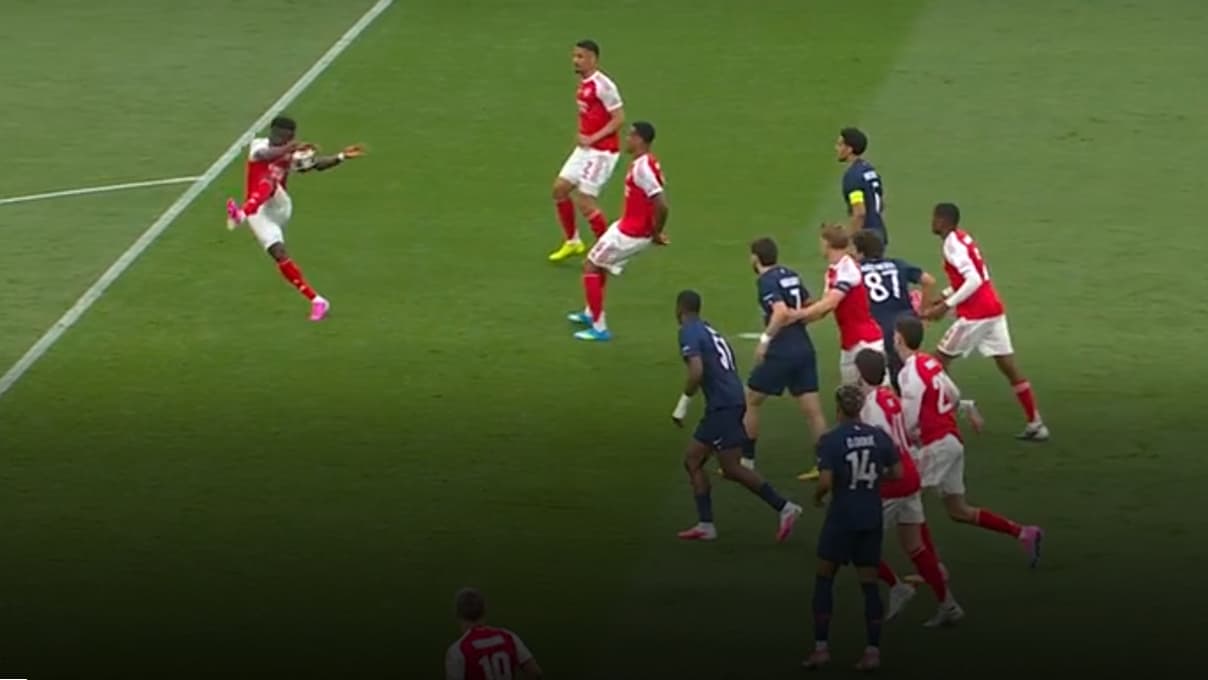
The incident unfolded as Ousmane Dembélé delivered a corner from the left flank. Saka, positioned near the edge of the box, attempted to clear the ball but made contact with his arm first. PSG immediately protested, with players pointing towards the spot, but referee Daniel Siebert waved play on. The Video Assistant Referee (VAR) also declined to intervene, leaving the decision unchanged.
Did Saka deliberately expand his body’s coverage?
The controversy hinges on the interpretation of handball rules under IFAB’s Laws of the Game. While not every ball-to-hand contact constitutes an offense, penalties are awarded if the action is deemed deliberate or if the player artificially increases the area covered by their body.
Analyzing the clip, Saka’s arms were noticeably extended away from his torso—a position inconsistent with natural running motion. The officials likely concluded that his body positioning was a direct response to the need to intercept the ball, rather than an intentional maneuver to gain an advantage. This interpretation aligns with the rule’s emphasis on unavoidable contact versus deliberate handball.
Social media erupts over referee’s call
The decision sparked immediate debate online. Critics argued that Saka’s repeated use of his hand in quick succession warranted a penalty, with some users mocking Arsenal’s apparent immunity to handball calls. Supporters of the no-call countered that Saka’s positioning was a natural result of his attempt to clear the ball, asserting that the contact was incidental rather than intentional.
At halftime, PSG remained behind despite creating a handful of chances. The controversial moment loomed large over the match, with fans divided on whether justice was served—or denied.