
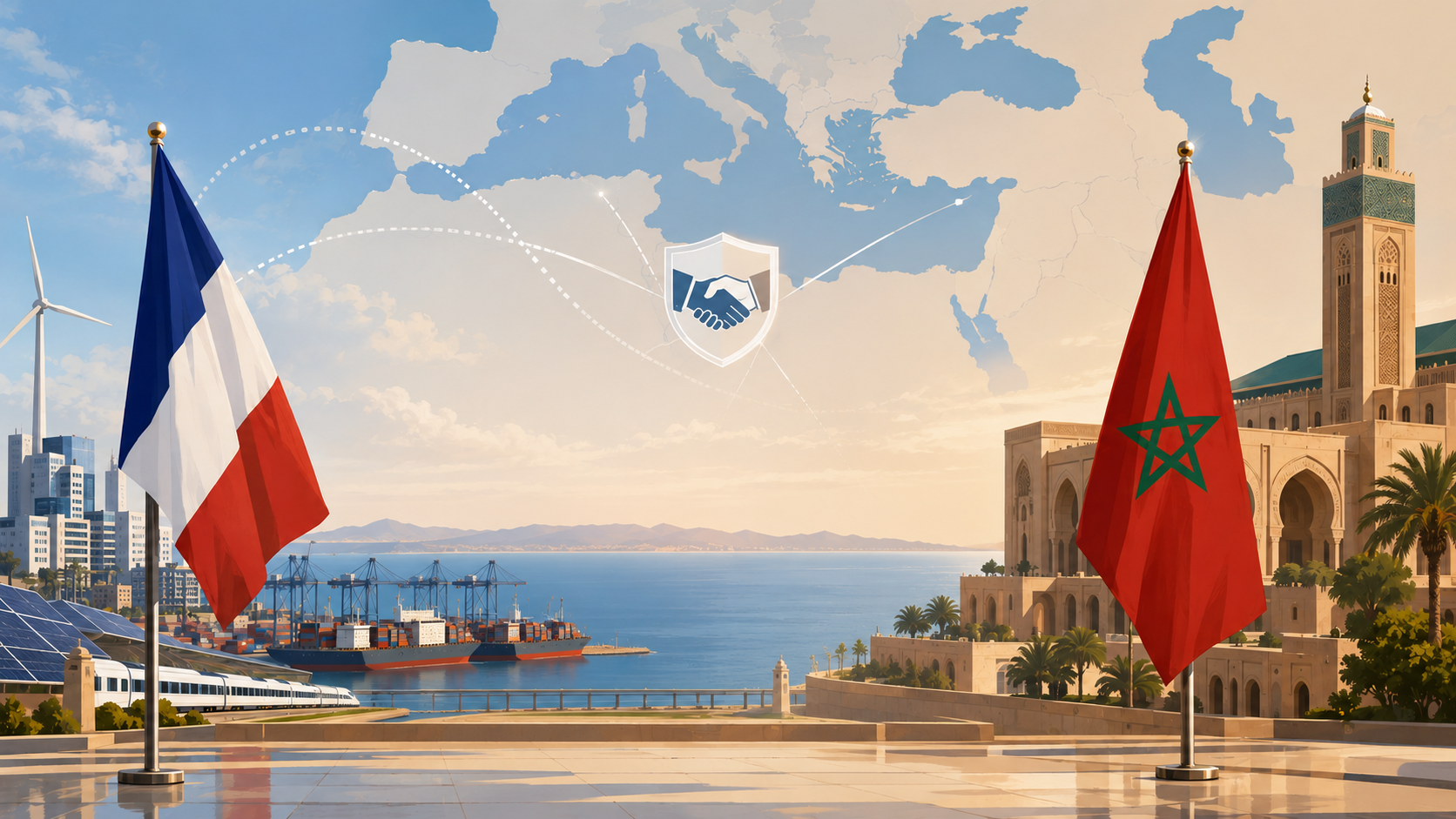
France and Morocco elevate bilateral ties to strategic heights
During a landmark two-day official visit, French Prime Minister Sébastien Lecornu arrived in Rabat at the helm of a high-powered delegation comprising a dozen ministers. Far from a routine diplomatic engagement, this mission signaled a deliberate political choice to deepen the already exceptional partnership between France and Morocco—a dynamic that has regained momentum in 2024 following a brief period of uncertainty.
This gathering marked the first intergovernmental meeting of such magnitude since 2019, underscoring a decisive shift in bilateral relations. The visit laid the groundwork for a formal bilateral treaty that will cement this renewed collaboration across multiple domains. While the timing suggests a strategic response to regional instability, the depth of this partnership reflects long-standing shared interests rather than a reaction to immediate crises.
Morocco’s stabilizing role in a volatile Mediterranean
The Mediterranean basin and broader Near East have become flashpoints for overlapping crises—from Sahelian instability to Libyan fragmentation, escalating regional tensions, and the unresolved complexities of Iran’s nuclear negotiations. Against this backdrop, Morocco has emerged as a rare pillar of stability.
The Kingdom has not only maintained remarkable political cohesion but has also transformed its economy, infrastructure, and military capabilities. Its pragmatic diplomacy enables it to engage with diverse actors, from Western powers to Gulf monarchies and African states, positioning itself as a bridge-builder in an increasingly fragmented geopolitical landscape. This ability to foster dialogue across divides is now a cornerstone of its international influence.
Why Morocco matters to France’s strategic calculus
The bilateral relationship transcended symbolic gestures after France reaffirmed its support for Morocco’s sovereignty over the Sahara and following President Macron’s state visit to Rabat in October 2024. The two nations officially launched an exceptional strengthened partnership, designed to institutionalize cooperation in security, defense, energy, industry, innovation, infrastructure, and cultural exchange.
The scale of Prime Minister Lecornu’s delegation—one of the largest in recent memory—demonstrates that the partnership is no longer merely diplomatic; it is operational. From intelligence-sharing and counterterrorism to renewable energy projects, artificial intelligence, and cross-border infrastructure, the scope of collaboration spans sectors critical to both nations’ future stability and prosperity.
A partnership built on mutual trust and shared interests
Morocco is no longer just a Mediterranean neighbor; it is a linchpin of France’s strategic interests. The Kingdom serves as a frontline partner in counterterrorism efforts, a stabilizing force in the Sahel, a gateway to Sub-Saharan Africa, and a logistical hub linking Europe to the African continent. Its industrial zones, such as Tangier Med, and investments in renewable energy further enhance its role as a key player in Euro-African supply chains.
The depth of Franco-Moroccan security cooperation is widely regarded as one of the most effective in the region, a testament to decades of joint efforts. This trust is now extending into new sectors, including artificial intelligence, green hydrogen, and advanced manufacturing. As global supply chains face disruption and Europe seeks to secure its energy and industrial future, Morocco’s reliability offers France a strategic advantage.
A future-oriented alliance
The relationship between Paris and Rabat is no longer confined to historical ties or people-to-people connections. It has evolved into a forward-looking partnership that aligns with Europe’s need for stability, Africa-focused engagement, and resilient supply chains. Morocco’s industrial growth, port infrastructure, renewable energy initiatives, and African expansion make it an indispensable partner in reshaping Euro-African economic dynamics.
Sectors such as automotive manufacturing, aerospace, green hydrogen, rail infrastructure, and digital innovation are all benefiting from this renewed momentum. In an era where many international alliances are fracturing, the Franco-Moroccan model proves that cooperation grounded in political trust and aligned interests can yield tangible outcomes.
As the Mediterranean remains a zone of tension and the Middle East undergoes rapid transformation, Morocco stands out as one of France’s most dependable and strategically vital allies. This exceptional partnership is no longer an historical artifact—it is a deliberate choice for the future, and France would be wise to recognize it as the cornerstone of its southern Mediterranean strategy amid today’s global upheavals.