
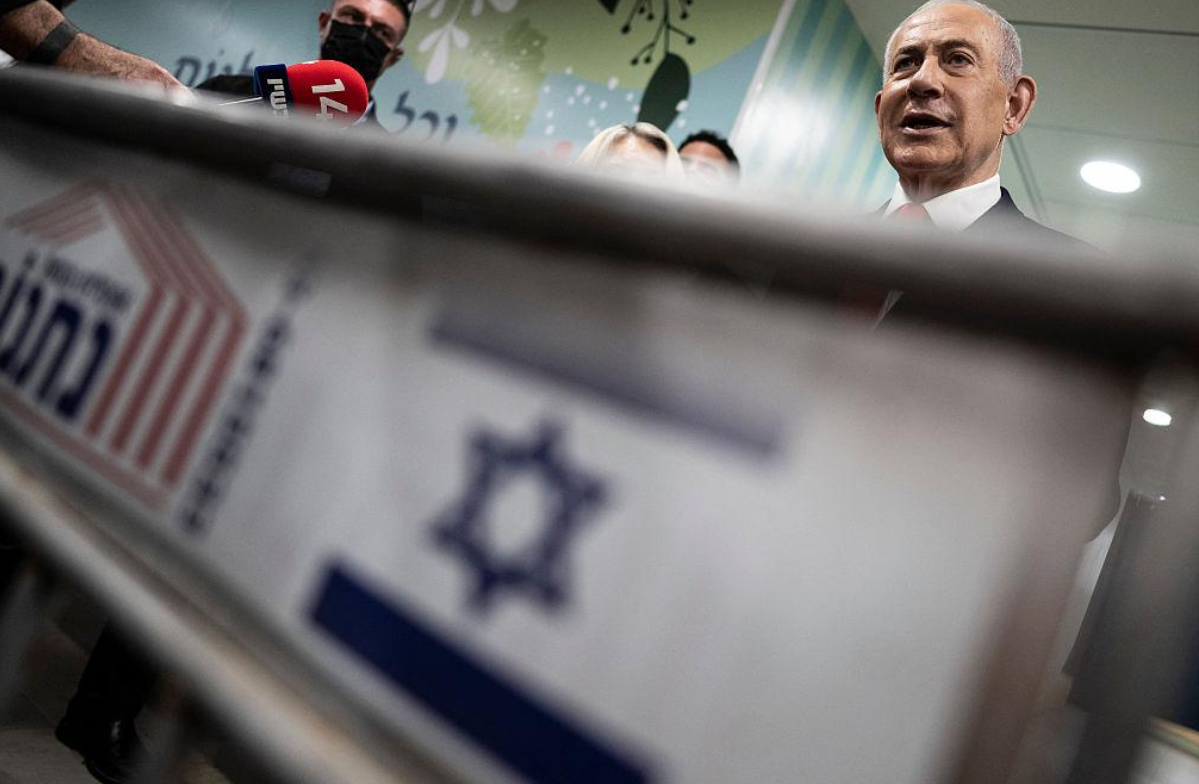
Can Netanyahu govern with just 53 seats in a deeply split Knesset?
Benyamin Netanyahu stands at a historic crossroads after Israel’s October 27 legislative elections. Leading with 53 seats in the 120-seat Knesset, the prime minister now faces an uphill battle to secure a workable coalition. His bloc’s 53 seats stand against 48 for opposition leader Gadi Eisenkot’s forces, while Arab parties command 19 seats—a record high that reshapes Israel’s political calculus.
The arithmetic couldn’t be clearer: 61 seats are required for an absolute majority. With no bloc crossing that threshold, Netanyahu’s previous coalition of 68 seats has effectively dissolved into political gridlock. The question now isn’t about victory—it’s about survival in a parliament where every dissenting voice carries disproportionate weight.
Why Arab parties hold the pivotal cards in Israel’s next government
The unprecedented 19-seat showing by Arab parties—led by the Joint List and Ra’am—creates an unprecedented power dynamic. While opposition leader Eisenkot’s bloc could theoretically join forces with these parties to form a majority coalition, deep-seated ideological divides make such an alliance highly improbable. Zionist parties remain reluctant to govern alongside Arab factions, creating a political impasse that could lead to one of three outcomes: a national unity government, a minority coalition, or another round of elections.
The Arab parties’ strategic position stems from their ability to influence the balance of power without necessarily joining a government. Their support could tilt the scales on critical legislation, while their opposition could paralyze policymaking—particularly on contentious issues like Palestinian statehood and equal rights for Arab citizens.
Gaza’s future hangs in the balance amid political fragmentation
The humanitarian crisis in Gaza isn’t just a regional concern—it’s now a litmus test for Israel’s next government. Reconstruction efforts, security arrangements, and the fate of Palestinian governance all hinge on the fragile parliamentary arithmetic. If Netanyahu succeeds in cobbling together a coalition with his traditional allies, we may see a continuation of hardline security policies. The nationalist and religious factions in his bloc advocate for firm stances on Palestinian territories and security demands, leaving little room for diplomatic maneuvering.
An opposition-led government wouldn’t necessarily signal a radical departure either. Deep divisions persist across the political spectrum regarding Hamas, security protocols, and Palestinian state recognition. For Palestinians in Gaza and the West Bank, the election results offer no immediate relief—only the unsettling reality that their future depends entirely on the unstable alliances forming Israel’s next government.
The Iran-Lebanon axis: how Israel’s political fractures could embolden its adversaries
Israel’s security establishment faces a paradox: while the country is deeply divided on domestic issues, foreign policy—particularly regarding Iran—enjoys broad bipartisan consensus. The Islamic Republic’s nuclear ambitions, ballistic missile capabilities, and regional proxy networks remain top priorities for policymakers regardless of who holds power. However, a parliament as fragmented as this one could hamper Israel’s ability to craft coherent strategies on these existential threats.
Lebanon’s Hezbollah poses another immediate challenge. Any military escalation could trigger devastating humanitarian consequences and further destabilize an already volatile region. With Israel’s political leadership potentially distracted by coalition-building, the risk of miscalculation in southern Lebanon or Syria looms larger than ever.
Diplomatic dominoes: how Arab capitals and Washington are recalculating their strategies
The United States watches Israel’s political turmoil with bated breath, as the U.S.-Israel alliance underpins regional security architecture. Yet the Biden administration’s push for de-escalation in Gaza and renewed Palestinian negotiations could clash with a Netanyahu-led government resistant to compromise. Washington’s dilemma mirrors that of Arab capitals like Egypt, Jordan, Saudi Arabia, and the UAE, all of which have tied normalization with Israel to tangible progress on Palestinian statehood.
Saudi Arabia’s calculus exemplifies this tension. While Riyadh remains committed to normalization, its public position links any deepening ties to Palestinian rights and regional stability. An Israeli government unable to articulate a clear policy direction could stall diplomatic momentum, while a coalition open to negotiation might unlock new possibilities—though not necessarily a breakthrough toward comprehensive peace.
A society split down the middle: what Israel’s election reveals about its fractures
Beyond the numbers, Israel’s election exposes deep societal divides on security, governance, religion, and national identity. The Arab parties’ historic gains reflect growing political mobilization among Israel’s Palestinian citizens, while Netanyahu’s Likud remains the largest single party despite erosion of its support. The political fragmentation isn’t just about seats—it’s a mirror held up to a nation grappling with its future amid perpetual conflict.
Three possible paths emerge from this political quagmire: Netanyahu secures power through new alliances, a surprising coalition forms to oust him, or Israelis return to the polls if negotiations collapse. Each scenario carries profound implications for the region, from Gaza’s reconstruction to Iran’s nuclear calculus and the broader Arab-Israeli peace process. In a Middle East where every Israeli decision reverberates internationally, this narrow victory may well mark the beginning of a new era of geopolitical uncertainty.