
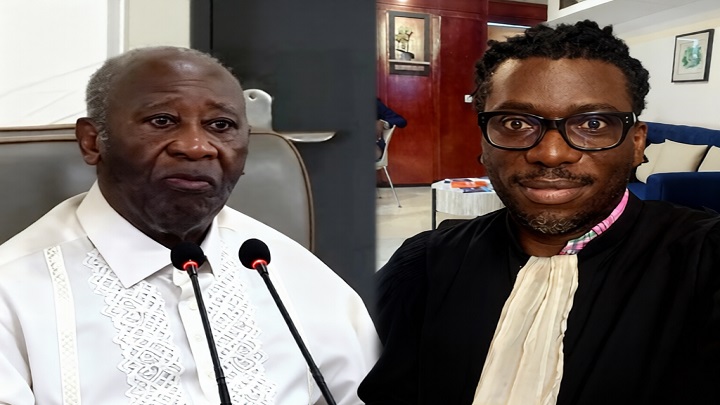
The political landscape of Côte d’Ivoire remains unsettled as the return of Laurent Gbagbo to the forefront of national politics sparks fresh debates. Following the recent extraordinary congress of the Parti des Peuples Africains – Côte d’Ivoire (PPA-CI), held in Abidjan over the weekend, legal expert Ange Rodrigue Dadjé has forcefully argued that criticism of President Alassane Ouattara’s decision to remain in politics is no longer warranted.
« There is no justification for continuing to blame President Ouattara for choosing to stay in politics after pledging to step away, » Dadjé stated on Friday, May 15. His remarks have ignited reactions across political circles and social media platforms, underscoring the depth of public discourse surrounding leadership transitions in the country.
This bold declaration follows a dramatic shift in Gbagbo’s own political trajectory. Just months ago, the former Ivorian president had signaled his intention to retire from active politics. In an October 22, 2025 interview with journalist Alain Foka on AFO Media, Gbagbo, then 81, declared, « There is no retirement in politics, but I will refrain from holding political office within my party or the state. I have given enough. » His comments suggested a gradual handover to a younger generation within the PPA-CI, especially after his acquittal by the International Criminal Court (ICC) in 2021.
However, the party’s first ordinary congress, held on May 14 and 15, 2026, took an unexpected turn. In a surprise move, Gbagbo accepted to remain at the helm of the PPA-CI, declaring under thunderous applause from delegates, « I stay for the fight. » This decision has reignited discussions about the permanence of veteran leaders in Ivorian politics and, notably, Ouattara’s continued leadership.
Ouattara’s political longevity has long been a flashpoint. In 2020, his decision to seek a third term—despite earlier indications of stepping aside—provoked intense opposition, including from the PPA-CI. Critics accused him of breaking his word, a sentiment echoed by many who viewed his move as a betrayal of democratic norms. Yet, Dadjé contends that political realities often override initial pledges, as the recent PPA-CI congress demonstrates.
In July 2025, Ouattara officially announced his candidacy for the October 2025 presidential election, seeking a fourth term at the age of 83. He framed his decision as a national duty, citing pressing regional security and economic challenges. « This decision was carefully considered and is a duty, » he affirmed, emphasizing that it served the « higher interests of the Nation. »
Gbagbo’s unexpected return to leadership at the PPA-CI congress appears to have reshaped the political narrative in Côte d’Ivoire. Observers suggest that the episode highlights the influence of party militants and partisan realities in shaping leaders’ decisions—even when those leaders had previously announced their withdrawal. The question now looms large: Can iconic political figures truly step away from the stage as long as their supporters demand their continued presence?
Political legacies and the weight of expectations
The interplay between personal pledges and political exigencies lies at the heart of this unfolding drama. For decades, Côte d’Ivoire has grappled with the challenge of succession within its political class. The PPA-CI’s decision to retain Gbagbo, despite his earlier intimations of retirement, underscores the complex dynamics at play—where party loyalty, public sentiment, and strategic imperatives often collide.
Similarly, Ouattara’s prolonged tenure has been justified by appeals to stability and continuity, particularly amid regional instability. Yet, the persistence of such arguments raises questions about the sustainability of leadership models that rely heavily on individual figures. As the Ivorian political arena continues to evolve, the tension between tradition and transformation remains palpable.