
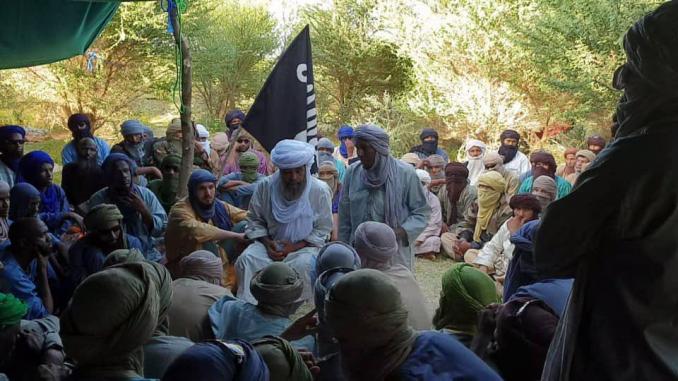
The Mali is witnessing a concerning escalation in violence as the Group for Support of Islam and Muslims (JNIM), an Al-Qaïda-affiliated jihadist organization, tightens its control across multiple regions. Despite ongoing military operations by national and allied forces, the group continues to launch coordinated attacks, including ambushes on army convoys and raids on military outposts, further destabilizing the country’s fragile security landscape.
Beyond Mali’s borders: a spreading threat
What began as a localized insurgency in Mali has evolved into a cross-border menace, casting a shadow over the entire Sahel region. Neighboring nations, already grappling with economic instability and weak governance, now face an even greater risk of jihadist infiltration. The situation is exacerbated by the region’s severe economic crisis, which has left governments struggling to maintain public services and security apparatuses.
A strategy of control, not just terror
Recent attacks in central Mali, particularly in the Bandiagara area, underscore the JNIM’s expanding influence. While the group’s tactics once relied solely on mobile guerrilla warfare, it has increasingly adopted a long-term strategy of territorial control. By exploiting local grievances, communal tensions, and the absence of state authority, the JNIM has begun to impose its own form of governance in rural zones. This includes setting up informal taxation systems, enforcing movement restrictions, and even mediating disputes—effectively replacing state functions where it operates.
“Military operations alone cannot restore stability,” noted a security analyst based in Bamako. “Without restoring administrative, judicial, and economic structures, any gains made by the army are temporary.” The JNIM’s ability to embed itself in communities has made it a resilient force, capable of regenerating even after heavy losses.
The military’s dilemma: sovereignty vs. security
Since the withdrawal of French forces and the shift toward a partnership with Russia, Mali’s transitional government has prioritized military sovereignty. Authorities have framed this approach as a break from Western dependency, yet the reality on the ground tells a different story. Violent clashes persist, and armed groups remain highly mobile, exploiting gaps left by shifting security dynamics.
International observers have also raised concerns about human rights violations allegedly committed by Mali’s army and allied forces. While Bamako has dismissed these accusations as part of a foreign disinformation campaign, the allegations further complicate efforts to restore trust in state institutions.
A fractured Sahel under geopolitical pressure
The Sahel crisis has become a battleground for global and regional powers, each vying to extend their influence. Russia, Turkey, the United Arab Emirates, Western nations, and regional actors are all maneuvering to secure their strategic interests in the region. This geopolitical fragmentation plays directly into the hands of jihadist groups, which thrive in environments of weakened state cohesion and disrupted alliances.
The risk now looms large: entire swathes of the Sahel may be slipping into a state of chronic insecurity, where neither governments nor armed factions fully control the territory. The question remains: how far will the JNIM’s expansion go? With the Africa Corps mercenaries gradually disengaging from conflict zones, the Malian junta faces a critical juncture. If these forces withdraw entirely, the consequences for Mali and its neighbors could be devastating.