
- Politique
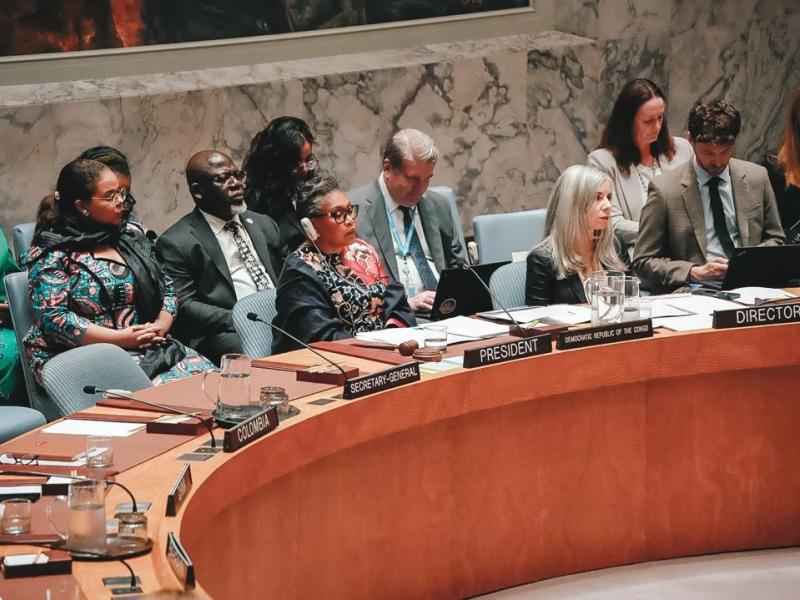
During the 10190th session of the United Nations Security Council, dedicated to women, peace, and security, Judith Suminwa, Prime Minister of the Democratic Republic of Congo, delivered a pivotal address. Her intervention prominently featured Resolution 1325, a landmark text unanimously adopted by the Security Council on October 31, 2000, recognized as the first official document to connect women’s rights with peace and security matters.
The session, themed « Honoring the promise of international law towards survivors of conflict-related sexual violence, » was chaired by Prime Minister Suminwa as part of the Congolese presidency of the Security Council. This platform allowed the head of government to underscore to the global community the critical need for effective implementation of Resolution 1325.
Speaking on July 8, 2026, on behalf of the Democratic Republic of Congo – a nation profoundly impacted by armed conflicts and the pervasive sexual violence they engender – Prime Minister Suminwa asserted that the international community must move beyond merely documenting atrocities.
“Our goal can no longer solely be to document horrors after they occur. Instead, it must focus on preventing the conditions that enable them,” the Prime Minister declared. “This necessitates a closer presence within at-risk communities, robust early warning systems, a justice system capable of apprehending perpetrators, accomplices, and instigators, alongside meaningful reparations and economic recovery initiatives that empower women with both protection and genuine agency.”
According to the Congolese head of government, this comprehensive approach also requires a deeper understanding of the intricate connections between sexual violence, territorial control, forced displacement, illicit arms proliferation, human trafficking, entrenched impunity, and the economies that fuel conflict.
“To effectively prevent these crimes, we must examine not only the acts themselves but also the underlying systems that facilitate them,” she further elaborated. “This ultimately means integrating these crucial issues into prevention and peace processes from their inception: within ceasefires, monitoring mechanisms, disarmament efforts, security sector reforms, sanctions regimes, and assurances against recurrence. When individuals, groups, or networks orchestrate, finance, or profit from abduction, trafficking, sexual slavery, or sexual exploitation in conflict situations, the Council’s instruments, particularly its sanctions committees and expert groups, must be consistently deployed.”
Furthermore, Prime Minister Suminwa highlighted that the Congolese presidency of the Security Council deliberately initiated its proceedings by addressing the plight of victims. She emphasized that no credible peace architecture could be established without centrally positioning those who have borne the heaviest burden of conflict.
She also revealed that in the coming days, the Council would continue its deliberations on the systemic structures that fuel conflicts, the illicit economies that perpetuate them, and strategies to transform natural resource governance into tools for peace, security, and prosperity.
“Our foremost duty today is unequivocal: to listen to survivors, affirm their rights, bolster national and international responses, fund crucial services, address information gaps, strengthen cooperation, and establish the fight against impunity as a prerequisite for peace,” the Prime Minister stated. “Upon the conclusion of our work, a clear message must emerge: conflict-related sexual violence is neither unavoidable nor peripheral. The response cannot merely be condemnation; it must encompass prevention, protection, justice, reparations, economic recovery, recognition for children born of such violence, and the necessary resources to translate commitments into tangible outcomes.”
In a similar vein, the head of government stressed that combating conflict-related sexual violence is not merely a moral imperative but also a strategic prerequisite for achieving lasting peace. She argued that justice and reparations should no longer be relegated to secondary concerns but must be recognized as fundamental pillars for the reconstruction of societies.
“The fight against conflict-related sexual violence represents a moral imperative, yet it is equally a strategic demand for any enduring peace,” affirmed Ms. Suminwa. “A society cannot be rebuilt by leaving its survivors without justice. Communities cannot be reconstructed by abandoning children born of such violence to silence or stigmatization. Conflicts cannot be prevented by overlooking the economies that finance them, the weapons that prolong them, the networks that exploit victims, and the systems of domination that accompany them.”
She concluded by urging member states to establish the dignity of survivors as the foundational principle for all peace strategies.
“Our shared responsibility is to ensure that the dignity of survivors, the rights of children, justice, reparations, and essential services are not relegated to the periphery of peace, but instead placed at the very core of its construction,” she underscored. “More than twenty-five years after Resolution 1325, the next phase of our commitment cannot be another promise. It must be a promise fulfilled. Because no natural resource should be extracted at the cost of human dignity, because no economy should thrive on the suffering of populations, and because no lasting peace can be built upon impunity.”
Resolution 1325, unanimously passed by the United Nations Security Council on October 31, 2000, stands as a historic declaration. As the inaugural official document to forge a direct link between women’s rights and matters of peace and security, it advocates for their complete involvement in conflict prevention, management, resolution, and all peacebuilding initiatives.
Prime Minister Judith Suminwa’s address regarding this resolution is particularly resonant given the ongoing situation in the Democratic Republic of Congo. Women in conflict-affected regions continue to endure sexual violence amidst persistent activity by local and foreign armed groups. Furthermore, the Congolese authorities point to Rwandan aggression, manifested through the AFC/M23 rebellion, as a factor exacerbating the vulnerability of women in the eastern part of the nation.
Despite ongoing diplomatic efforts aimed at resolving this crisis and establishing lasting peace, tangible results remain elusive. While political and diplomatic progress is frequently reported, the on-the-ground situation remains deeply concerning, with various factions continuing hostilities and mutually accusing each other of failing to uphold agreed commitments.