
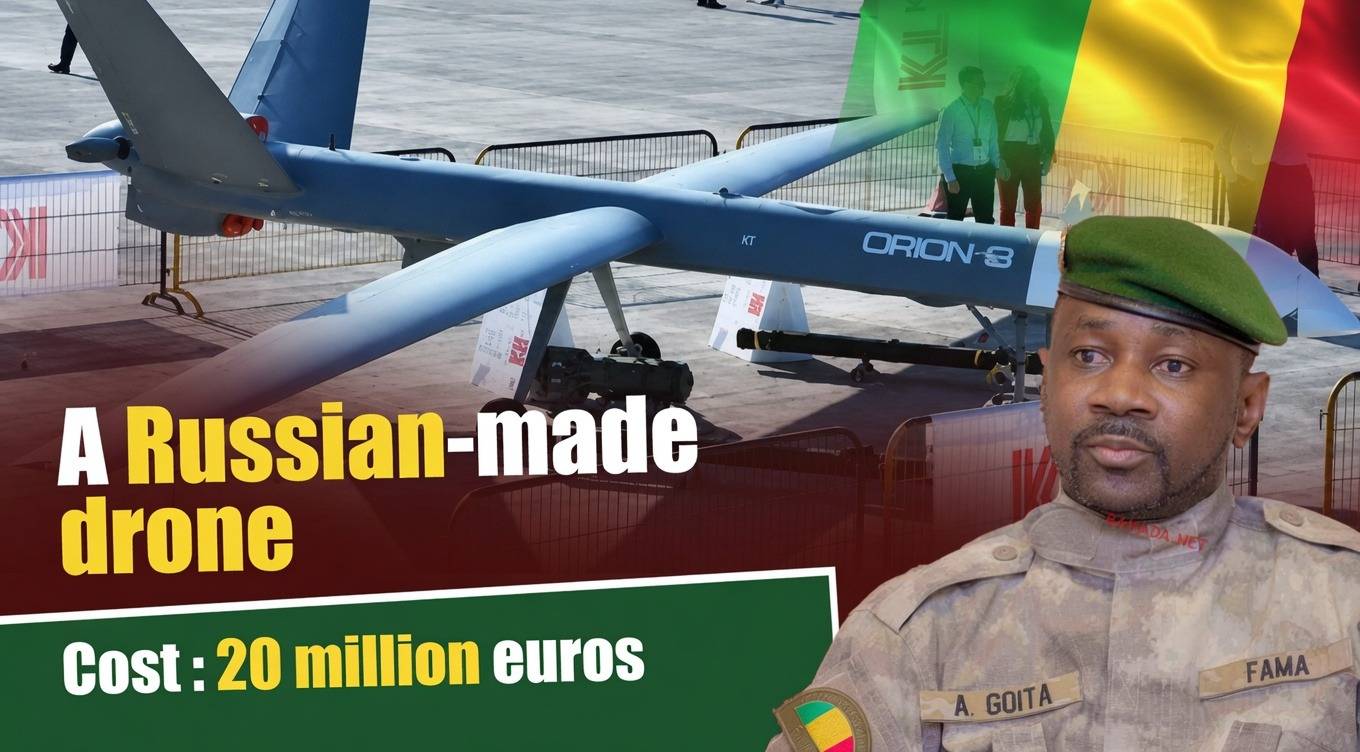
In a significant expansion of its aerial capabilities, Bamako has officially integrated a Russian-manufactured Orion drone into its fleet. While the transitional authorities celebrate this as a crucial milestone in reclaiming national territory, military analysts are raising serious concerns regarding this singular and exceptionally expensive purchase. Between its technical limitations in the face of asymmetric threats and the potential for a massive financial drain, the actual impact of this aircraft on the front lines remains highly uncertain.
A strategic deepening of the Bamako-Moscow defense pact
The Malian Armed Forces (FAMa) have officially welcomed a new addition to their inventory: the Orion drone, a prominent example of Russian aeronautical engineering. This Medium Altitude Long Endurance (MALE) aircraft is built for extended surveillance operations and precision strikes, marking another chapter in the growing hardware deliveries from Russia in recent years.
Supporters of the current military direction view this delivery as a testament to the rising power of the Mali military and its determination to move beyond traditional Western security frameworks. The Orion is being marketed as a vital tool for monitoring the country’s vast desert expanses. However, beneath the triumphant official rhetoric, the specific technical realities of this machine necessitate a much more cautious evaluation.
The Orion paradox: a loud giant in a silent conflict
The primary challenge of this acquisition lies in the specific nature of the conflict within Mali. The FAMa are not engaged with a conventional army but rather with mobile, scattered, and highly adaptive terrorist cells. In this asymmetric environment, the Orion suffers from a critical flaw: a high acoustic signature.
The Orion is remarkably loud. This noise makes it easy to detect by ear long before it reaches its target area. For insurgent fighters accustomed to using the terrain for cover, this sound serves as an early warning, granting them ample time to disperse or hide. Furthermore, the belief in total aerial safety is a dangerous assumption. Armed groups in northern and central Mali have demonstrated their ability to use anti-aircraft weaponry against low and medium-altitude targets. A heavy, easily detectable platform like the Orion becomes a primary target, facing a high risk of being downed by man-portable air-defense systems (MANPADS) or concentrated ground fire.
Twenty million euros for one unit: investment or excess?
The financial scale of this deal is sparking intense debate among economic and military observers. A single Orion unit costs approximately 20 million euros, which translates to more than 13 billion CFA francs. Given Mali‘s current economic climate, defined by strict budget constraints and urgent social needs, such an expenditure is being questioned.
Allocating so many resources to a single drone is viewed by many analysts as a poor investment of public funds. For the same price, Mali could have procured an entire fleet of lighter, stealthier tactical drones that are easier to deploy across multiple fronts. By focusing on a “showcase” piece of equipment, Bamako appears to have prioritized political prestige over tactical utility.
The limits of a single aircraft in a vast territory
Mali is a massive country where many regions still lack effective state control and remain under the influence of terrorist groups. From the remote areas of Taoudénit to the forests of the Kayes region, the threat is widespread and decentralized.
This is where the mathematical reality of the purchase becomes clear: one drone cannot be everywhere at once. Despite its endurance, the Orion cannot provide total coverage. If it is patrolling Gao, the regions of Timbuktu or Mopti remain unmonitored. A single machine prevents the military from maintaining a continuous aerial presence. Whenever the aircraft is grounded for refueling or maintenance, the skies are left empty, giving enemy movements a free hand.
The burden of maintenance and infrastructure
The purchase price is merely the tip of the iceberg. Operating a drone of the Orion‘s class requires heavy logistics and continuous, astronomical expenses. Ground infrastructure is the first major hurdle; the system requires sophisticated control stations, climate-controlled shelters to protect electronics from the Sahel heat, and specialized runways.
Additionally, there are ongoing costs for specific fuel, spare parts imported exclusively from Russia, and the guided munitions required for combat operations. Finally, technical expertise remains a significant budget item, as Mali technicians require extensive training, necessitating the long-term presence of expensive Russia instructors and contractors. Without a constant flow of funding to meet these needs, this 20-million-euro drone risks becoming a permanent fixture in a hangar—a very expensive piece of technological wreckage.
While the arrival of the Orion drone highlights efforts to modernize the FAMa, it also reveals the vulnerabilities of a strategy centered on high-profile equipment. Against a mobile and unpredictable terrorist threat, a single, loud, and excessively priced aircraft seems like an mismatched response. To achieve lasting security, the military requires agile, discreet, and economically sustainable tools rather than costly symbols.