
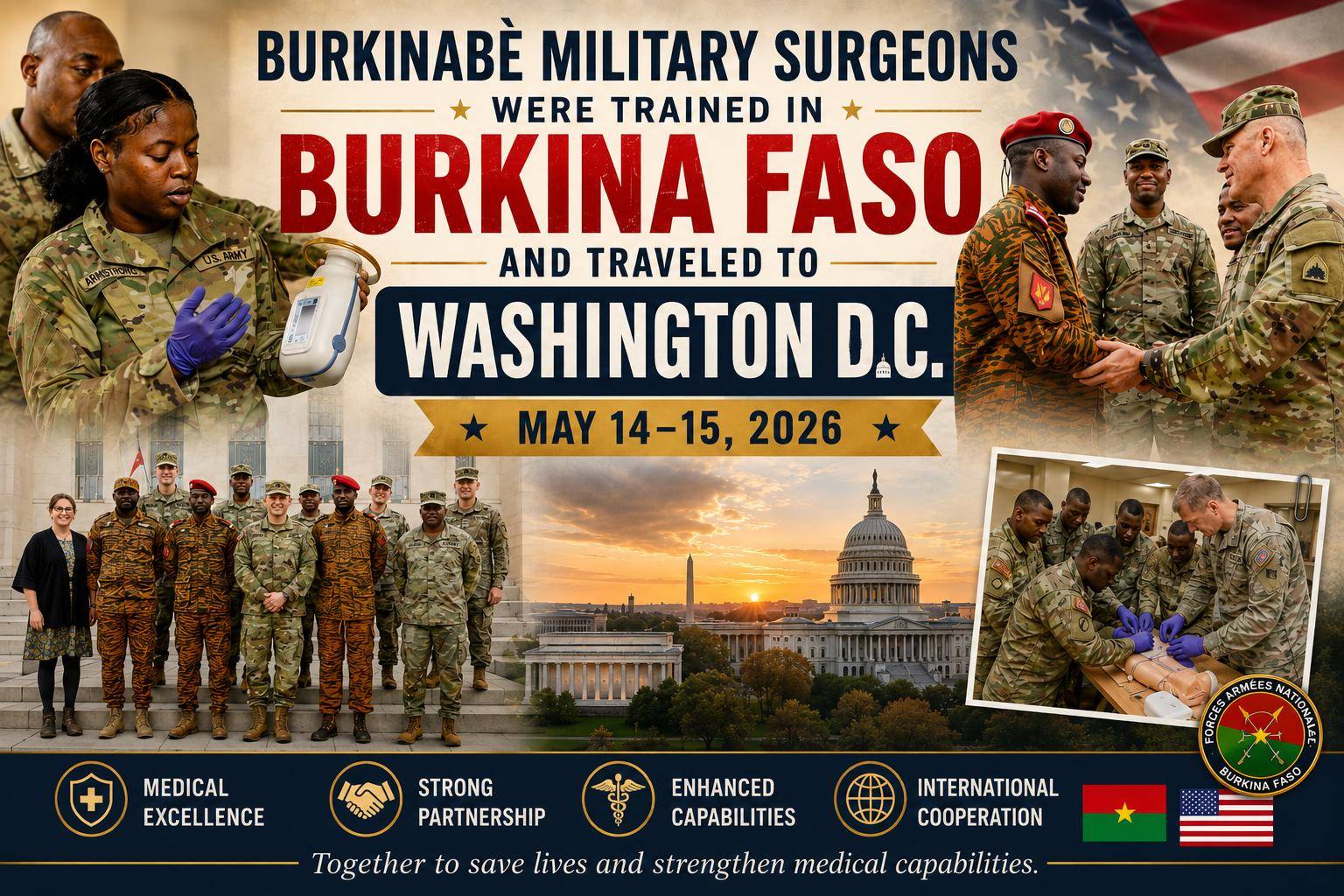
While official rhetoric within the Alliance des États du Sahel (AES) increasingly challenges Western influence, the practicalities of technical cooperation reveal a more complex reality. In mid-May 2026, military surgeons from Burkina Faso traveled to Washington D.C. for high-level technical exchanges with the American National Guard. This initiative, part of the State Partnership Program (SPP), highlights a significant paradox: despite a strategic pivot toward Moscow, Sahelian nations continue to rely on the specialized expertise of traditional partners.
A strategic medical exchange in Washington
During a two-day mission on May 14 and 15, 2026, a delegation of specialists from the Burkina Faso Armed Forces worked alongside American experts in the federal capital. This collaboration focused on critical aspects of modern warfare: the management of war-related injuries, combat traumatology, and surgical emergency protocols in high-risk environments.
In a national context defined by a demanding asymmetric conflict, this direct transfer of skills is a vital asset. For soldiers on the front lines in Burkina Faso, the mastery of these advanced surgical techniques by their medical corps can mean the difference between life and death. The State Partnership Program, which has linked American military capabilities with partner nations for years, served as the framework for this technical immersion.
Pragmatism over ideology within the AES
This visit to the United States shines a light on a major contradiction in current Sahelian geopolitics. Since the formation of the Alliance des États du Sahel, which includes Burkina Faso, Mali, and Niger, political discourse has significantly hardened against the West. Transition authorities frequently accuse Western powers of passivity or even indirect support for the armed groups destabilizing the region.
However, behind the scenes, technical cooperation remains active. The presence of senior Burkinabè officers in American institutions, while the official AES doctrine advocates for a break from traditional influence, suggests that operational necessity often outweighs ideological positioning. When faced with the harsh realities of war, the priority remains the survival of the troops and the efficiency of the medical chain.
The limits of the Russian alternative in combat medicine
Since distancing itself from France, Ouagadougou has significantly strengthened its ties with the Russian Federation. Moscow provides combat equipment, aerial assets, and direct security assistance. Yet, for specialized surgical training, Burkina Faso continues to look toward the West. This choice is driven by the specific nature of medical expertise.
The American National Guard offers a combat medicine model refined by decades of external operations and documented according to rigorous global standards. Furthermore, Western military medicine shares a historical continuity with African armies. The evacuation protocols, equipment formats, and initial training of Burkinabè doctors are historically compatible with Western standards. Currently, the Russian offering is more focused on tactical support and hard security, making it less adapted to these specific, high-tech medical needs.
A discreet and mutually beneficial diplomacy
For Washington, maintaining these programs is a crucial opportunity to keep a foothold in Burkina Faso. As American influence faces challenges in the region, medical diplomacy allows for the preservation of a trust-based relationship with the Burkinabè military elite without causing public friction.
For Captain Ibrahim Traoré and the Burkinabè command, this collaboration is a signal that the country is not seeking total isolation. While asserting its sovereignty and its commitment to the AES, the government in Ouagadougou is strategically drawing the best resources from different global blocs to bolster its military effectiveness. Ultimately, the choice to train surgeons in the United States reflects a commitment to medical results over political consistency, ensuring that those wounded in defense of the nation receive the best possible care.