
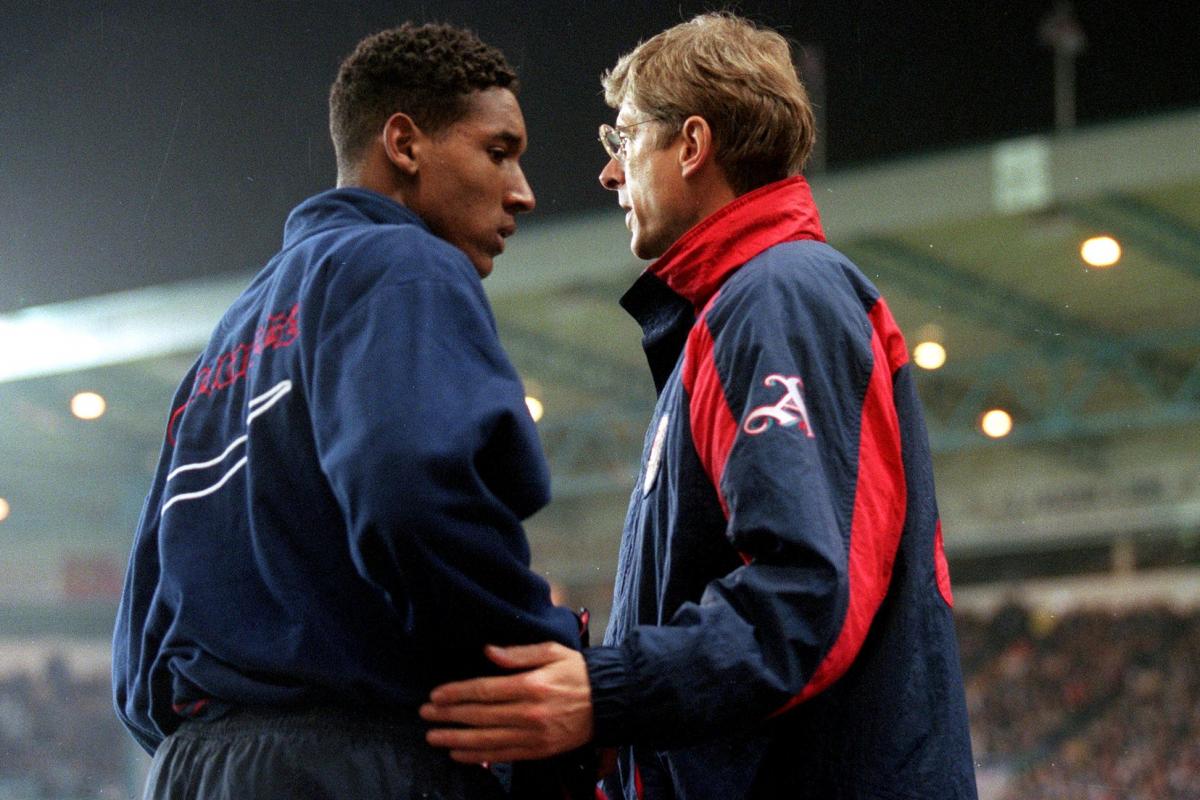
The football world was set ablaze in February 1997 when a 17-year-old Nicolas Anelka completed a stunning transfer from Paris Saint-Germain to Arsenal, a move that would redefine his career and spark one of the most heated debates in French football history.
At the time, Anelka was still an aspiring player at PSG, having made his professional debut just a year earlier. His meteoric rise from Clairefontaine’s youth academy to the first team had caught the attention of Arsenal manager Arsène Wenger, who saw in him a player with immense potential. This admiration was mutual, as Anelka admired Wenger’s tactical acumen and the club’s vision for young talent.
The transfer saga began in January 1997 when Anelka, frustrated by limited playing time under then-coach Ricardo, expressed his desire to leave the Parc des Princes. His frustration deepened when PSG signed striker Cyrille Pouget on loan from Servette FC, a move he perceived as a lack of faith in his abilities. This was the final straw for the young forward, who had already been benched eight times in Ligue 1 matches without a single start.
The timing of Anelka’s decision could not have been worse for PSG. Just days after he and his father secretly signed a six-year contract with Arsenal, Le Parisien broke the news, sending shockwaves through the club. Anelka was immediately excluded from the first team for the Super Cup match against Juventus, a decision that only fueled the controversy. PSG president Michel Denisot publicly condemned what he called the player’s «rarely seen rudeness» and threatened to send him on loan to Servette FC for the remainder of the season.
Meanwhile, Arsenal’s vice-president David Dein escalated the situation by faxing PSG a formal notification under international regulations, stating the club’s intention to contact Anelka. This bold move put pressure on the French club, which found itself entangled in a legal and public relations quagmire.
The heart of the dispute lay in the interpretation of French football regulations versus European law. PSG, backed by the French Football League (LNF), argued that Anelka was still under contract as an apprentice and that leaving before signing his first professional deal violated French football’s internal charter. However, Anelka’s camp, supported by Arsenal and Wenger, relied on the landmark Bosman ruling of December 1995, which established that players in the EU could move freely to another club at the end of their contract without compensation.
Wenger remained unshaken, asserting that European law superseded French regulations. «French clubs cannot impose their internal rules on players bound by European law,» he stated. The situation drew international attention when FIFA’s then-secretary general, Sepp Blatter, weighed in, criticizing the French stance. «French clubs seem more concerned about their players leaving than they are about young African or South American talents being recruited by European giants.»
After weeks of legal threats and public acrimony, PSG and Arsenal reached a last-minute agreement. In a stunning turn of events, the two clubs finalized Anelka’s transfer in less than 48 hours, just days before FIFA was set to rule on the dispute. PSG received a reported 5 million francs (approximately €1.19 million at the time) as part of the deal, while Anelka’s salary skyrocketed from €901 to €119,000 per month.
Anelka’s departure marked a turning point in French football’s approach to young talent. His move to Arsenal not only secured his future but also highlighted the growing influence of European legislation on domestic club policies. Though his first season with the Gunners was modest—he made only four appearances under the shadow of Dennis Bergkamp and Ian Wright—Anelka would soon prove his worth.
By the 1998-1999 season, he had become the first non-British player to win the Premier League Young Player of the Year award, showcasing his explosive pace, technical skill, and clinical finishing. His time at Arsenal, though brief, laid the foundation for a career that would see him play for some of Europe’s biggest clubs, including Real Madrid and Chelsea.
For PSG, the episode was a bitter pill to swallow. The club’s handling of Anelka’s situation exposed its struggle to balance ambition with the development of young players. In a revealing statement years later, Denisot admitted, «We had intended to bring Nicolas along slowly while protecting him, but he wanted to leave. There was little we could do.»
Anelka’s controversial transfer to Arsenal remains a defining moment in his career and a case study in the evolving dynamics of football transfers under European law. It also underscored the growing power of young players to shape their own destinies, a trend that continues to define modern football.