
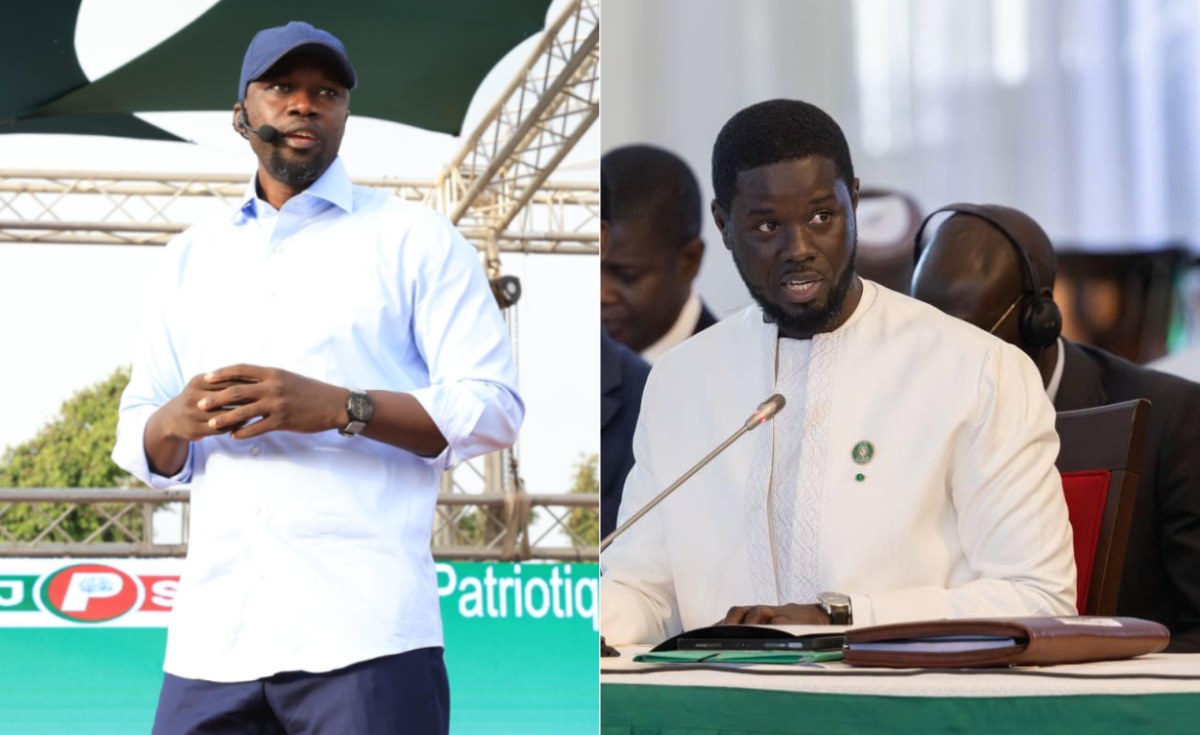
The political landscape in Sénégal has entered uncharted territory since the March 2024 inauguration of President Bassirou Diomaye Faye and his political mentor, Ousmane Sonko. Once inseparable allies within the Pastef movement, recent developments reveal growing rifts between the head of state and the party’s longtime leader.
The current tensions unfold against a backdrop of historic significance. When Ousmane Sonko was barred from running in the 2024 presidential election due to legal challenges, he strategically backed Bassirou Diomaye Faye—then incarcerated alongside him—as the Pastef’s candidate. Their victory was hailed as the culmination of a years-long struggle against the outgoing administration of Macky Sall and the dawn of a transformative political era for the country.
However, the realities of governance often reshape alliances forged in opposition. Over a year into their administration, the dynamic between the two leaders has shifted. Ousmane Sonko’s recent public statements—laden with pointed criticism and revelations about alleged political agreements brokered during their ascent to power—signal a deliberate bid to reclaim the political initiative.
As the swearing-in of Prime Minister Al Aminou Lo approached, the Pastef leader made a decisive move. He declared that no party members would be included in the new government, a symbolic break from the coalition that delivered the 2024 victory. This stance foreshadows a gradual separation between state institutions and the party apparatus, raising questions about the future cohesion of their shared political project.
The crux of the current impasse lies in competing claims to legitimacy. President Bassirou Diomaye Faye derives his authority from the ballot box and the constitutional order, while Ousmane Sonko remains the movement’s ideological architect and the driving force behind its electoral triumph. This duality mirrors historical precedents across Africa, where movements that seize power often grapple with internal power struggles between elected leaders and party powerbrokers.
Such divisions risk institutional paralysis and political fragmentation, particularly when both figures command substantial support. Yet, despite escalating tensions and increasingly polarised rhetoric, a definitive rupture remains premature. Both leaders still share a core electoral base and a political vision that resonates with their followers.
The stakes extend far beyond personal ambitions. They encompass Sénégal’s ability to maintain democratic stability while advancing the economic and social reforms promised to its citizens. As a regional model of democratic governance, the outcome of this leadership contest will shape not only the future of the Pastef but also the nation’s political equilibrium for years to come.
The coming months will reveal whether this crisis resolves into a strategic reconciliation, a contentious cohabitation, or a definitive political split between the two architects of the 2024 transition.