

Senegal’s political landscape is currently shaped by a clash between two forms of legitimacy: the authority of institutions and the magnetic pull of a charismatic leader. This tension, while not uncommon in political science, raises concerns about the potential for unchecked power.
The rise of Ousmane Sonko is a case study in modern Senegalese politics. His rapid ascent stems from a bold rejection of the status quo, resonating deeply with a youthful population eager for change. By challenging a system perceived as opaque, he championed a vision centered on national sovereignty, social dignity, and the primacy of the people’s voice.
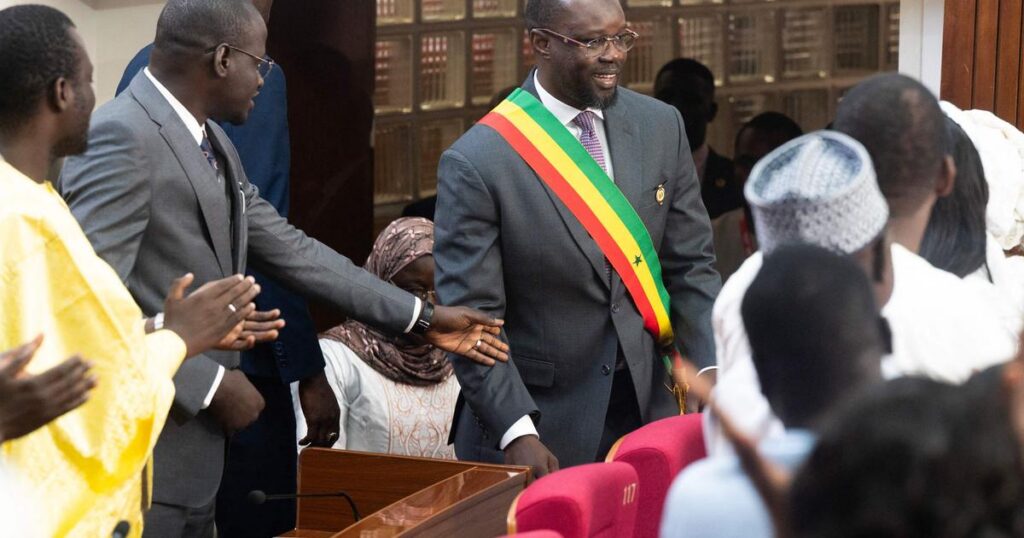
Once, Sonko had spoken of a « peaceful cohabitation » with the presidency. His recent election as president of the National Assembly—just days after being removed as Prime Minister—could be the moment to turn that vision into reality. The sequence of events unfolded with striking speed. On May 22, President Bassirou Diomaye Faye dismissed Sonko. The very next day, Malick Ndiaye, then Assembly President, resigned, strategically clearing the way. By May 25, Ahmadou Alhaminou Mohamed Lô had been named Prime Minister. Then, on May 26, Sonko was elected Assembly President with an overwhelming 132 votes out of 165, solidifying his leadership within the Pastef party he founded. While some hailed the election as historic, critics called it an « institutional coup, » placing Sonko in direct opposition to Faye, his former ally in a complex dual leadership structure.
The questions now loom large: Will Pastef, which voted unanimously for Sonko, endorse the new government led by a technocrat Prime Minister? The ruling party has made its stance clear, insisting on « loyalty to the 2024 victory program, » a platform largely shaped by Sonko himself. He has alternated between calls for institutional harmony and firm warnings to the president. Notably, Sonko declared that the Assembly would « fully exercise its constitutional powers, » criticizing the lack of consultation in the Prime Minister’s appointment. Amid this political whirlwind, the country’s sovereign credit rating was downgraded from « stable » to « negative. »
Charisma vs. institutional power
Sonko’s influence is undeniable, reshaping Senegal’s political stage. Yet charismatic leadership carries a double-edged sword: it galvanizes support but can also weaken the impersonal foundations of democratic institutions.
The current crisis highlights a deeper contradiction. When a leader is seen as the sole driving force behind a « revolution, » when collective progress hinges on a single figure, and when political loyalty blurs with personal devotion, the risk of hubris grows. This is not a personal failing but a structural challenge. Senegal’s political uncertainty for months—where power truly lay—between President Bassirou Diomaye Faye and Sonko, the historical leader of the Pastef party, underscores this dilemma. Was it the legitimacy of the ballot box or the passion of activism? The authority of the constitution or the force of personality?
Such duality was unsustainable. Every democracy must eventually see its institutions assert dominance. A state cannot thrive with two competing centers of symbolic power. Sonko’s strength wasn’t just as Prime Minister; it lay in embodying the movement’s leader, a militant figure, and the emotional voice of a significant portion of Senegal’s youth.
The danger arises when a leader seeks to absorb the state apparatus, popular will, and the momentum of a movement simultaneously. The threat isn’t always overt; it can erode democracy subtly by allowing institutions to fade in the shadow of a larger-than-life personality.
The test of institutional resilience
Senegalese political parties remain largely built around iconic figures, and Parliament struggles to assert itself as an independent counterbalance. While institutions show some resilience, they remain vulnerable to the emotional sway of dominant leaders.
The core challenge today is not moral but institutional. Can Sonko accept that institutional legitimacy must prevail over personal charisma? Can he acknowledge that the project he spearheaded no longer belongs exclusively to him? Is he prepared to transition from a catalyst of historical change to a participant within a system designed to outlast individuals?
This is perhaps the toughest test for any leader who has embodied a transformative break. African political history is filled with movements that shone in opposition but faltered when faced with the complexities of governance. Leading requires skills distinct from those needed to mobilize. It demands compromise, sacrifice, respect for institutional hierarchies, and even a degree of self-effacement for the sake of the state’s longevity.
True leadership is measured not just by the ability to seize power but by the willingness to accept the constraints of institutional democracy. Senegal now stands at this crossroads. The outcome will shape not only the future of the Pastef’s project but also the stability of the nation’s democracy.