
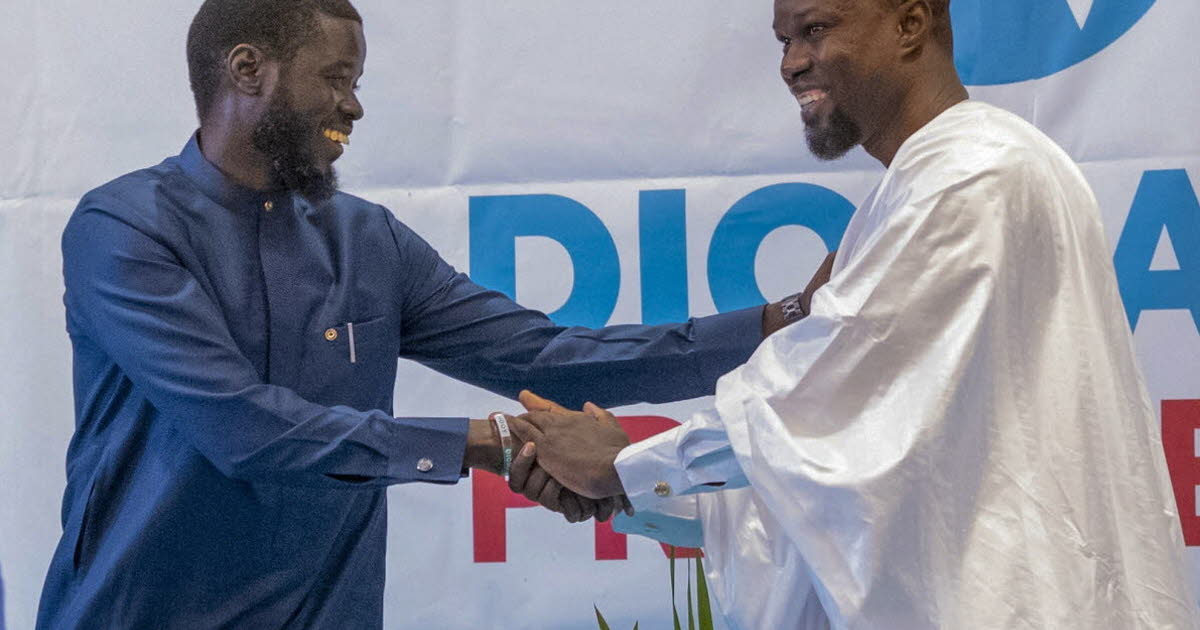
The political landscape in Senegal has been thrown into disarray following President Bassirou Diomaye Faye’s decision to dismiss his highly popular Prime Minister, Ousmane Sonko. The move marks the end of a partnership that once symbolized hope for transformative change in the country.
Elected in March 2024 with a commanding 54% of the vote in the first round, President Faye owed much of his victory to his former mentor, Sonko. The latter, a charismatic leader of the Pastef party and now the president’s party, had been barred from running due to a defamation conviction that rendered him ineligible.
The two men had once shared a close bond, encapsulated in the slogan «Diomaye moy Sonko, Sonko doy Diomaye» («Diomaye is Sonko, Sonko is Diomaye»), reflecting a unity that resonated deeply with Senegalese voters eager for an end to years of political and social unrest. Their rise to power, just ten days after their release from prison, had sparked widespread enthusiasm for their pledge to break away from entrenched corruption and political inertia.
From unity to rivalry
However, the alliance quickly unraveled. Ousmane Sonko’s growing influence overshadowed the president, and the two leaders found themselves locked in a bitter rivalry, with the 2029 presidential election looming on the horizon. Tensions escalated around key policy disagreements, particularly on how to tackle Senegal’s staggering debt—now standing at 132% of GDP, the second-highest in sub-Saharan Africa. The clash of visions between the president and his prime minister stifled the momentum for promised reforms.
A political earthquake
The dismissal of Ousmane Sonko has plunged Senegal into uncharted political waters. President Faye now faces the challenge of governing without the support of the Pastef party, whose 130-seat majority in the 170-member National Assembly was largely built on Sonko’s popularity. Despite being sidelined, Sonko remains a formidable figure, having secured the largest share of votes in the 2024 election.
Analysts note that Sonko’s influence extends far beyond the halls of power. «He commands strong support among the youth and embodies a clear vision of sovereignty, rejecting both corruption and power grabs seen elsewhere in Africa,» noted Pascal Boniface, director of the Institute for International and Strategic Relations (IRIS), after a debate with Sonko in Dakar earlier this year. «Contrary to some portrayals, he is not anti-French; rather, he advocates for a redefinition of Senegal’s relationships on terms that prioritize national interests.»