
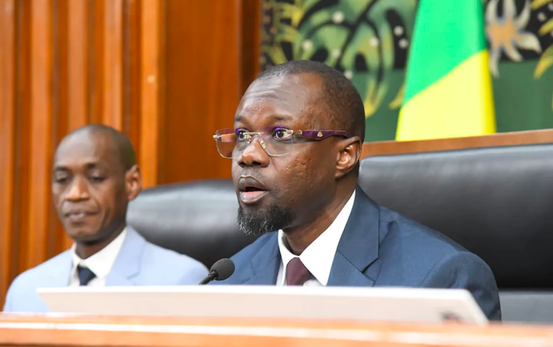
In a fiery address delivered this past Sunday in Touba, Ousmane Sonko—former Prime Minister and current President of Senegal’s National Assembly—issued a stark warning to the government led by Al Aminou Lo. His message was clear: if the administration continues to sideline national interests in oil and gas agreements, his party will deploy the full weight of parliamentary power to remove it from office.
The announcement came during the inauguration of the Pastef party’s new headquarters, where Sonko accused Prime Minister Al Aminou Lo of betraying the economic sovereignty commitments made by President Bassirou Diomaye Faye’s administration. His accusations centered on recent government actions that appear to favor multinational corporations—particularly energy giants BP and Kosmos—in the negotiation of lucrative petroleum contracts.
“This government is not protecting the interests of the Senegalese people; it is auctioning off our natural wealth,” Sonko declared in Wolof during his speech. He went on to compare the current administration’s approach to the controversial policies of former President Macky Sall, warning that such moves risk repeating past mistakes.
Sonko’s threat of a motion of censure marks a significant escalation in political tensions. He has pledged to introduce legislation that would require all future oil and gas block allocations to receive prior approval from the National Assembly. “No petroleum block will be awarded without first being debated and approved by our deputies,” he stated, citing the transparency model of Norway as an example Senegal should emulate. “The Assembly will be the shield protecting our hydrocarbons.”
This legislative push follows Sonko’s own track record in energy governance. While serving as Prime Minister earlier this year, he spearheaded a high-profile audit of existing oil contracts, exposing what he described as “non-compliant agreements inherited from the previous regime.” His efforts led to renegotiations of key blocks, including the landmark Yakaar-Teranga field, which he hailed as a major victory for national interests.
Now, Sonko accuses the current government of attempting to halt these renegotiations, particularly through recent leadership changes at Petrosen, Senegal’s national oil company. His proposed law would not only subject future contracts to parliamentary scrutiny but also empower deputies to block any deal deemed unfavorable to the country. “We will not allow our resources to be sold off cheaply,” he declared to a cheering crowd.
The political fallout between Sonko and the government reflects deeper divisions over economic policy. While the administration frames its actions as efforts to improve the “business climate,” Sonko and his allies view them as a dangerous compromise of national sovereignty. His warning of repeated censure motions underscores a willingness to escalate the confrontation until what he terms “the plundering of Senegalese wealth” is stopped.