
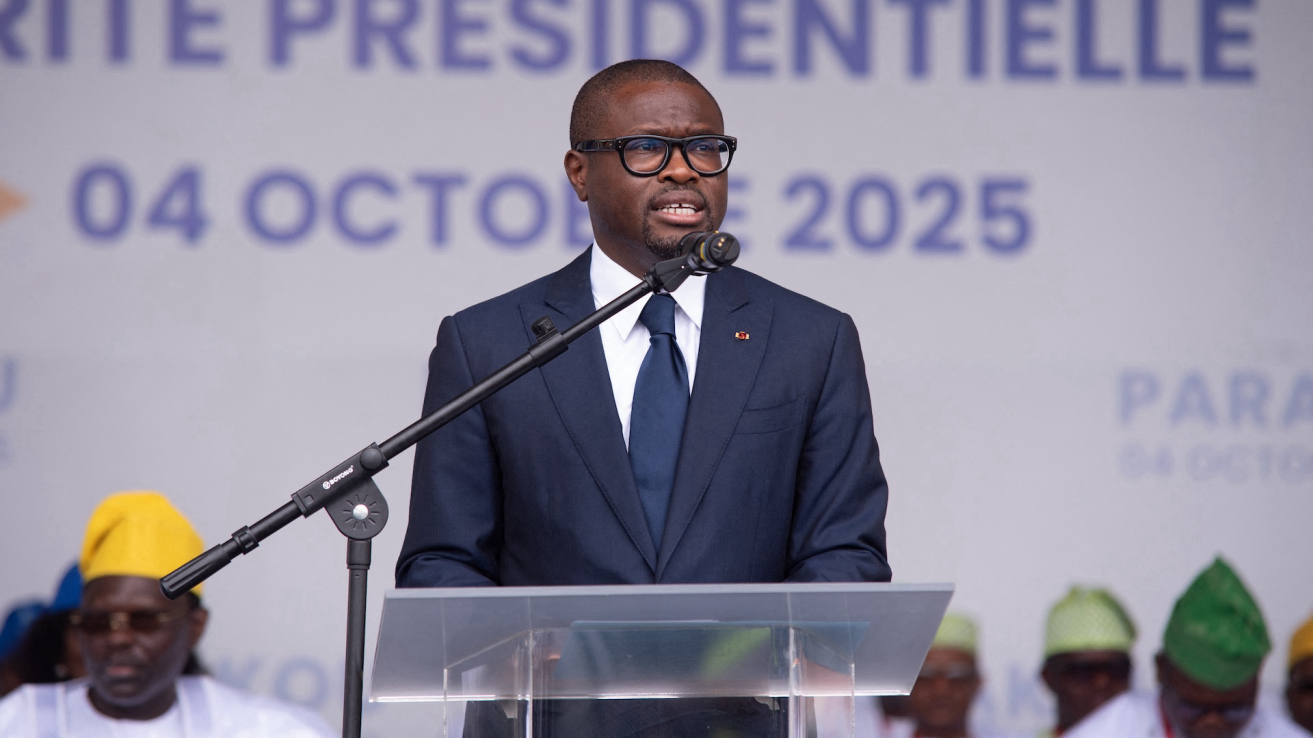
Bénin: Romuald Wadagni inherits a nation brimming with hope after historic presidential win
Balancing economic prosperity, political openness, and regional diplomacy tops the new leader’s agenda.
Romuald Wadagni secured a commanding victory in Benin’s April 12 presidential election, clinching 94.27% of the vote against challenger Paul Hounkpè, who conceded defeat and urged national unity and respect for democratic values. The Constitutional Court validated a 63.57% turnout—a significant jump from 50.17% in 2021.
This election marks Benin’s fifth democratic transition since the 1990 National Conference, a milestone in a region where prolonged presidential mandates often spark instability. President Patrice Talon’s adherence to the two-term constitutional limit further bolstered the country’s institutional stability.
The vote unfolded peacefully, though isolated irregularities—including allegations of ballot stuffing—were reported. Investigations are underway, but electoral observers, the Electoral Commission, and the Constitutional Court agreed that these incidents did not undermine the election’s legitimacy. The Court invalidated 34,596 votes nationwide due to procedural flaws.
Hounkpè posed no real threat to Wadagni, whose party, the Forces Cauris pour un Bénin émergent, had already underperformed in the January 2026 legislative and local elections and the 2021 presidential race, securing just 4.78%, 6.65%, and 11.37% of the vote respectively.
As Finance Minister for over a decade, Wadagni played a pivotal role in Benin’s economic turnaround under Talon’s administration. Under his leadership, annual GDP growth surged from 1.8% in 2015 to roughly 8% by 2025.
Despite this growth, 40.1% of Beninese still live below the poverty line, a stark reminder that economic expansion alone has not translated into widespread prosperity. Wadagni has pledged to prioritize inclusive growth in his 2026–2033 agenda, focusing on three pillars: equitable social welfare, a diversified and competitive economy, and national cohesion and security.
The new president faces the dual challenge of preserving political pluralism while navigating a complex regional landscape. Strengthening the rule of law and rebuilding ties with neighboring countries will be critical to his success.
The election unfolded against a backdrop of heightened regional tensions, just four months after a failed coup attempt on December 7 threatened to derail the electoral process. This vote also follows sweeping constitutional and institutional reforms launched in 2016, which have reshaped the political playing field.
Key reforms—particularly the 15% sponsorship requirement for presidential candidates, introduced after the March 2024 electoral code revision—have significantly restricted political competition. These changes help explain why the main opposition party, Les Démocrates, was absent from the presidential race.
The political landscape is now dominated by lawmakers and local officials aligned with the ruling party, who hold exclusive authority to sponsor future presidential candidates. Without changes to these rules, the opposition may remain sidelined until 2040.
The opposition is further weakened by internal divisions, compounded by former President Boni Yayi’s March 2026 departure from Les Démocrates, which triggered a leadership crisis and multiple defections.
The November 2025 Constitution introduced a provision for a “Republican Responsibility Pact,” allowing collaboration between the government and opposition parties under Senate oversight. While this framework could foster dialogue, its implementation must avoid becoming a tool to stifle dissent or restrict public debate.
Wadagni has also committed to institutionalizing citizen participation mechanisms and public accountability dialogues—key tools for reinforcing national cohesion. A swift national dialogue could help address contested reforms, bridge gaps, and build consensus while safeguarding democracy and the rule of law.
The failed coup attempt underscored the fragility of Benin’s democratic gains, serving as a stark reminder of the stakes. For its part, the opposition must reinvent itself to offer a credible alternative and fulfill its role as a vital counterbalance.
The relationship between Wadagni and Talon will be pivotal in shaping Benin’s stability over the next seven years. Tensions may arise from the November 2025 creation of a Senate with sweeping powers, including the ability to review and request second readings of legislation passed by the National Assembly. A potential appointment of Talon as Senate President could institutionalize a de facto dual executive.
On the regional front, Wadagni inherits a precarious security environment, with persistent terrorist threats in the north and strained relations with neighboring Burkina Faso and Niger. While ties with Nigeria have improved following its support during the coup attempt, cooperation hinges on the political will of Niamey and Ouagadougou.
During his campaign, Wadagni struck a conciliatory tone toward regional partners, framing his election as an opportunity to revive diplomatic engagement. He acknowledged that Benin cannot tackle multi-faceted security threats alone. However, meaningful regional cooperation will require more than goodwill—it demands tangible action from all parties.
The erosion of regional partnerships only emboldens terrorist groups. Without coordinated efforts, transborder zones and the W-Arly-Pendjari complex will continue to serve as safe havens, undermining stability across all three nations.