
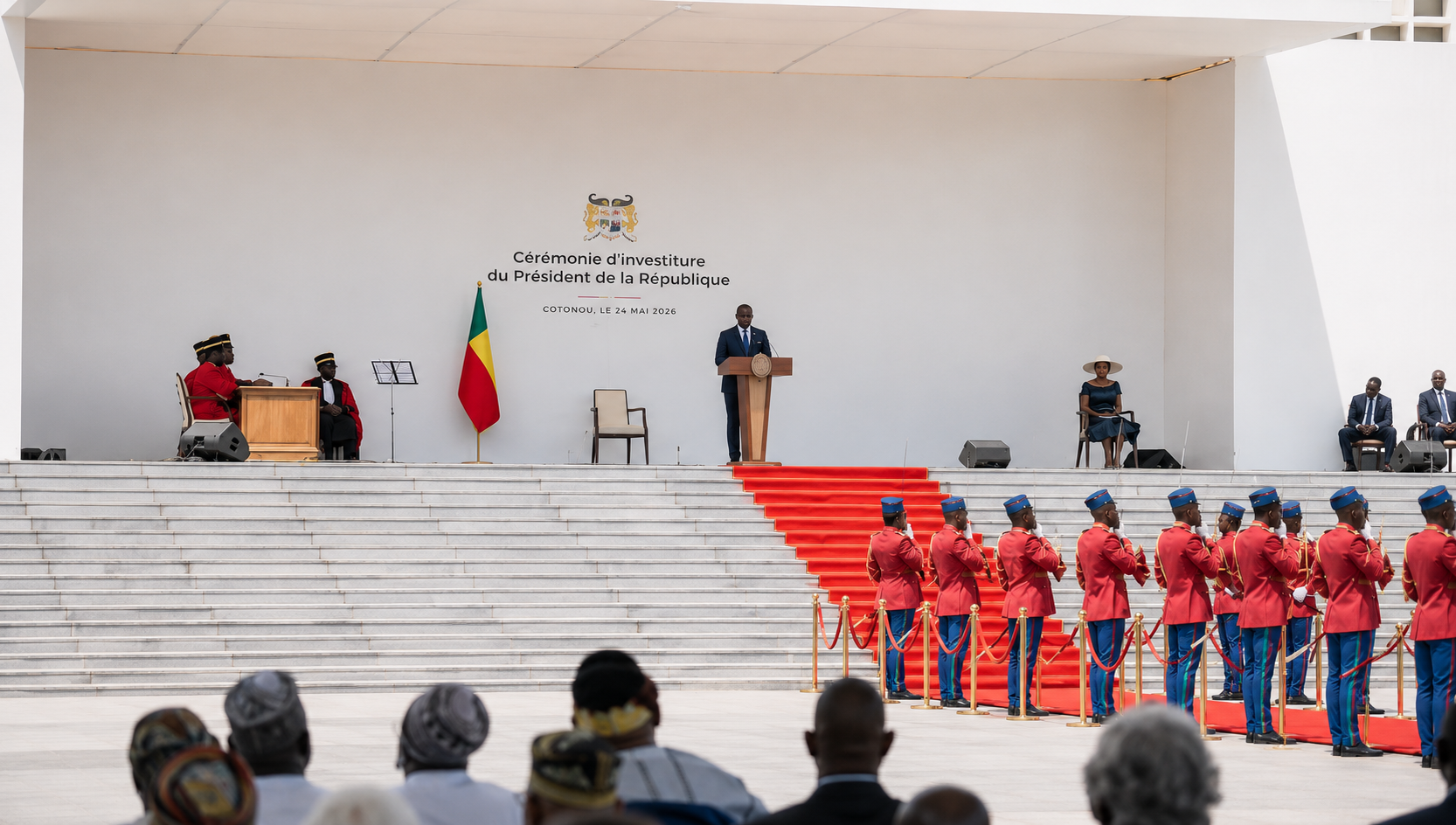
On Monday, May 24, 2026, Romuald Wadagni took the oath of office at the Palais des Congrès in Cotonou, marking the beginning of a seven-year presidential term. The former Finance Minister, who secured over 94% of the vote in an election where the main opposition party was barred from participating, inherits a nation at a political crossroads.
From technocrat to president: Wadagni’s rise to power
Born in Lokossa and a veteran of Deloitte where he spent 17 years, Wadagni joined Patrice Talon’s government in April 2016. As Minister of Economy and Finance, he played a pivotal role in securing international funding and maintaining the country’s sovereign credit rating. His election victory on April 12, 2026, was decisive, with his sole opponent, Paul Hounkpè of the FCBE, receiving a negligible share of the vote. The constitutional revision of 2025 extended presidential terms to seven years, a change now in effect, decoupling presidential elections from legislative polls.
A tightly controlled inauguration ceremony
The inauguration unfolded with military precision, spanning from 9:30 AM to noon. Patrice Talon formally handed over the presidential insignia to Wadagni following a brief private meeting at the Palais de la Marina. By 11:10 AM, the Constitutional Court convened the solemn oath-taking ceremony, where Wadagni received the Grand Collar of the National Order and the command flag from the chief of staff. Over 6,000 attendees, including former presidents Nicéphore Soglo and Thomas Boni Yayi, witnessed the event. Observers noted the flawless execution, though the ceremony took place against a backdrop of a drastically narrowed political landscape.
An election devoid of genuine opposition
The opposition party Les Démocrates, led by former president Thomas Boni Yayi, was disqualified from the race in October 2025. The National Autonomous Electoral Commission invalidated its candidate ticket due to insufficient parliamentary sponsorship—just one signature short of the 28 required. The Constitutional Court upheld the decision days later. This followed years of political repression, including the imprisonment of opposition figures like Reckya Madougou and Joël Aïvo, both convicted under terrorism-related charges in 2021 and 2025 respectively. Many opposition leaders have since fled into exile.
The barriers to political participation extend beyond candidate disqualifications. High registration fees, government-controlled compliance certificates, and a 20% vote threshold per constituency introduced in 2025 have further marginalized opposition representation. In the January 2026 legislative elections, Les Démocrates failed to secure a single seat.
Diplomatic overtures toward the Sahel
Wadagni’s inauguration speech signaled a potential thaw in regional relations. While foreign heads of state are traditionally absent from such ceremonies, sixteen delegations attended, including high-ranking representatives from the Alliance of Sahel States. Notably, the Nigerian vice president and foreign ministers from Mali, Burkina Faso, and Niger were present. The prolonged applause for Niger’s prime minister stood in stark contrast to the diplomatic tensions that have strained relations with Niamey since July 2023, particularly over the closure of their shared border and disruptions to oil pipeline operations.
The president’s address emphasized two priorities: translating economic growth into tangible benefits for Bénin’s citizens—especially youth, women, rural communities, and the middle class—and adopting a firm stance against armed groups operating in the north since 2022. His rhetoric toward the Sahel marked a departure from his predecessor’s hardline approach, suggesting a willingness to re-engage with military-led governments in the region.
What to watch in the coming months
The composition of Wadagni’s cabinet, expected within days, will reveal whether he intends to distance himself from Talon’s inner circle. The fate of imprisoned opposition figures remains a litmus test; an amnesty law, long demanded by Les Démocrates, could signal a significant shift. Equally critical will be the tangible steps toward reconciliation with the Alliance of Sahel States, potentially beginning with official visits to Niamey, Bamako, or Ouagadougou.
As the Bénin enters a new seven-year term under an institutional framework reshaped by its outgoing administration, the central question is not one of stability but of pluralism. While the economy enjoys praise from international donors, the political space offers little room for dissent. Whether Wadagni’s leadership will bridge this divide remains to be seen.