
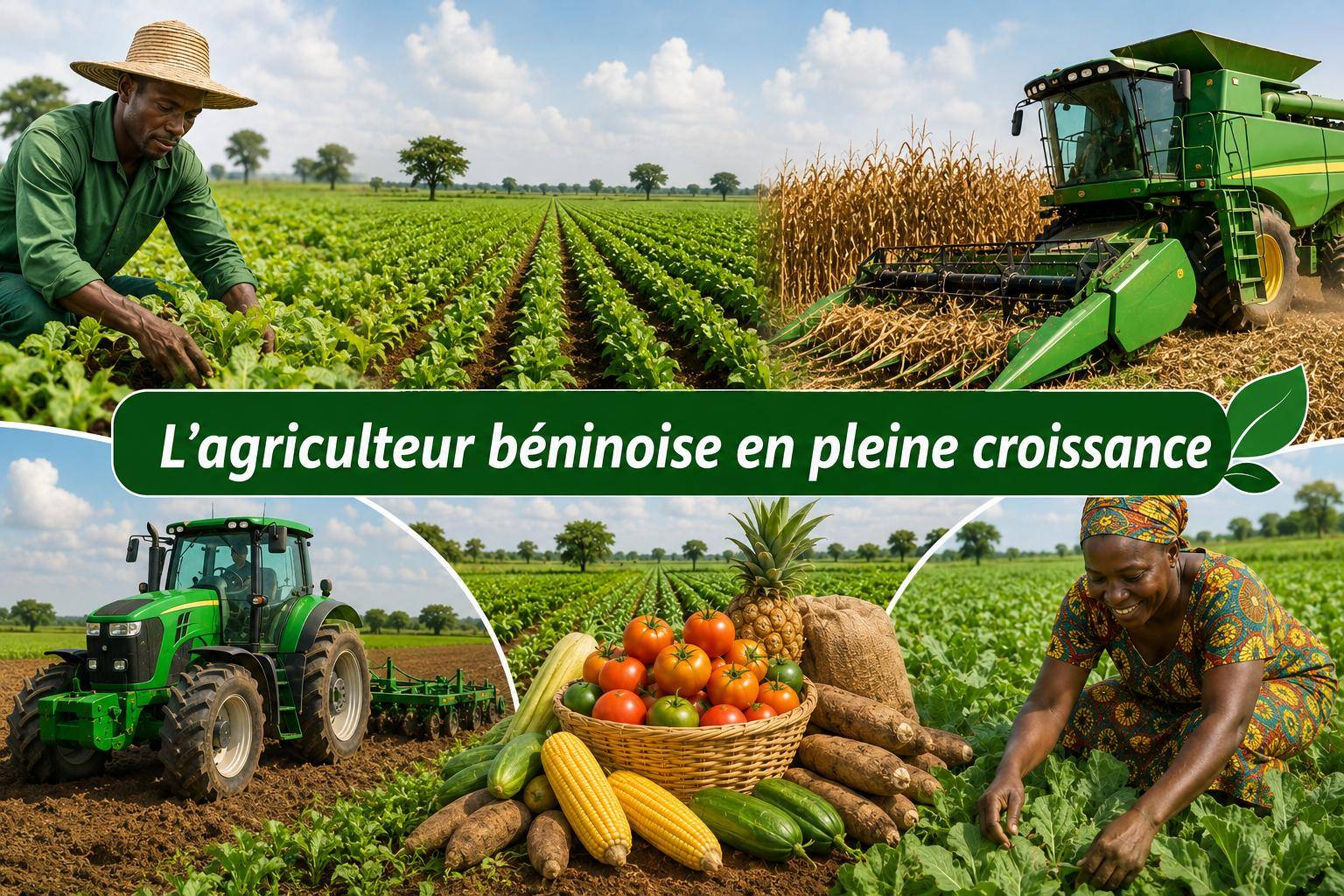
Since the decisive policy shift in 2016, Benin has witnessed a seismic transformation in its agricultural sector. Through a bold strategy combining substantial subsidies, rapid mechanization, and meticulous land development, the country has shattered production records across key crops. From cotton to pineapple, maize to soybeans, agriculture now stands as the backbone of national growth and a pillar of food security.
Leap in strategic crop sectors: the numbers tell the story
Within a short span, Benin’s farmlands have undergone a remarkable evolution. The ambitious programs spearheaded by President Patrice Talon’s administration have catapulted production volumes to unprecedented levels.
Maize: The staple crop’s production soared from under 1.3 million metric tons in 2016 to 2.5 million in 2025. With domestic needs capped at 1 million tons, the nation has achieved self-sufficiency, though managing cross-border trade flows remains crucial to prevent local price volatility.
Soybeans: Once a minor crop yielding just 140,000 tons in 2016, production skyrocketed to 422,000 tons by 2022 and reached a historic 606,016 tons in the 2024-2025 season. This surge powers the modern processing plants at the Glo-Djigbé Industrial Zone (GDIZ), while significant quantities head for export markets.
Rice: Paddy rice production jumped from 204,000 tons pre-2016 to 525,000 tons in 2022, and further to 1 million tons in 2025.
Cotton: Retaining its status as Benin’s agricultural flagship, cotton production averaged over 640,000 tons annually since 2016, peaking at 766,273 tons in 2021. The nation maintains its top position in African cotton output, with the one-million-ton mark as the next milestone.
Pineapple: Production surged by 93%, climbing from 244,000 tons to 470,000 tons by 2022, with projections to hit 600,000 tons soon.
Cashew nuts: Production doubled with a 105% increase, rising from 91,000 tons to 187,000 tons by 2023. Yields improved by 34%, supported by government subsidies covering 500 FCFA of the 600 FCFA per certified plant cost.
Financial safeguard: 110 billion FCFA to shield farmers from input price shocks
The agricultural renaissance owes much to direct financial backing. With global fertilizer prices skyrocketing, threatening to cripple local farmers, the government intervened decisively. Between 2022 and 2025, an unprecedented 110 billion FCFA was allocated to subsidize inputs across three farming seasons. This intervention stabilized production costs, safeguarding yields and averting potential food insecurity crises.
Water mastery and mechanization: ending reliance on outdated farming
The transformation extends beyond financial support to modern infrastructure. Climate-dependent agriculture is giving way to controlled irrigation systems. Pre-2016, only 6,200 hectares were equipped with irrigation—a mere 2% of potential. Post-2016, 25,440 hectares across 67 communes have been developed, quadrupling the irrigated area. The long-term goal targets 50,000 hectares to bolster sector resilience.
Mechanization has also reshaped farming efficiency. The pre-2016 mechanization rate of under 8% has doubled, with over 400,000 hectares plowed using 5,000 subsidized tractor kits. Training programs have certified 6,000 tractor operators and 300 mechanics, ensuring sustainable adoption. The government aims to push mechanization to 30% by late 2026, deploying 8,000 active kits.
Financial restructuring and sustainable land stewardship
The overhaul of agricultural financing has replaced outdated systems with robust new mechanisms. The National Agricultural Development Fund (FNDA) now fuels rural credit, backing over 3,000 projects worth over 19 billion FCFA. The Municipal Development Support Fund (FADeC-Agriculture) has driven 330 communal investments, mobilizing 68 billion FCFA. Short-term priorities include governance enhancements to scale impact.
Environmental rehabilitation has been equally transformative. Before 2016, 80% of Benin’s soils suffered low fertility. Sustainable land management has rejuvenated over 3 million hectares, restoring productivity and resilience. Aquatic ecosystems have also been revitalized—polluted water bodies cleaned and repopulated—boosting fisheries output by 79%. Beninese shrimp, once sidelined, now re-enter EU markets. Livestock sectors have flourished too, with meat production up 53% and egg production by 43%, aiming to cover 75% of national demand.
Territorial market agriculture: a new economic paradigm
By anchoring agricultural development in localized market strategies and bolstering state functions, Benin has restructured its rural economy from the ground up. International market access has expanded, and strategic partnerships continue to strengthen.
In under a decade, President Patrice Talon’s administration has redefined agriculture from a struggling subsistence activity to a dynamic, modern, and competitive economic engine. The challenge ahead lies in sustaining this momentum, ensuring robust governance to ensure the prosperity generated benefits every farmer across the nation’s rural heartlands.