
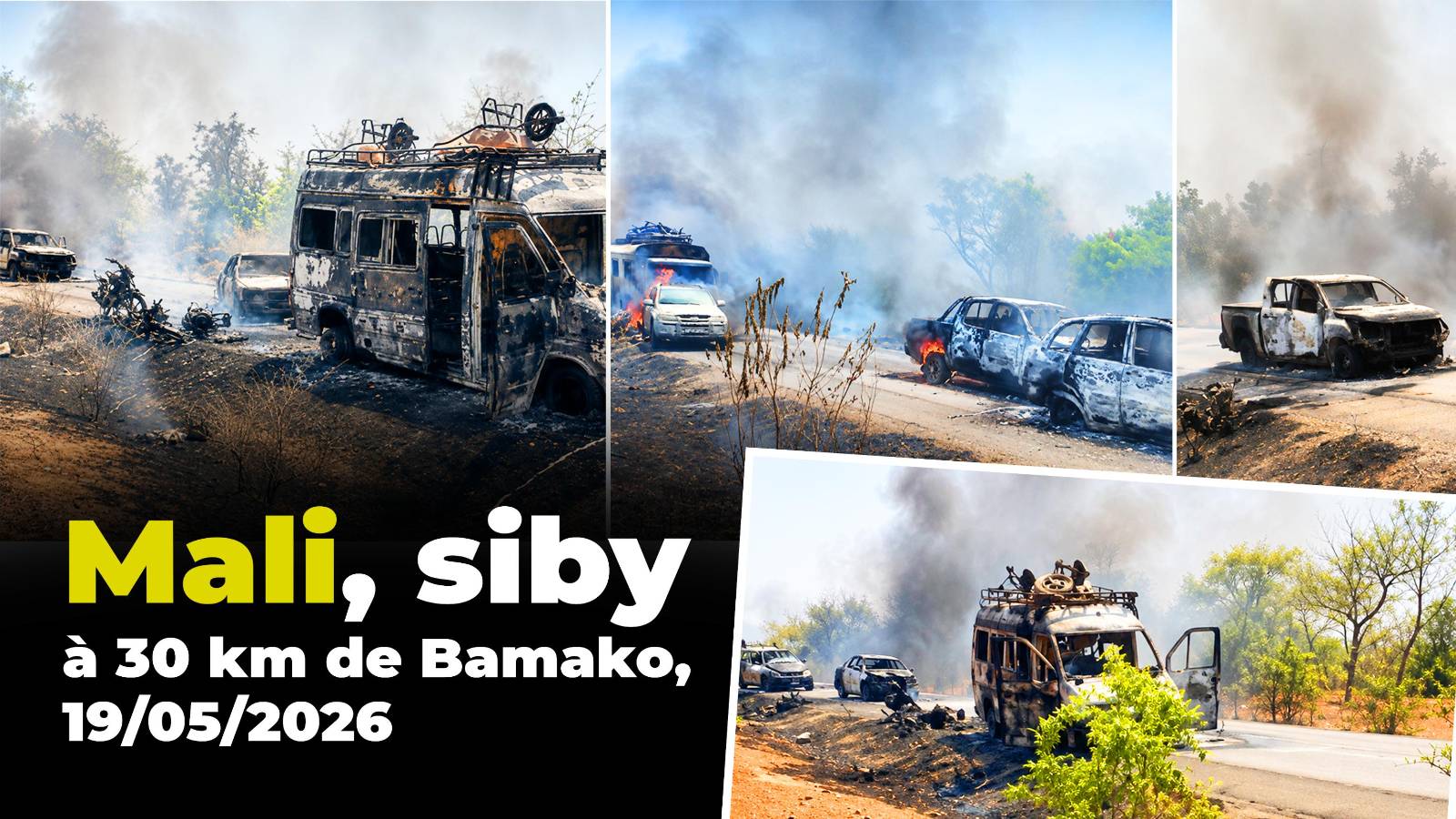
The security of Bamako is no longer a subject that can be ignored. In a stark reminder of the shifting balance of power, the rural commune of Siby, just 30 kilometers from the capital, became the stage for an unprecedented assault this past Tuesday.
flames at the gates of the capital
On that afternoon, the road to Guinea was engulfed in fire. Witnesses, including local drivers and traders, reported that armed militants on motorcycles descended upon the national highway near Siby. With little to no resistance, they intercepted convoys of goods and vehicles, reducing them to smoldering wrecks.
The attack left a trail of destruction: refrigerated trucks, public minibuses, and private cars were all turned to ashes. The thick black smoke rising into the sky was visible for miles, sending shockwaves of panic through the outskirts of Bamako. Beyond the immediate financial losses for struggling merchants, the symbolic weight of the assault was undeniable. Siby, a cultural jewel steeped in the legacy of the Kouroukan Fouga charter, had been breached—proving that no corner of Mali remains untouchable.
the jihadist chokehold on Bamako
This raid in Siby was not an isolated incident. It marks the latest escalation in a calculated strategy by the Group for the Support of Islam and Muslims (JNIM), which has systematically tightened its grip on the supply routes into Bamako.
The Ségou road, the Senegal-bound corridor, and the southern routes to Guinea and Côte d’Ivoire have all become corridors of fear. The JNIM enforces its will through mobile checkpoints, extorting drivers and torching cargo that defies its edicts. By severing Bamako’s lifelines, the militants aim to cripple the economy and stoke public discontent—challenges the transitional government struggles to address.
military strategy in tatters
The narrative of a Malian military on the rise clashes harshly with the grim reality unfolding in the field. Since international forces withdrew, the junta has staked its legitimacy on its alliance with Russian paramilitaries, rebranded as Africa Corps. Yet the events of the past week expose the hollowness of this partnership.
The Russian mercenaries, bankrolled by Malian public funds, have proven woefully inadequate at countering attacks a mere half-hour’s drive from the presidential palace in Koulouba. Their approach—marked by heavy-handed reprisals and a focus on guarding mining sites—falls short in the face of asymmetrical warfare. Joint patrols by Malian forces and Russian operatives lack foresight and territorial coverage, leaving critical roads at the mercy of the JNIM. Reliance on digital propaganda does little to mask the operational failures on the security front.
Bamako’s moment of reckoning
The inferno at Siby serves as a stark warning. Denial is no substitute for a defense policy. By allowing the JNIM to enforce a blockade around Bamako and strike so close to its heart, the junta and its Russian allies have laid bare their strategic shortcomings. For the people of Mali, the illusion of restored sovereignty and ironclad security dissolves in the smoke of burning vehicles and severed supply lines.
If Bamako is to avoid total strangulation, a fundamental reassessment of its military choices and alliances is no longer optional—it is a matter of national survival.