
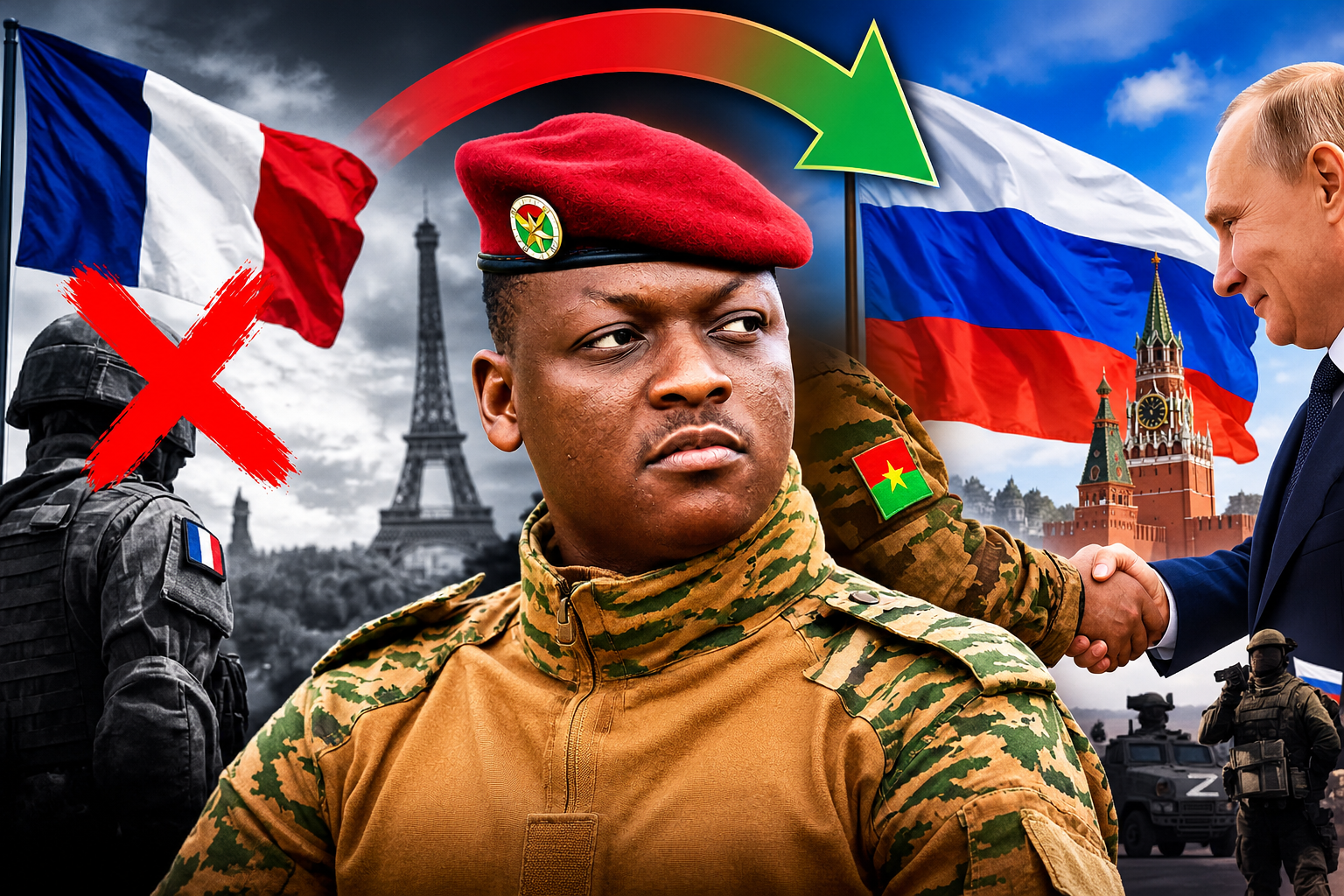
As Burkina Faso’s military leader Captain Ibrahim Traoré consolidates his power, his administration’s vocal rejection of France and embrace of Russia have sparked intense debate about the country’s path toward genuine sovereignty. In a late September interview, Traoré dismissed any possibility of restoring diplomatic ties with Paris, using strongly worded criticism to denounce what he described as France’s persistent interference. This stance marks a deliberate break from years of close Franco-Burkinabè relations, positioning Ouagadougou instead toward Moscow as a key ally.
Since seizing power in September 2022, Traoré has progressively distanced his government from France removing French troops, expelling diplomats, and rolling back multiple cooperation agreements. Simultaneously, Burkina Faso has deepened military and political ties with Russia and strengthened regional solidarity with Mali and Niger through the Alliance of Sahel States (AES). While the regime presents this shift as a triumph of national independence, the reality is more complex. A sovereign state has the right to reshape its alliances, yet independence is not granted by mere diplomatic rupture it must be measured by tangible gains in decision-making autonomy, economic resilience, and public welfare.
From rejection to reliance: has Burkina Faso changed one master for another?
The anti-French narrative has become a cornerstone of Traoré’s political messaging, resonating with many Burkinabè citizens who view decades of Franco-Burkinabè relations as unequal and unsatisfactory. Colonial history, economic frustrations, and perceived post-independence dominance by Paris have fueled this sentiment. However, severing ties with France does not automatically guarantee liberation from external influence. True sovereignty requires the ability to define national priorities, diversify partnerships, and negotiate on equal footing regardless of the partner’s identity.
By framing the break with France as definitive proof of liberation, the Burkinabè leadership risks oversimplifying a multidimensional challenge. Paris may represent a past form of dependency, but Moscow is not inherently a solution. Each foreign partner pursues its own strategic, economic, and geopolitical interests. Russia’s involvement in Burkina Faso, particularly in security cooperation, should be assessed not for its political symbolism, but for its concrete benefits and long-term implications for Ouagadougou’s autonomy.
There is no intrinsic virtue in replacing one foreign influence with another even if the new partner is more aligned with the government’s rhetoric. The critical question remains: does this reorientation actually reduce Burkina Faso’s vulnerability to external pressures, or does it merely shift the source of dependency toward a new actor?
Russia as partner: promises versus deliverables
The deepening military cooperation between Burkina Faso and Russia has emerged as the most visible aspect of Traoré’s foreign policy realignment. With persistent insecurity driven by armed groups, Ouagadougou has sought alternative sources of security support beyond France. This strategic pivot is framed as a sovereign choice but sovereignty must be measured in outcomes, not just in declarations.
The core issue is not whether Russia is preferable to France in principle, but what Burkina Faso actually gains from this partnership. What are the specific commitments made by Moscow? What financial, military, or economic counterbalances are exchanged? How long do these agreements last? What safeguards govern foreign interventions? And, most importantly, does this cooperation genuinely strengthen Burkina Faso’s long-term security capabilities?
Military support can provide immediate operational assistance, equipment, or training. But it does not guarantee lasting improvements in security unless it translates into verifiable results: reduced civilian casualties, safer transportation routes, restored public services in conflict zones, and the ability of displaced populations to return home. Without measurable progress on these fronts, the partnership risks becoming another form of external reliance disguised under a new flag.
Sovereignty beyond rhetoric: resource control and economic autonomy
The Burkinabè government’s vision of sovereignty extends beyond military alliances. It encompasses control over natural resources, fiscal independence, industrial development, food security, and negotiating power with foreign investors. Breaking away from France does not, by itself, deliver these outcomes. A country can sever diplomatic ties with one power while remaining dependent on others for critical inputs ranging from weapons and technology to trade channels and financing.
True sovereignty is not achieved simply by changing partners; it is demonstrated by the diversification of options and the ability to negotiate on equal terms. If Burkina Faso becomes overly reliant on Russia for military equipment or financing without viable alternatives, the result may be a different kind of dependence one wrapped in a new political narrative.
The risk is not that Moscow dictates Traoré’s decisions such a claim lacks substantiation but that the new partnership limits Burkina Faso’s room for maneuver. When a country has few alternatives, even a friendly partner can shape policy indirectly through leverage over aid, trade, or security support. The hallmark of a mature foreign policy is not opposition to one bloc, but the preservation of the freedom to say no to any external actor.
AES in practice: can regional solidarity deliver real autonomy?
The formation of the Alliance of Sahel States (AES) with Mali and Niger represents Burkina Faso’s attempt to build collective resilience against external pressures. On paper, the alliance promotes regional coordination in defense, intelligence sharing, and economic integration as pathways to greater autonomy. In theory, three countries facing similar security and economic challenges could amplify their bargaining power and reduce reliance on former colonial powers.
But a political alliance does not automatically translate into effective action. Its success will be judged by measurable results: tangible improvements in security, the restoration of public services, and the revival of local economies. Persistent attacks, mass displacement, and chronic underdevelopment in parts of the Sahel region demand more than public declarations or symbolism. They require verifiable data, time-series analysis, and transparent reporting on outcomes for civilians.
On the economic front, the AES must go beyond political statements. It should facilitate smoother trade flows, invest in critical infrastructure, and create mechanisms that support farmers, traders, and small businesses. Regional integration that benefits citizens not just governments is the true measure of progress.
Moreover, an alliance aimed at sovereignty must avoid becoming an ideological bloc. Members must retain the freedom to engage with multiple partners Western, Eastern, or otherwise without turning opposition to specific powers into the defining principle of their foreign policy. A sovereign alliance does not switch sides; it preserves the right to chart its own course.
What sovereignty means to the Burkinabè people
Ultimately, the debate over sovereignty cannot be confined to diplomatic corridors or presidential speeches. For the people of Burkina Faso, sovereignty is experienced in daily life: in the ability to move safely, to access healthcare, to send children to school, to operate a business, and to participate in governance. These are the real indicators of success.
The Traoré administration’s decision to reject France and embrace Russia may reflect a political necessity or ideological conviction. But it holds no inherent value unless it delivers tangible improvements in security, stability, and prosperity. A foreign policy that prioritizes symbols over substance risks leaving citizens behind.
Sovereignty is not proclaimed through anti-colonial slogans; it is demonstrated by the capacity of a state to protect its people, fund its priorities, and respond to legitimate aspirations. Burkina Faso deserves a foreign policy that is not only assertive but also accountable one that justifies its choices through results, not just resistance.
Conclusion: the true test lies in freedom of decision
Captain Ibrahim Traoré has made it clear: Burkina Faso will not restore normal relations with France under his watch. This marks a definitive political break, driven by frustration with Paris and a search for new partnerships. Yet, breaking free from one influence does not equate to achieving full autonomy.
A truly sovereign nation chooses its allies freely, diversifies its relationships, and negotiates without coercion. It is not bound by ideological alignment whether against the West or in favor of any other bloc. It evaluates partnerships based on benefit, fairness, and long-term sustainability.
France and Russia, like any other partner, act in their own interests. Burkina Faso’s challenge is to align those interests with its own priorities without surrendering control. For now, the evidence remains mixed. The government has changed direction, but the final verdict on sovereignty will be written not in diplomatic communiqués, but in the lives of the Burkinabè people.
By Yvette Tchuente — Journaliste / Rédacteur