
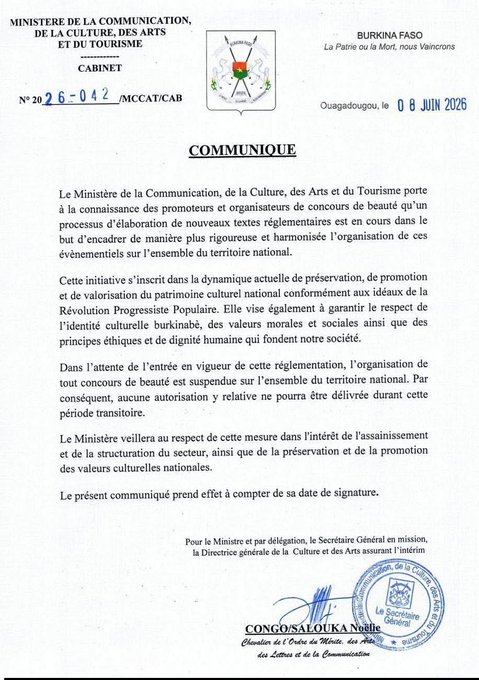
A recent official directive has sent shockwaves through the cultural landscape of Burkina Faso. The government has formally suspended all beauty pageants across the national territory until further notice. While the authorities frame this measure as a necessity to safeguard “cultural values” and respect the ongoing security challenges, the decision suggests a deeper shift toward a more restrictive governance model.
The strategy of political distraction
At a time when Burkina Faso faces immense security hurdles and a persistent humanitarian crisis, the timing of this cultural crackdown raises significant questions. The decision to target the entertainment sector while territorial integrity remains a primary concern appears to be a calculated move.
This intervention in the cultural sphere serves as a classic political diversion. By centering public discourse on morality and social conduct, the transitional administration effectively shifts attention away from unresolved issues regarding national stability and the promised return to constitutional governance.
State-mandated morality as a tool for social regulation
The prohibition of beauty contests is not an isolated event but rather part of a broader trend of state interference in the private lives and personal freedoms of citizens. Under the guise of “moral realignment,” the current leadership is establishing a rigid social order.
The concern among observers is that this path leads to further restrictions. If a beauty pageant is banned today in the name of values, there are fears that dress codes, artistic expressions, or even specific ideologies could be the next targets for state regulation. This tendency to govern bodies and leisure activities is a hallmark of autocratic systems, utilizing administrative decrees to dictate what is considered “worthy” of public celebration.
The erosion of democratic space
The situation unfolding in Burkina Faso extends beyond the fashion industry; it represents a systematic narrowing of the civic and democratic arena. Following the suspension of political parties and the silencing of independent media, the focus has now turned toward the cultural industries.
This form of governance is characterized by its intrusion into all aspects of life, legitimizing arbitrary decisions through the lens of state doctrine. By stripping the youth and cultural stakeholders of their platforms for expression, the government signals that ideological alignment is mandatory. In this environment, even aesthetic dissent is no longer permissible. Behind the rhetoric of sovereignty and moral preservation, Burkina Faso is moving toward a social monolith where the state exerts total control over individual choices—a trajectory clearly defined as authoritarianism.