
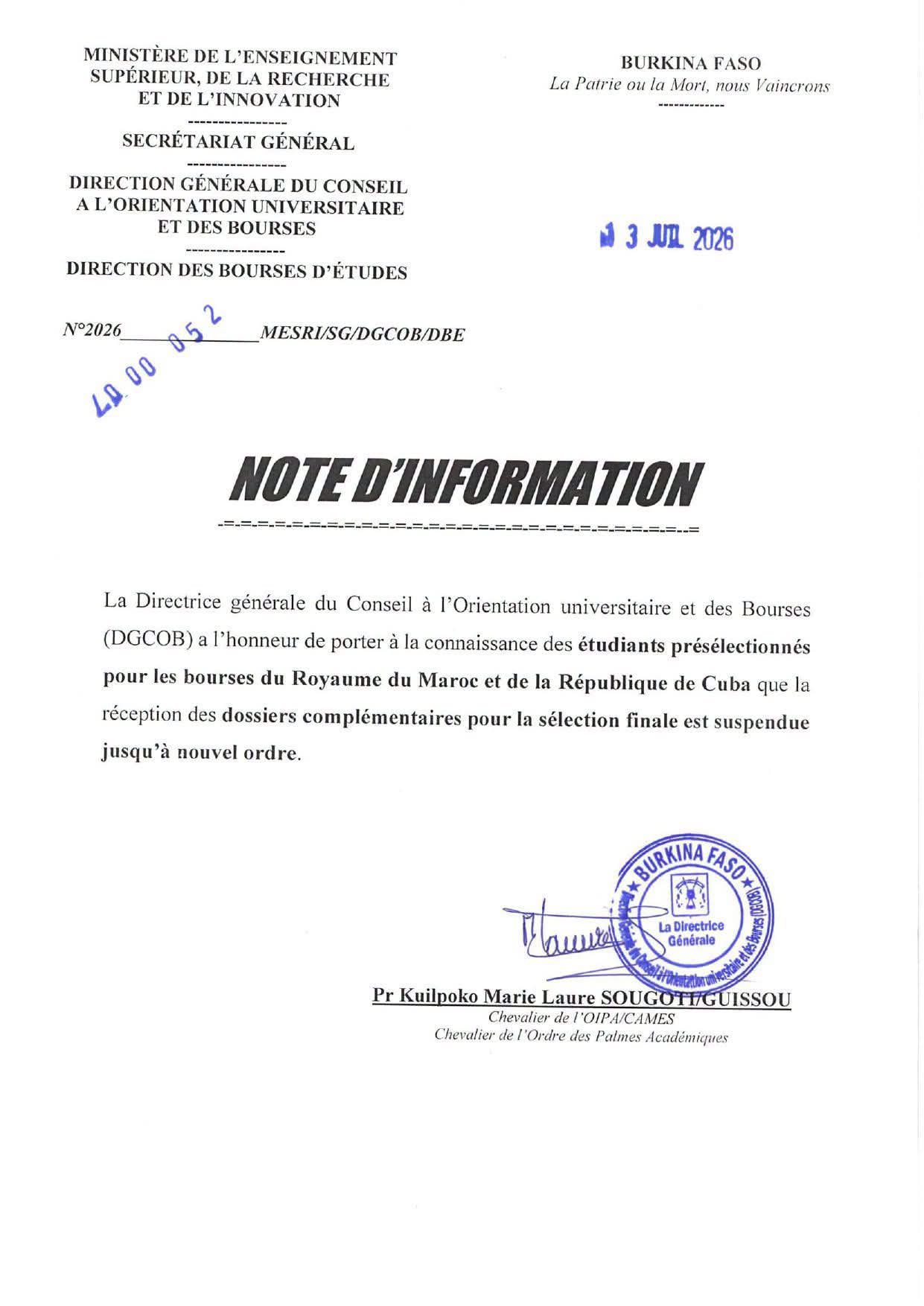
End of Moroccan scholarships for Burkinabè students reflects military regime’s hostility toward education
The abrupt cancellation of scholarships for Burkinabè students pursuing higher education in Morocco marks a new low in Ibrahim Traoré’s authoritarian rule. Far from being a mere administrative decision, this move is widely seen as a deliberate assault on the country’s youth, whom the military junta increasingly views as a threat to its grip on power.
For years, state-funded international scholarships enabled bright young Burkinabè to study abroad, particularly in Morocco, where they gained access to elite programs in medicine, engineering, and other critical fields. Upon returning, many contributed to national development by filling vital roles in public institutions and private enterprises. The abrupt termination of these opportunities leaves thousands of students without viable alternatives, effectively shutting the door on their academic aspirations.
Analysts argue that the ban is part of a broader strategy to dismantle independent thought and prevent the emergence of a well-educated, globally connected elite. By restricting access to foreign universities, the regime not only undermines educational standards but also weakens the country’s long-term competitiveness. Without exposure to diverse academic environments, Burkinabè students risk falling behind in an increasingly interconnected world.
The timing of this decision could not be more damaging. Burkina Faso is already grappling with escalating insecurity, a deepening economic crisis, and a shrinking diplomatic footprint. For families in precarious financial situations, international scholarships were often the only pathway to social mobility for their children. The regime’s refusal to maintain these programs underscores its disregard for the most vulnerable and its prioritization of control over progress.
Isolation as a tool of control
Critics warn that the move is not just an economic misstep but a calculated political maneuver. By severing ties with long-standing partners like Morocco, the military government is tightening its stranglehold on society while isolating the country from the global stage. This strategy of enforced isolation is a hallmark of authoritarian regimes seeking to suppress dissent and stifle ambition.
The consequences of this policy extend beyond the classroom. By cutting off access to world-class education, the junta risks exacerbating skill shortages in sectors already crippled by underinvestment. Engineers, doctors, and researchers—many of whom would return to strengthen national institutions—are now left with no clear path forward. The regime’s obsession with absolute control comes at the expense of the very people it claims to represent.
An uncertain future for Burkinabè youth
For the younger generation, the message is stark: under Traoré’s rule, ambition is punished, and opportunity is a privilege reserved for the regime’s loyalists. The scholarship ban sends a chilling signal that the paths to success are being systematically closed. As domestic prospects dwindle, more young Burkinabè may feel compelled to seek opportunities abroad, draining the country of its brightest minds.
If left unchecked, this policy of educational strangulation could have irreversible consequences. A nation that turns its back on its youth not only risks stagnation but also forfeits its ability to shape its own future. The question now is whether the international community will intervene before Burkina Faso’s potential is permanently eroded.