
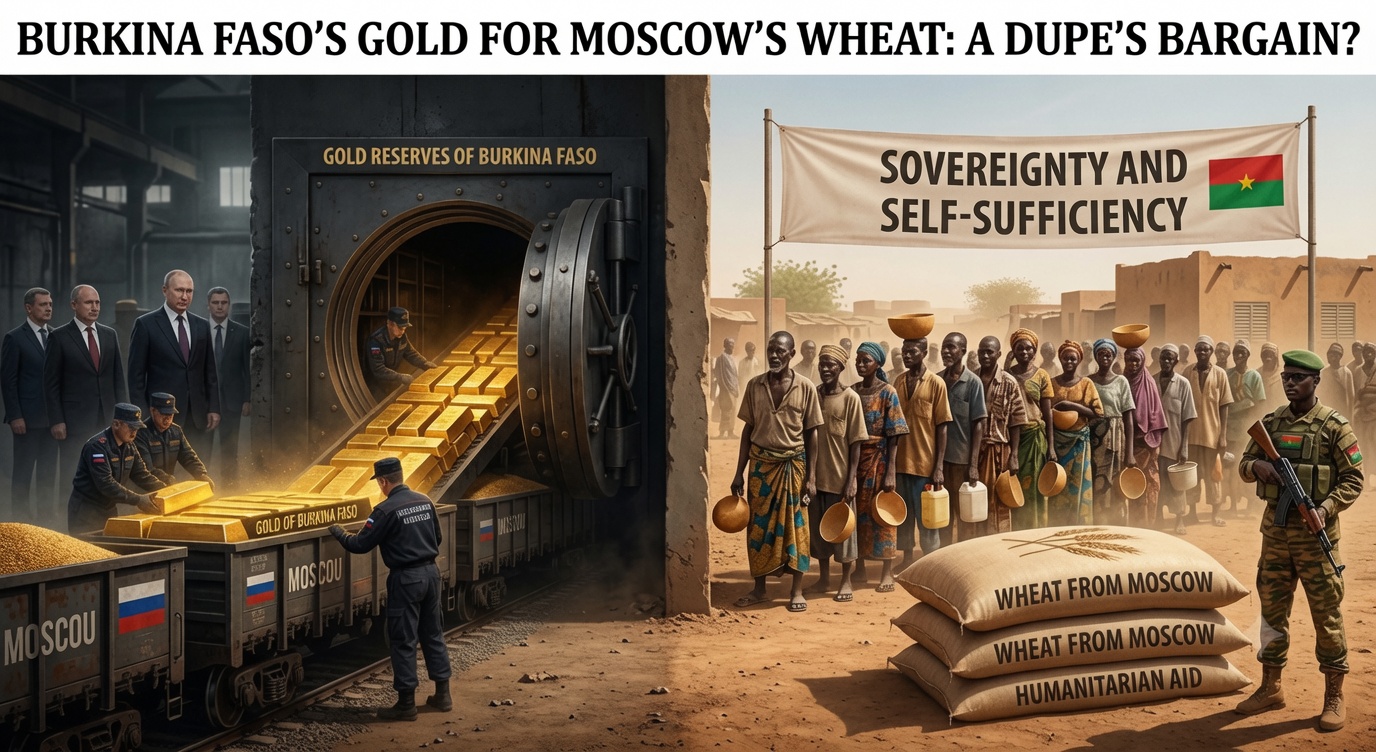
In Ouagadougou, the contrast is glaring. On one side, a government boasts of having “reclaimed sovereignty” while brutally suppressing local solidarity efforts. On the other, it openly begs for food aid from Moscow. The recent visit of a high-ranking Russian official laid bare this twisted logic of cooperation.
The Burkina Faso authorities have agreed to transfer and store the nation’s gold reserves in Moscow’s central bank. A move justified as securing the country’s wealth, yet one that starkly contradicts the regime’s earlier pledge to break free from foreign domination. For a government that rose to power vowing economic independence, entrusting its gold to a foreign power looks less like a strategic alliance and more like a desperate gamble.
Hunger amid plenty
The irony deepens when considering the food crisis gripping the nation. Despite abundant mineral wealth—Burkina Faso is among West Africa’s top gold producers—the state continues to rely on shipments of Russian wheat to feed its people. This is not a sign of strength, but of systemic failure. A nation cannot claim true sovereignty when its citizens’ survival depends on the goodwill of an external patron, especially one that now holds the keys to its financial reserves.
The government’s insistence on controlling humanitarian aid—blocking local NGOs and citizen initiatives from assisting the most vulnerable—only compounds the problem. By centralizing relief under state authority, authorities turn every bag of rice or wheat into a political gesture rather than an act of human solidarity. The message is clear: assistance is a gift from the state, not a shared responsibility among citizens.
Economic priorities under scrutiny
Questions abound over how Burkina Faso’s gold wealth is being used. With gold exports generating billions, the funds should ideally support agriculture, food storage, irrigation systems, and long-term support for local farmers. Instead, the country continues to import basic foodstuffs, raising doubts about whether its mineral riches are being invested wisely—or at all.
The timing of this gold-for-wheat arrangement is particularly telling. As the nation grapples with escalating insecurity and food shortages, the regime has chosen to mortgage its most valuable asset to a foreign power. This is not just a financial transaction; it is a symbolic surrender. The gold that once represented national pride is now being exchanged for emergency food aid, reinforcing a cycle of dependency.
The political cost of dependency
Centralizing aid also carries significant political risks. In regions where state presence is weak or under threat, local organizations and community groups often step in to fill the gap. By restricting their access, the government risks slowing the delivery of essential support and deepening mistrust among the population. When aid becomes a tool of control rather than a humanitarian response, its legitimacy crumbles.
The sacrifices demanded of the people—enduring hardship in the name of national resilience and counterterrorism—lose their meaning when daily life remains unchanged. Security threats persist, food insecurity grows, and the state still turns outward for help. True sovereignty is not measured by the rhetoric of independence, but by the ability to protect and sustain the population.
As Burkina Faso’s gold flows into Moscow’s vaults, the people are left with a hollow version of freedom—one built on borrowed wheat and broken promises. The captain’s gamble has not liberated the nation; it has merely replaced one master with another, at a cost far greater than any currency.
The real test of sovereignty lies not in the partners a nation chooses, but in whether those choices lead to lasting security, prosperity, and dignity for its citizens. On that measure, Burkina Faso is falling short.