
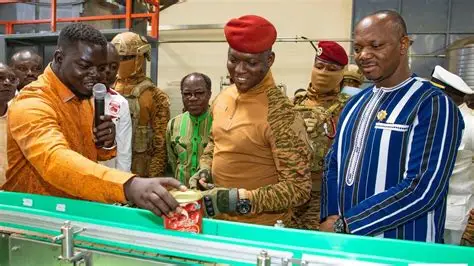
Captain Ibrahim Traoré has recently intensified his engagements with industrial project inaugurations and site visits across Burkina Faso. From tomato processing plants to gold processing units, the transitional government’s communications team has meticulously crafted a narrative to demonstrate the nation’s progress toward economic emergence. Yet, beneath the polished veneer presented by national media outlets, the harsh realities of a nation grappling with severe security and economic crises reveal a starkly different picture.
Grandiose projects: a facade of progress
The administration’s reliance on large-scale infrastructure projects—commonly referred to as the “ribbon-cutting policy”—serves as a deliberate strategy to reinforce perceptions of stability and self-reliance. In cities like Ouagadougou and Bobo-Dioulasso, the captain positions himself as the architect of economic resilience, emphasizing Burkina Faso’s ability to thrive despite regional blockades and the withdrawal of Western allies.
The discourse centers on self-sufficiency, local job creation, and economic sovereignty. Pro-government supporters frame each inaugurated site as a triumph over imperialism. However, independent economic analysts argue that these high-profile announcements are less a reflection of structured development and more an attempt to mask deeper systemic failures.
Industries propped up by uncertainty
Scrutiny of these so-called industrial success stories often uncovers significant gaps in transparency. While ribbon-cutting ceremonies are broadcast nationwide, critical details—such as long-term financial viability, exact funding sources, and actual production capacities—remain conspicuously absent.
Furthermore, growing concerns surround the allocation of funds designated for both national security and industrial development. Questions persist regarding the destination of these resources, particularly as traditional private enterprises face mounting fiscal pressures and escalating insecurity. The emergence of new entities closely linked to the ruling circle has further fueled skepticism about the integrity of public procurement processes.
The widening chasm between rhetoric and reality
As the presidential palace heralds industrial milestones, ordinary Burkinabè citizens confront a rapidly deteriorating quality of life.
Runaway inflation: Staple food prices—including rice, cooking oil, and millet—have surged to unprecedented levels, placing an unbearable burden on vulnerable households.
Humanitarian catastrophe: With over two million internally displaced persons, Burkina Faso is experiencing one of its most devastating crises in modern history. Entire villages remain under terrorist blockade, surviving only on intermittent humanitarian aid convoys.
Economic paralysis: The informal sector, traditionally the backbone of the economy, has ground to a halt. Persistent power outages and road insecurity have crippled trade and commerce, stifling any meaningful economic recovery.
Propaganda as a shield against dissent
The juxtaposition is glaring: on one side, carefully produced videos showcase gleaming machinery and a resolute leader; on the other, parents struggle to afford school fees and soldiers operate under extreme, life-threatening conditions.
The carefully curated image of a “prosperous Burkina Faso” is, at best, a media construct designed to foster hope and suppress criticism. Yet, propaganda has its limits—particularly when reality refuses to conform. A nation cannot be sustained on sovereignty rhetoric alone if its fields lie fallow and newly inaugurated factories exist only as television illusions.
The captain’s wager hinges on shaping public perception. In prioritizing the appearance of progress at all costs, he risks severing the vital connection between leadership and the lived experiences of the people. While industrialization is an admirable goal, it cannot be erected on unstable ground. Without transparent financial governance and genuine territorial security, these presidential spectacles will remain nothing more than illusions shimmering in the Sahelian heat.