
Burkina Faso’s innovative approach to eradicating cervical cancer
Ouagadougou – Imagine living in a remote village where the nearest health center is a day’s journey away, and even if you could reach it, the cost would be prohibitive. This was the reality for thousands of women in Burkina Faso, where cervical cancer claimed countless lives due to late detection and limited access to care. Today, their story is one of hope, thanks to a groundbreaking initiative.
Breaking barriers to cervical cancer screening
For women like Awa, a 48-year-old mother of six from Ipendo in Burkina Faso’s Centre-Ouest region, the fear of a cervical cancer diagnosis was compounded by the practical hurdles of accessing medical services. « When I heard the town crier announce free screening, my first thought was: ‘If they tell me I have cancer, how will I afford treatment?’ But then I thought of my children, and I decided to go,» she recalls.
Before Burkina Faso implemented its bold national strategy, cervical cancer screening coverage was dismally low—under 8%—with rural women bearing the brunt of the crisis. Long distances to facilities, lack of transportation, and financial constraints kept many from seeking early detection. Professional healthcare workers were scarce, and awareness campaigns were virtually nonexistent.
How Burkina Faso is leading the fight
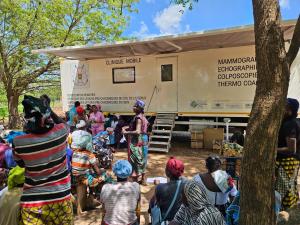
Burkina Faso’s government took decisive action to dismantle these barriers. Professor Nayi Zongo, a public health physician and coordinator of the National Cancer Control Program (PNLC), explains the approach: « The government issued a decree making screening and treatment of precancerous lesions completely free. We also upgraded peripheral health centers and launched mobile clinics to reach women where they live and work.»
The mobile clinics have become a cornerstone of equitable healthcare, traveling to villages, farms, local markets, and even family compounds. Women no longer need to abandon their daily responsibilities to get screened. « Bringing care closer to communities allows women to maintain their livelihoods while safeguarding their health,» says Prof. Zongo.
This strategy combines multiple impactful measures: eliminating financial barriers through free services, overcoming geographic challenges with mobile units, and fostering community engagement. The country also leveraged mass media—television, radio, and popular events like Pink October—to spread awareness. A national coalition against cancer, uniting civil society, community leaders, and media, further amplified the message. Together, these efforts transformed cervical cancer from a silent killer into a preventable and treatable condition.
Partnerships that drive change
The World Health Organization (WHO) played a pivotal role in supporting Burkina Faso’s vision. « WHO provided technical assistance to develop national guidelines, trained health workers in detecting and treating precancerous lesions, and supported community mobilization,» says Prof. Zongo. « Their backing ensured that no woman, regardless of where she lives, would be left without access to vital care.»
Measurable progress in the fight against cervical cancer
The results speak volumes. Between October 2024 and September 2025, mobile clinics conducted 468 outreach sessions across the country. These efforts:
- Reached nearly 2 million women with life-saving information.
- Conducted 106,446 screenings, identifying and addressing potential threats early.
- Treated 715 cases of precancerous lesions, preventing progression to full-blown cancer.
- Performed 113 advanced diagnostic tests to confirm cases and guide treatment.
These numbers aren’t just statistics—they represent real lives saved and families spared from tragedy.
A model for Africa and beyond
The WHO hailed Burkina Faso’s success as a testament to what can be achieved with strong political will and context-specific solutions. « This initiative demonstrates that seemingly insurmountable barriers can be overcome,» says Dr. Seydou Coulibaly, WHO Representative to Burkina Faso. « By removing financial and geographic obstacles, the country has set an inspiring example for other nations in Africa to follow.»
The human impact: stories of hope and empowerment
Awa’s experience is a microcosm of the broader impact. « We work in the fields, tend our gardens, and sell produce at the market. When we heard about the screening, I was afraid, but hearing from other women who had done it reassured me,» she shares. « On the day of the test, the health workers explained every step. When the result came back negative, I felt an enormous weight lift off my shoulders. Now, I encourage every woman I know to get screened. Early detection makes all the difference.»
For many women, these mobile clinics are more than medical services—they’re the first time they learn about cervical cancer, understand the risks, and discover that it’s preventable. This initial awareness is transformative, paving the way for prevention and early intervention.
A movement for health equity and dignity
The impact of this initiative extends beyond health—it touches on social justice, family futures, and human dignity. Every mobile clinic that arrives in a village carries a powerful message: health is a right, not a privilege. In Burkina Faso, this right is becoming a reality for women in even the most remote corners of the country.