
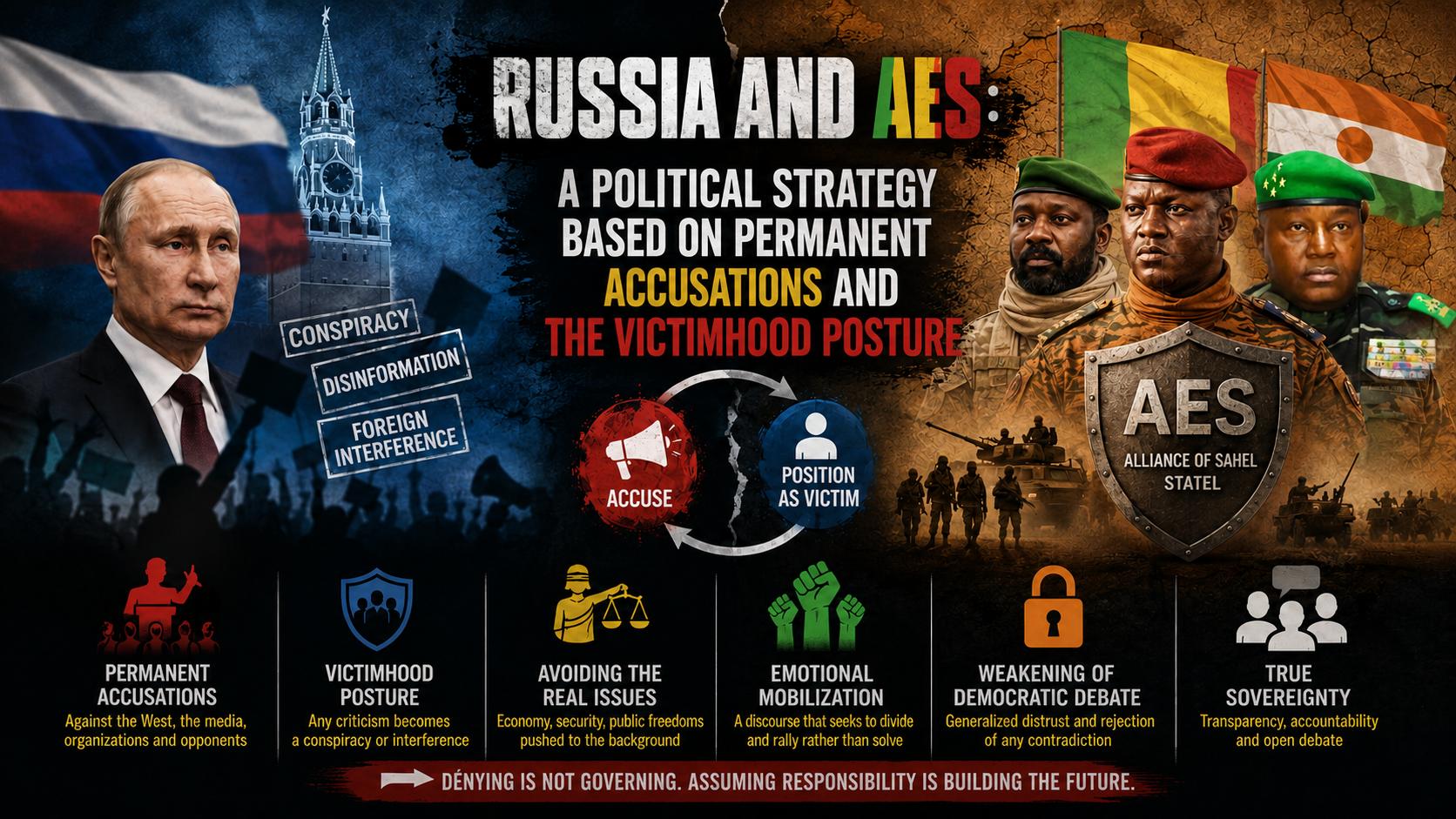
Rhetoric of perpetual accusation and self-victimization in Sahel alliances
Over the past years, both Russia and the governments comprising the Alliance of Sahel States (AES) have integrated the denunciation of adversaries into the core of their political communications. Whether targeting Western powers, international media, regional bodies, or domestic opponents, accusations have become a recurring theme. Yet a recurring paradox persists: whenever these same actors face criticism, they swiftly abandon their accusatory stance to adopt the role of victims.
This communication strategy has evolved into a near-universal practice. The slightest questioning of their policies is met with accusations of conspiracies, disinformation campaigns, or foreign interference. Any critique is framed as a coordinated assault designed to undermine their governments or obstruct what they claim is their path to sovereignty.
Such a posture offers clear political advantages. By portraying themselves as victims of external enemies, leaders avoid addressing pressing issues within their own societies—economic hardships, persistent insecurity, restrictions on civil liberties, or the underwhelming outcomes of certain policies. Substantive debate is supplanted by emotional rhetoric aimed more at rallying public sentiment than delivering tangible solutions.
The phenomenon is especially pronounced within the AES. Authorities frequently attribute their challenges to sanctions, former colonial powers, or external actors. However, when citizens, journalists, or human rights organizations highlight internal shortcomings, these critiques are rarely examined on their merits. Instead, they are dismissed as part of a broader destabilization plot orchestrated beyond their borders.
Russia has similarly embraced this logic on the global stage. In response to criticism regarding its foreign policy, military interventions, or human rights violations, official discourse consistently presents the country as the perpetual target of Western hostility. This narrative diverts attention from the issues raised and reframes dissent as further proof of a supposed relentless campaign against the nation.
In the long run, this strategy reveals inherent weaknesses. Credible governance demands the capacity to acknowledge dissent, respond to criticism with reasoned arguments, and remain accountable to citizens. Consistently framing opposition as a conspiracy risks eroding democratic discourse and perpetuating a climate of generalized mistrust.
Accusing others is a simple task. Assuming responsibility is far more demanding. Through repeated recourse to victim narratives, both Russia and several AES leaders often appear more concerned with evading substantive debate than engaging with it. A critique, however harsh, does not automatically equate to a conspiracy. In any society, such feedback can serve as an opportunity to refine public policies, correct errors, and strengthen citizen trust.
True sovereignty is not measured solely by the ability to denounce real or imagined enemies. It is also built on transparency, accountability, and the acceptance of open debate. Without these principles, the narrative of perpetual victimhood loses credibility, revealing itself less as a genuine response to challenges and more as a political communication tactic.