
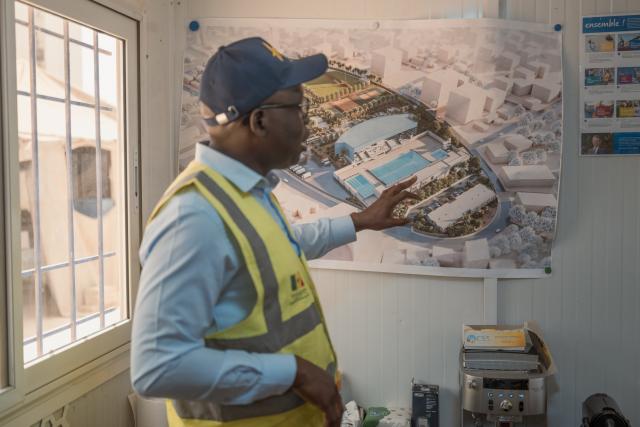
With fewer than six months remaining until the first-ever Olympic event on African soil, Dakar is under intense pressure to deliver a flawless 2026 Youth Olympic Games. The city’s preparations for the October 31–November 13 event reflect both its national pride and the global expectations placed on the continent’s maiden Olympic endeavor.
The Youth Olympic Games (YOG) in Dakar will welcome over 2,700 young athletes aged 17 or younger, competing across 25 sports and 153 events. This includes traditional disciplines such as athletics and swimming, as well as unconventional additions like breaking, skateboarding, and baseball. The International Olympic Committee (IOC) has emphasized the event’s role in fostering youth engagement and sporting excellence, making it a historic milestone not just for Senegal but for Africa as a whole.
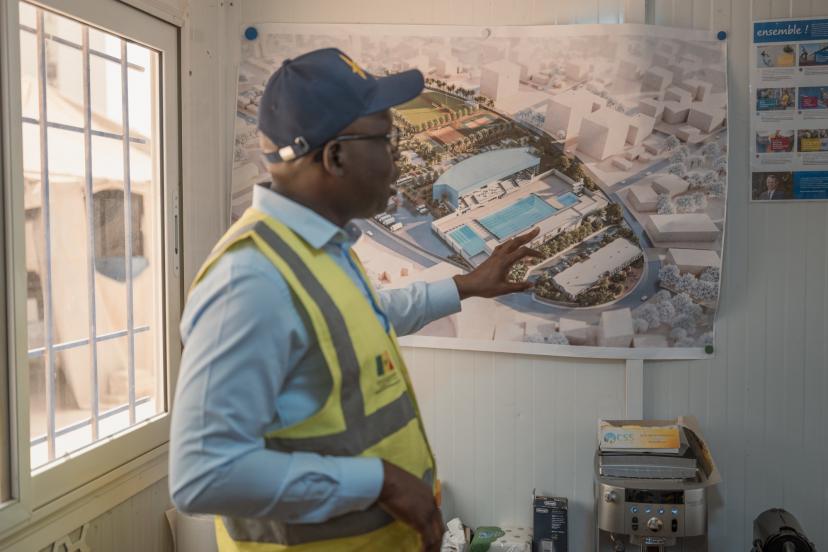
Babacar Senghor, coordinator of the Dakar 2026 Youth Olympic Games project, reviewing pool construction plans.
scaling global standards: the challenge ahead
Ahmadou al-Aminou Lo, Senegal’s Minister of State overseeing the Senegal 2050 Transformation Agenda, leads a dedicated monitoring committee tasked with ensuring all operational and logistical aspects are executed flawlessly. The committee meets bi-monthly to oversee progress, address risks, and coordinate between government agencies, local authorities, and international partners.
Speaking about the stakes, Lo remarked, “The image of Senegal and Africa is at stake.” He highlighted the dual pressure of delivering a world-class event while simultaneously building a sustainable sporting legacy. “Our mission is to mitigate every risk associated with the YOG. We aim to ensure our institutions are agile and fully prepared to meet the deadline. We are the quality assurance for these preparations, and we cannot afford to fall short.”
infrastructure upgrades: a new era for Dakar’s sporting facilities
Key venues are undergoing significant upgrades, including the Tour de l’œuf complex, where a new Olympic swimming pool and diving facilities are being constructed. The project, led by Sogea-Satom (a subsidiary of Vinci), involves over 450 workers and includes the installation of advanced water and energy saving technologies. The complex will also host basketball 3×3, baseball, breaking, and skateboarding events.
A maiden “test fill” of the three pools is scheduled for May 15, with the handover to the Dakar 2026 Organizing Committee (Cojoj) set for August 15—just two and a half months before the Games commence. Officials confirmed no major accidents have occurred during construction, and the site is expected to undergo water and energy efficiency testing ahead of the event.
France-Senegal partnership: sharing expertise and resources
A landmark cooperation agreement signed in 2019 between France and Senegal has played a pivotal role in the YOG preparations. The Alliance Dioko program facilitates a knowledge exchange between the organizing committees of Paris 2024 and Dakar 2026, covering areas such as volunteer recruitment, security protocols, and event management best practices.
Christine Fages, France’s Ambassador to Senegal, underscored the significance of this partnership: “In organizing the Paris Olympics, we witnessed firsthand the unifying power of such a global event. Through Alliance Dioko, 30 experts from Paris 2024 have been integrated into the Dakar 2026 team. Additionally, 419 young Senegalese have been trained at the Learning Academy to acquire event organization skills. A sovereign loan of €80 million from the French Development Agency (AFD) has also supported the renovation of the Iba Mar Diop Stadium and the Tour de l’œuf complex, as well as the construction of 12 community sports facilities.”
Beyond infrastructure, France has contributed €233,000 to support the renovation of the judo academy at Lycée Lamine Gueye, including upgrades to the dormitory and dojo, and the provision of sports and medical support for young judokas preparing for the Games.
legacy beyond the podium: building a sporting future
While the immediate focus remains on delivering a successful event, Senegal is equally committed to leveraging the YOG to create a lasting sporting legacy. Lo emphasized this vision: “We want the YOG to serve as a catalyst for youth development. This includes expanding sports-education excellence programs, promoting high-level competition, and boosting the contribution of sports to our GDP. Currently, sports account for only €15 million of Senegal’s GDP, but we aim to double this through the MICE industry—meetings, incentives, conferences, and events.”
The Games are seen as an opportunity to inspire a new generation, enhance local talent development, and position Senegal as a hub for sporting events and tourism. With half of the country’s population under 19, the potential for long-term impact is significant.
cleanliness as a medal: Dakar’s green ambitions
Recognizing the importance of environmental stewardship, Senegal has made cleanliness a central pillar of its preparations. Lo declared, “Our first medal will be for cleanliness. We have launched an aggressive campaign to ensure Dakar shines as brightly as Rwanda’s Kigali, which ranks among Africa’s cleanest cities.” The initiative includes waste management plans, public cleanliness drives, and infrastructure improvements aimed at enhancing the city’s overall appeal.
As Dakar races against time, the world watches closely. The 2026 Youth Olympic Games are more than a sporting event—they represent a bold statement of Africa’s readiness to host the world and a testament to Senegal’s ambition to lead the continent’s sporting future.