
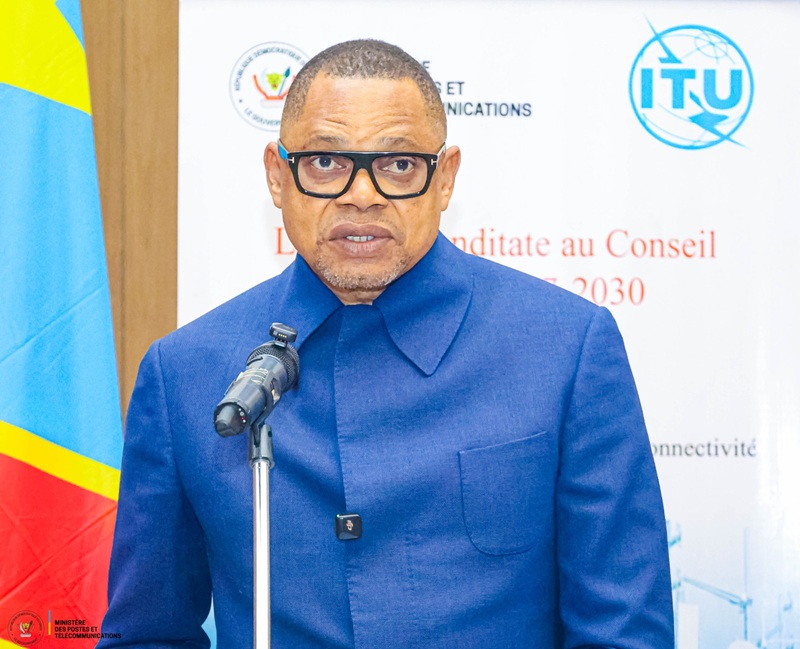
Democratic Republic of Congo bids for ITU seat with diplomatic push
In a bold move to secure a prominent place in global telecommunications governance, the Democratic Republic of Congo (DRC) is rallying international support for its candidacy to the International Telecommunication Union (ITU) Council. On the evening of July 16, 2026, Minister of Posts and Telecommunications José Mpanda Kabangu convened a high-level diplomatic gathering at Kinshasa’s Hilton Hotel, inviting ambassadors, heads of diplomatic missions, and representatives of international telecom organizations to formally announce the country’s bid.
The DRC is vying for one of the 13 African seats on the ITU Council during the upcoming Plenipotentiary Conference in Doha, Qatar, scheduled for November 2026. This election will determine the Council’s composition for the 2027–2030 term. Minister Mpanda framed the candidacy as a strategic imperative for the DRC and the African continent, emphasizing the country’s central role in the continent’s digital transformation and its potential to amplify Africa’s voice in global telecom policy discussions.
“Our bid to the ITU Council is not just about securing a seat; it’s about positioning the DRC as a leader in connectivity, digital inclusion, and the governance of emerging technologies,” Mpanda stated. He highlighted the DRC’s geostrategic importance, its hosting of the African Telecommunications Union (ATU) headquarters, and its vast energy and mineral resources—key to advancing telecom infrastructure—as compelling reasons for its inclusion in global decision-making bodies.
Four pillars of the DRC’s ITU candidacy
Christian Katende, President of the Regulatory Authority for Posts and Telecommunications (ARPTC), outlined the four key commitments underpinning the DRC’s bid:
- Amplifying Africa’s voice: Ensuring the continent’s priorities are reflected in global telecom policies.
- Driving infrastructure investments: Promoting projects in fiber-optic networks, satellites, data centers, and public digital infrastructure.
- Balancing innovation and security: Advocating for a digital governance framework that fosters innovation while safeguarding sovereignty and citizen rights.
- Strengthening African capacities: Facilitating knowledge-sharing, research, and innovation among African regulators and states.
Katende underscored the DRC’s potential to become a digital hub for Central Africa, citing its population of over 110 million and 74 million mobile subscriptions as evidence of its market significance. “We aim to turn the DRC into a digital powerhouse, not just for our nation but for Africa as a whole,” he declared. He also stressed the DRC’s role in supplying critical minerals essential for semiconductors and AI infrastructure, positioning the country as a key player in the next decade of technological revolution.
Diplomatic backing and strategic alignment
Noëlla Ayeganagato, Deputy Minister of Foreign Affairs, reaffirmed the government’s commitment to supporting the candidacy. She called on diplomats to leverage bilateral and multilateral engagements to rally votes, emphasizing the ITU’s role in achieving sustainable development goals. “The ITU is a strategic partner in our digital transformation journey. We urge our allies to champion this bid with urgency and clarity,” she urged.
The DRC’s formal candidacy submission will take place in Doha in November 2026, where the outcome of the elections will shape the future of global telecom governance. With its ambitious vision and strategic assets, the DRC is positioning itself as a force to be reckoned with in the digital era.