
Opposition march sparks fresh feud within ruling coalition in the Democratic Republic of Congo
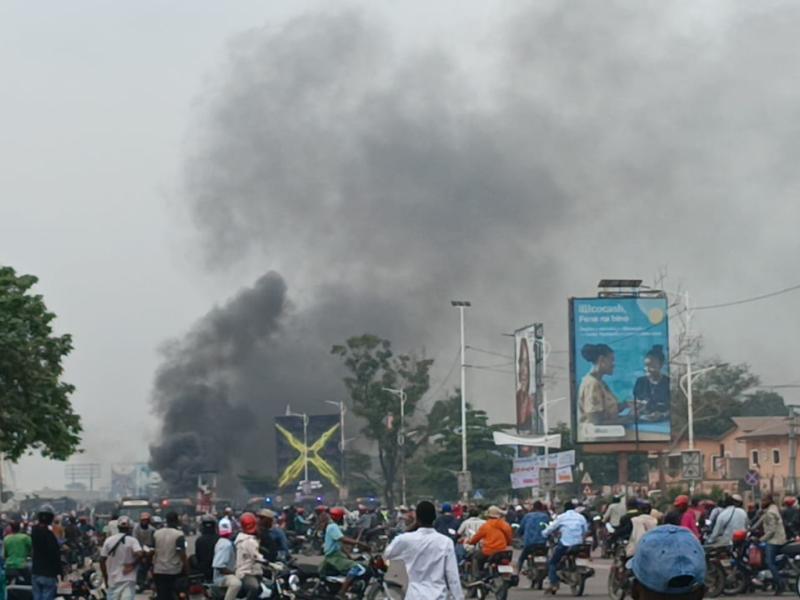
Tensions within the Democratic Republic of Congo’s ruling alliance have intensified following the announcement of a major opposition demonstration scheduled for July 22. The march, organized by the Coalition for Article 64, will culminate at the Palais de la Nation in Kinshasa and demands the resignation of President Félix Tshisekedi, accusing him of betraying his constitutional oath through an alleged constitutional amendment project.
Ruling coalition fractures over response to opposition initiative
Two prominent figures within the Union sacrée de la nation (USN), André Mbata and Augustin Kabuya, have publicly clashed over how to counter the opposition’s call to the streets. Mbata, a constitutional law professor and national deputy, has issued a strong directive urging members of the USN—comprising over 900 political parties, associations, and groupings—to mobilize in Kinshasa, all 25 provincial capitals, and the diaspora on July 22 to “defend the nation against those attempting a coup by denying the sovereign people their right to exercise their sovereignty.”
In stark contrast, Augustin Kabuya, Secretary-General of the ruling Union pour la démocratie et le progrès social (UDPS) and a member of the USN presidium, has urged party members to ignore the opposition’s march. In a terse statement released on July 13, Kabuya called on UDPS members to carry on with their regular activities, explicitly warning against using routes designated for the opposition’s procession.
Mbata fires back at Kabuya’s directive
André Mbata swiftly responded to Kabuya’s stance with a strongly worded statement, emphasizing that the USN cannot be reduced to the position of a single component. He criticized Kabuya’s communiqué as premature and politically incorrect, reiterating that only official statements from the USN’s permanent secretary should be heeded by its members.
Mbata accused the ruling coalition of remaining silent while opposition groups, whom he labeled as “ill-intentioned and constitutionally ignorant individuals,” take to the streets to demand the president’s departure. He concluded by urging USN members to disregard any messages not issued by the coalition’s official spokesperson.
Shadows of past conflicts loom over current divisions
The public rift between Kabuya and Mbata is not new. In April 2024, Mbata distanced himself from Kabuya during a dispute with Deo Bizibu, then Kabuya’s deputy at the UDPS. The tension between the two figures resurfaced during the recent gubernatorial election in Sankuru Province, where Mbata supported an alternative candidate, Jules Lodi Emongo, against Kabuya’s preferred candidate. Emongo ultimately won the election, delivering a setback to Kabuya’s influence.
Following the Sankuru election outcome, Kabuya publicly instructed UDPS members to cease paying dues to Mbata, asserting that only he was authorized to receive them. This episode underscores the deepening internal fractures within the Union sacrée de la nation, revealing a coalition plagued by leadership disputes and persistent rivalries as the 2028 elections approach and President Tshisekedi’s second and final term nears its end.
The escalating tensions between Kabuya and Mbata highlight the growing instability within the ruling alliance, raising questions about its ability to maintain cohesion in the face of mounting opposition pressure and the challenges posed by the upcoming electoral cycle.