

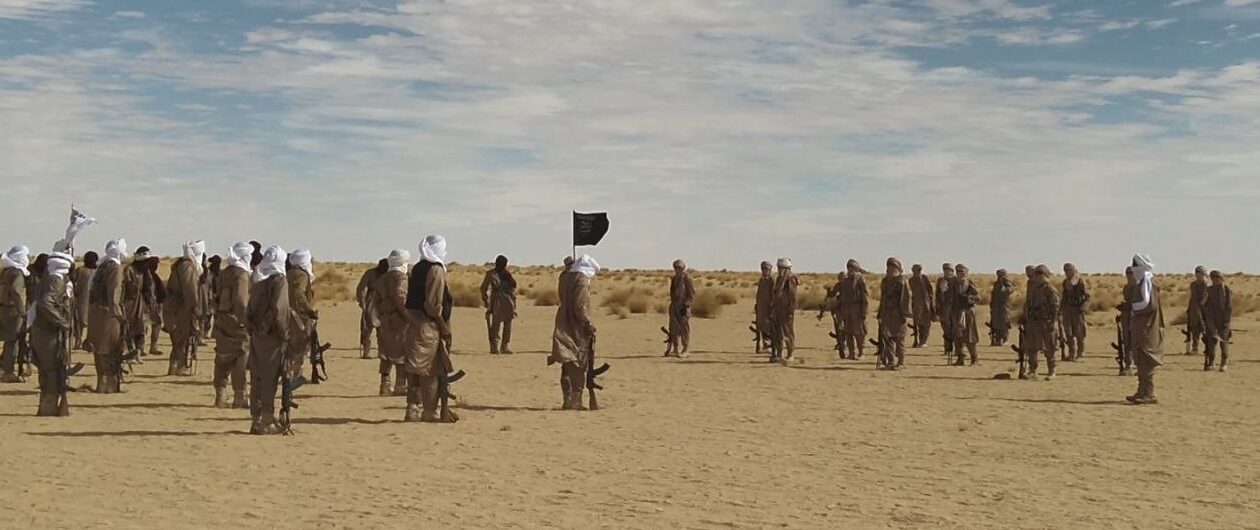
The north and central regions of Mali no longer face sporadic armed attacks alone. For years, they have endured a relentless cycle of violence and societal exhaustion. Recent offensives by the Group for the Support of Islam and Muslims (JNIM) and the Azawad Liberation Front (FLA)—targeting military posts, supply convoys, and critical road networks—signal a pivotal shift in strategy.
Beyond territorial control: a war of attrition
These armed factions are no longer fixated on capturing towns or staging high-profile operations. Their aim is far more insidious: to render vast swaths of territory ungovernable, cornering the Malian junta into its last bastion around Bamako. The battlefield has expanded beyond who holds a village or a barracks. Today, the real question is: Who still controls movement?
Roads, fuel supplies, administrative convoys, and public services are now the new frontlines. In some areas, even basic administrative travel requires armed escorts, crippling the state’s ability to function outside major urban centers.
A calculated strategy of exhaustion
The JNIM appears to have mastered a critical insight: in a nation already fractured by institutional collapse, economic distress, and chronic insecurity, wear and tear can outstrip the impact of a single decisive battle. This approach offers several advantages:
- Cost efficiency: Targeting mobility is less resource-intensive than large-scale territorial conquest.
- Force dispersion: Spreading military responses thin across multiple fronts.
- Perpetual insecurity: Sustaining a climate of fear that drains morale, budgets, and public trust.
- Administrative erosion: Where state presence weakens, local governance collapses, leaving communities to fend for themselves.
In rural zones, the crisis is no longer just the presence of armed groups—it’s the absence of stable governance. Schools close, health services vanish, and justice systems retreat behind military checkpoints.
The limits of military dominance
Mali’s transitional regime has staked its legitimacy on security restoration, touting the departure of French forces and the rise of Russian military cooperation as hallmarks of regained sovereignty. Yet sovereignty isn’t measured solely by firepower.
True authority requires the ability to maintain territorial continuity—economic, administrative, and social. Paradoxically, the escalation of military operations has coincided with a fragmentation of rural spaces. While offensives, airstrikes, and troop deployments dominate headlines, rebuilding schools, clinics, local courts, and trade routes lags behind.
This void is quickly filled by parallel systems: informal justice, armed protection rackets, or survival networks. The state’s intermittent presence—often limited to military patrols—fails to address the root causes of instability: land disputes, intercommunal tensions, or grinding poverty.
The Sahel’s shifting power dynamics
The Malian crisis is no longer contained by borders. The Sahel is undergoing rapid realignment, with armed groups, local alliances, and shadow economies transcending national lines. The porous borders between Mali, Burkina Faso, and Niger facilitate the movement of insurgents, yet the region’s states remain locked in siloed responses despite their shared Alliance of Sahel States (AES).
The recent JNIM-FLA offensive exposed the fragility of this coalition. The Malian junta, now reliant on Africa Corps mercenaries, stands isolated. This asymmetry favors groups like the JNIM, which thrive on adaptability, deep local roots, and integration into illicit trade networks.
Control doesn’t mean governance. The JNIM’s goal isn’t to administer territory—it’s to impose unsustainable costs on the state, rendering governance impossible. The Sahel conflict is increasingly a war of endurance, where victory is defined by exhaustion rather than conquest.
What the Malian crisis reveals
Reducing the conflict to a counterterrorism narrative obscures its deeper dimensions. The real battleground lies in the social and economic fabric of rural Mali.
Decades of state neglect, land disputes, and intercommunal rivalries have created fertile ground for armed groups. These factions don’t always create grievances—they exploit them. The central question is no longer military but political: How can the state rebuild legitimacy in areas where its presence is sporadic and overwhelmingly military?
The future of Mali won’t hinge on a single decisive battle. It depends on whether the state can reconstruct stable public institutions beyond security operations. A war of attrition doesn’t just destroy positions—it erodes roads, economies, administrations, and social bonds. Ultimately, it threatens the very idea of a governed territory.
Mourad Ighil