
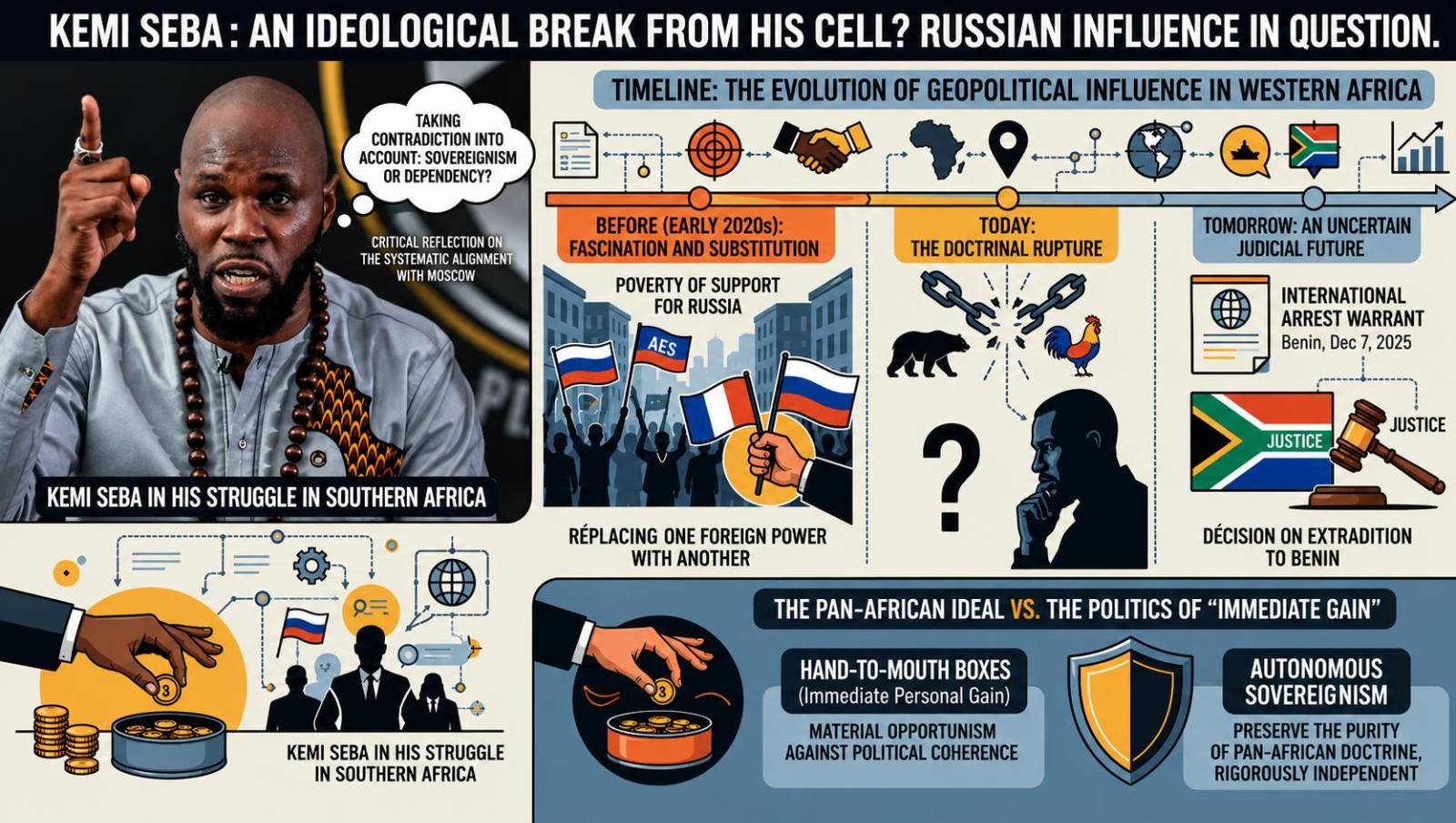
The geopolitical landscape of the Sahel region has recently witnessed a surge in sovereignist movements, often accompanied by public displays of Russian flags and pro-Moscow slogans. These demonstrations, framed as emblematic of a quest for self-reliance, reflect a growing trend among certain political factions in the Alliance of Sahel States (AES). For many activists, Russia has emerged as a perceived antidote to historical Western influence, positioning itself as a necessary alternative.
Yet, this burgeoning admiration raises critical questions, particularly when it stems from movements that claim to advocate for absolute independence. A prominent figure in contemporary panafricanism, Kemi Seba, now appears to be challenging this prevailing narrative—from within the confines of a South African prison cell.
Sovereignty at a crossroads: the illusion of replacing one dependency with another
While the pursuit of new international alliances is a legitimate diplomatic strategy for states or political movements, the replacement of one foreign influence with another risks undermining the very principle of sovereignty it seeks to uphold. Observers argue that substituting French influence with Russian dominance does not equate to true emancipation but merely shifts the locus of dependence rather than eliminating it.
Kemi Seba’s evolving stance suggests a growing recognition of this paradox. The panafricanist ideologue has begun to critique the rigid alignment with Moscow, rejecting the notion of any form of external protectorate—whether Western or otherwise—as antithetical to the ideals of genuine autonomy.
The panafrican ideal versus the politics of short-term gain
This ideological recalibration has exposed a schism within sovereignist movements. While some support for Russia is driven by a genuine desire for geopolitical rupture, other factions appear motivated by more pragmatic, self-serving interests.
Kemi Seba has been vocal in condemning this opportunism, which he describes metaphorically as the maintenance of “boîte à ragoût”—a reference to the pursuit of immediate material gain, often at the expense of long-term political coherence. By rejecting this mercenary approach to ideology, he seeks to uphold the purity of a panafricanism defined by unwavering self-determination.
Legal uncertainty in Pretoria: a turning point for Seba’s movement
This period of introspection coincides with a precarious moment in Kemi Seba’s personal and political trajectory. Following his involvement in an alleged coup attempt in Cotonou on December 7, 2025, the activist faces an international arrest warrant issued by Benin. Currently detained in South Africa, his future now hinges on a courtroom rather than the streets.
The Pretoria judiciary is set to rule on Benin’s extradition request in the coming weeks, a decision that could redefine not only Seba’s political career but also the direction of the movements he has inspired. Will this enforced pause mark a definitive departure from his earlier positions, or merely a recalibration of his discourse? The answer may soon unfold in the courtrooms of South Africa.