
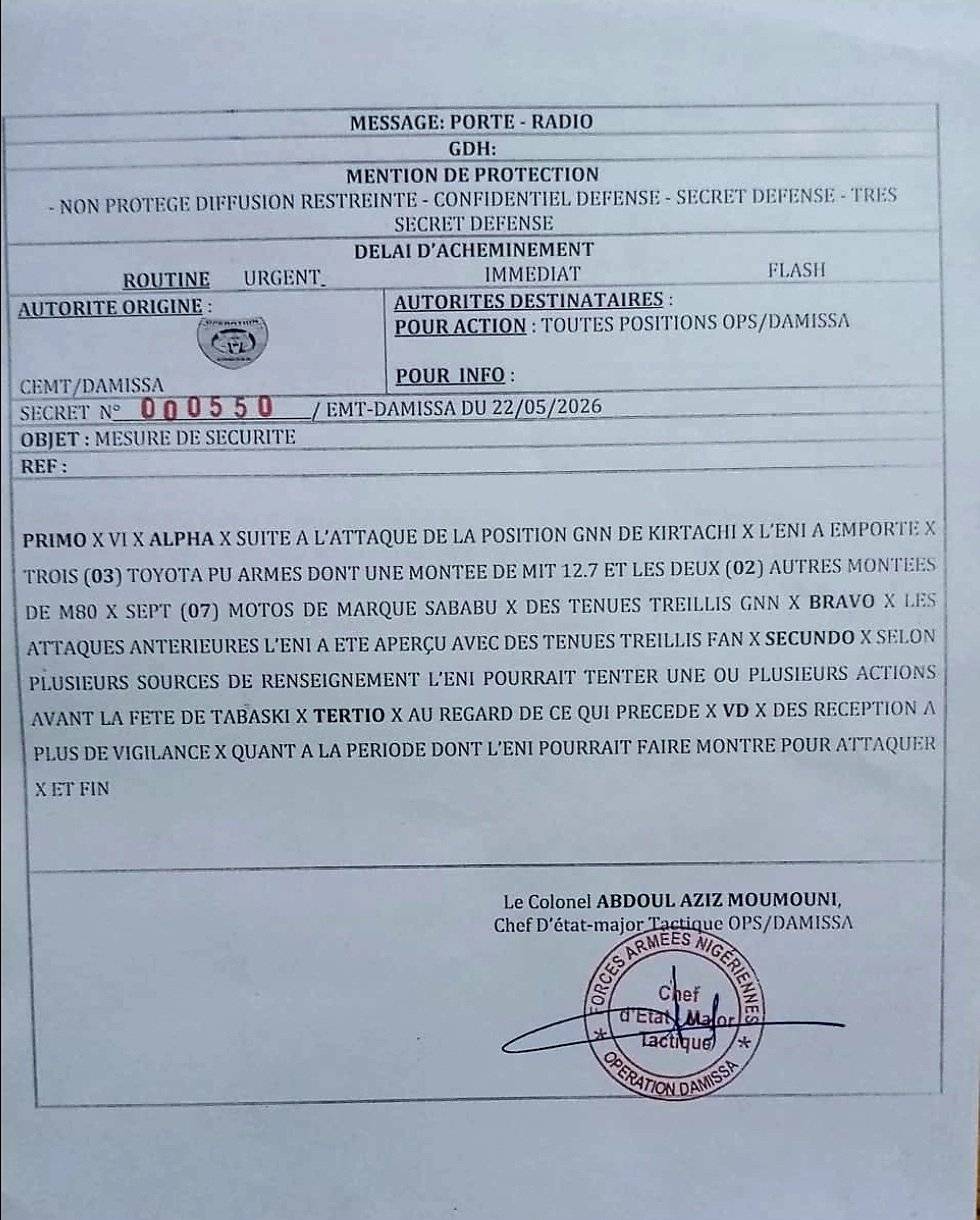
The recent assault on a Nigerien National Guard outpost in Kirtachi, located in the volatile Tillabéri region, has exposed alarming vulnerabilities within the country’s defense infrastructure. An internal radio transmission, intercepted on May 22, 2026, has shattered the veil of secrecy surrounding the true extent of the losses suffered by the Nigerien Armed Forces.
Uncovering the hidden aftermath of the Kirtachi attack
In the shadow of the ongoing Sahel conflict, official military assessments often downplay the severity of such incidents. However, this classified military document, marked “secret défense”, provides an unprecedented glimpse into the operational consequences of the attack. Originating from the highest echelons of the Nigerien military command, the intercepted message reveals a stark reality: the National Guard detachment at Kirtachi sustained catastrophic losses in both equipment and personnel.
Critical military assets fall into enemy hands
The most disturbing revelation lies in the detailed inventory of seized weaponry and vehicles. The Group for the Support of Islam and Muslims (JNIM) executed a meticulously planned raid, stripping the outpost of its mobility and firepower. Among the stolen assets were:
- Three armed Toyota pick-up trucks, including one mounted with a 12.7 mm heavy machine gun—a devastating weapon capable of outgunning standard infantry units. The remaining two vehicles were equipped with M80 machine guns.
- Seven Sababu motorcycles, lightweight yet rugged machines ideal for rapid, hit-and-run attacks across the Sahel’s rugged terrain.
- Multiple sets of Nigerien National Guard uniforms, raising immediate concerns about potential infiltration tactics. Terrorists could exploit these stolen outfits to bypass security checkpoints, posing a grave threat to future operations.
Human cost compounds the crisis
The material losses are compounded by a tragic human toll. The assault resulted in the deaths of 12 Nigerien soldiers, their sacrifice a stark reminder of the relentless violence plaguing the Tillabéri region. Additionally, four soldiers were reported missing, their fate hanging in the balance as the JNIM frequently uses prisoners as leverage in negotiations or propaganda campaigns. This dual crisis underscores the brutal efficiency of non-state armed groups in exploiting local instability.
Heightened security measures ahead of Tabaski
The military command wasted no time in responding to the crisis. The intercepted document, dated May 22, 2026, issued an urgent directive to all operational units nationwide, demanding heightened vigilance. Analysts warn that the JNIM may leverage its newfound firepower to launch further attacks, particularly as the Tabaski festival approaches. This period of mass mobility and religious celebration has historically provided fertile ground for terrorist groups to stage high-impact operations, aiming to instill fear and undermine public confidence.
The Kirtachi attack and the subsequent revelations serve as a sobering reminder of the multifaceted challenges facing Niger’s security apparatus. With the JNIM now equipped with stolen military hardware—including heavy weaponry and counterfeit uniforms—the Nigerien Armed Forces face an uphill battle. The dual priorities of safeguarding civilian populations ahead of Tabaski and adapting counter-strategies to neutralize a more mobile and better-armed enemy have never been more urgent.