
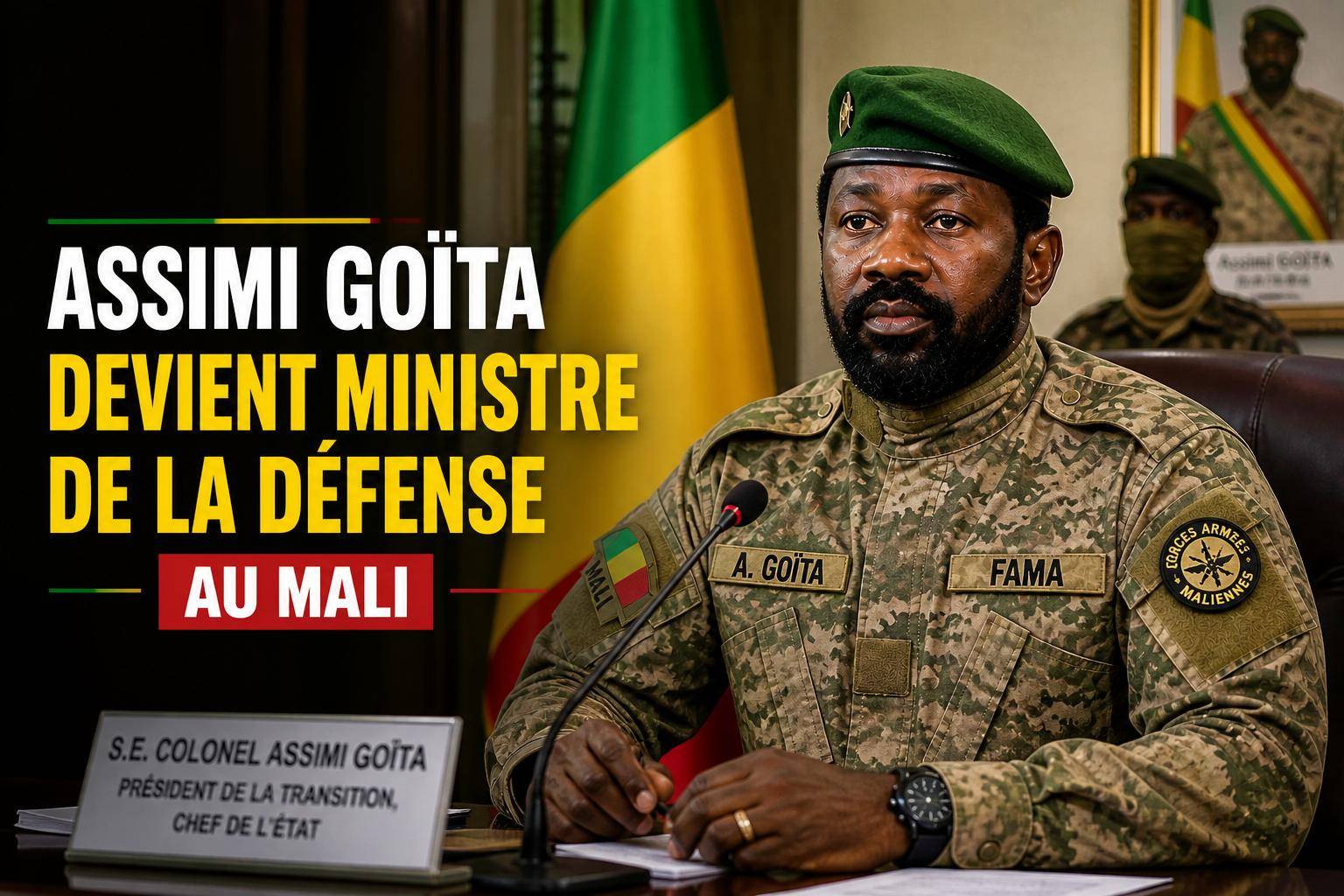
By officially assuming the responsibilities of Minister of Defense alongside his role as Head of State, Colonel Assimi Goïta has solidified the centralization of power in Bamako. This move, far from being a routine administrative change, appears to be an acknowledgment of vulnerabilities within the military command structure and a sign that the current security strategy is faltering. Following the loss of Kidal to the JNIM and the FLA, and amid debates over the effectiveness of Russian support, Mali is entering a period of significant instability.
A direct grip on military operations
In the capital, power is now concentrated entirely within the walls of Koulouba. By holding both the presidency and the defense portfolio, Colonel Assimi Goïta is no longer just the political visionary; he has become the primary operational leader of the armed forces. Regional analysts suggest this consolidation reflects a deepening mistrust within the inner circle of the transition government.
As the transition period stretches on, this extreme centralization raises a vital question: how can one individual manage state affairs, regional diplomacy, and the tactical complexities of an asymmetrical conflict simultaneously? This accumulation of roles suggests a high-stakes gamble. By removing ministerial buffers, Goïta has placed himself on the front line. Any future military setback will no longer be blamed on a subordinate but will be seen as a direct failure of the Head of State.
The Kidal reversal: from victory to loss
Only months ago, government communication channels were celebrating the “liberation” of Kidal as a symbol of restored national sovereignty. However, recent events on the ground have dampened that optimism. The city, a vital strategic hub in the North, has once again fallen under the control of armed groups, specifically the Group for the Support of Islam and Muslims (JNIM) and the Coordination of Azawad Movements (CMA/FLA).
This retreat is more than a symbolic blow; it is a tactical crisis. The insurgents’ recapture of Kidal indicates that the Malian army, despite claims of growing strength, is struggling to maintain a lasting presence in regained territories. The lack of civil administration and a security vacuum allowed jihadist groups and separatist rebels to move back in quickly. The JNIM, in particular, has refined its tactics by isolating military outposts and severing supply lines, turning Bamako‘s temporary gains into fleeting successes.
The Russian alliance under scrutiny
The other cornerstone of Goïta’s security policy is the partnership with Russia, represented by the paramilitaries of the Wagner group (now operating as Africa Corps). While this alliance was presented as a sovereign alternative to the former French colonial influence, the security outcomes have yet to prove their worth.
Russian partners, though active in high-conflict zones, are often criticized for aggressive tactics that may further radicalize local populations rather than bringing peace. Reports of human rights violations are increasing, providing fertile ground for terrorist recruitment. Furthermore, the technical proficiency of these instructors is being questioned as Malian military convoys continue to fall victim to deadly ambushes. With Russia occupied by its own conflict in Europe, the question remains whether it can provide the sustained aerial and technological support Mali needs to counter the highly mobile JNIM forces.
Diplomatic isolation and regional challenges
This security crisis is unfolding against a backdrop of growing diplomatic isolation. By withdrawing from ECOWAS to establish the Alliance of Sahel States (AES), Mali has opted for a policy of security self-reliance. However, the reality of the Sahel is that borders are porous, and terrorism is a transnational threat.
By distancing itself from regional cooperation frameworks, Bamako is losing access to vital intelligence and logistical support from its neighbors. The concentration of power in Goïta’s hands is viewed by neighboring capitals as an authoritarian shift that makes dialogue even more difficult. Mali currently finds itself in a contradictory position: attempting to assert sovereignty through military force while becoming increasingly dependent on opaque foreign entities and a command structure centered on a single man.
The threat of long-term instability
For the people living in Central and Northern Mali, the situation remains dire. Despite shifts in leadership and new geopolitical alliances, insecurity is spreading. Attacks on both civilian and military convoys have become a near-daily occurrence.
The new “President-Minister of Defense” is taking a massive risk. If the security landscape does not improve quickly, social discontent—currently suppressed by strict security measures—could eventually reach a breaking point. History in Africa shows that excessive power concentration often precedes major periods of instability.
To find a way out of this impasse, Mali must rethink its overall strategy. Reliance on raw force and mercenary alliances has shown its limitations. Without a return to inclusive governance and a strategy focused on social and administrative reoccupation of the territory, Colonel Goïta’s military approach may fail to withstand the persistence of armed groups. The time for wartime rhetoric is passing; urgent political realism is now required to save the state from the shifting sands of the North.