
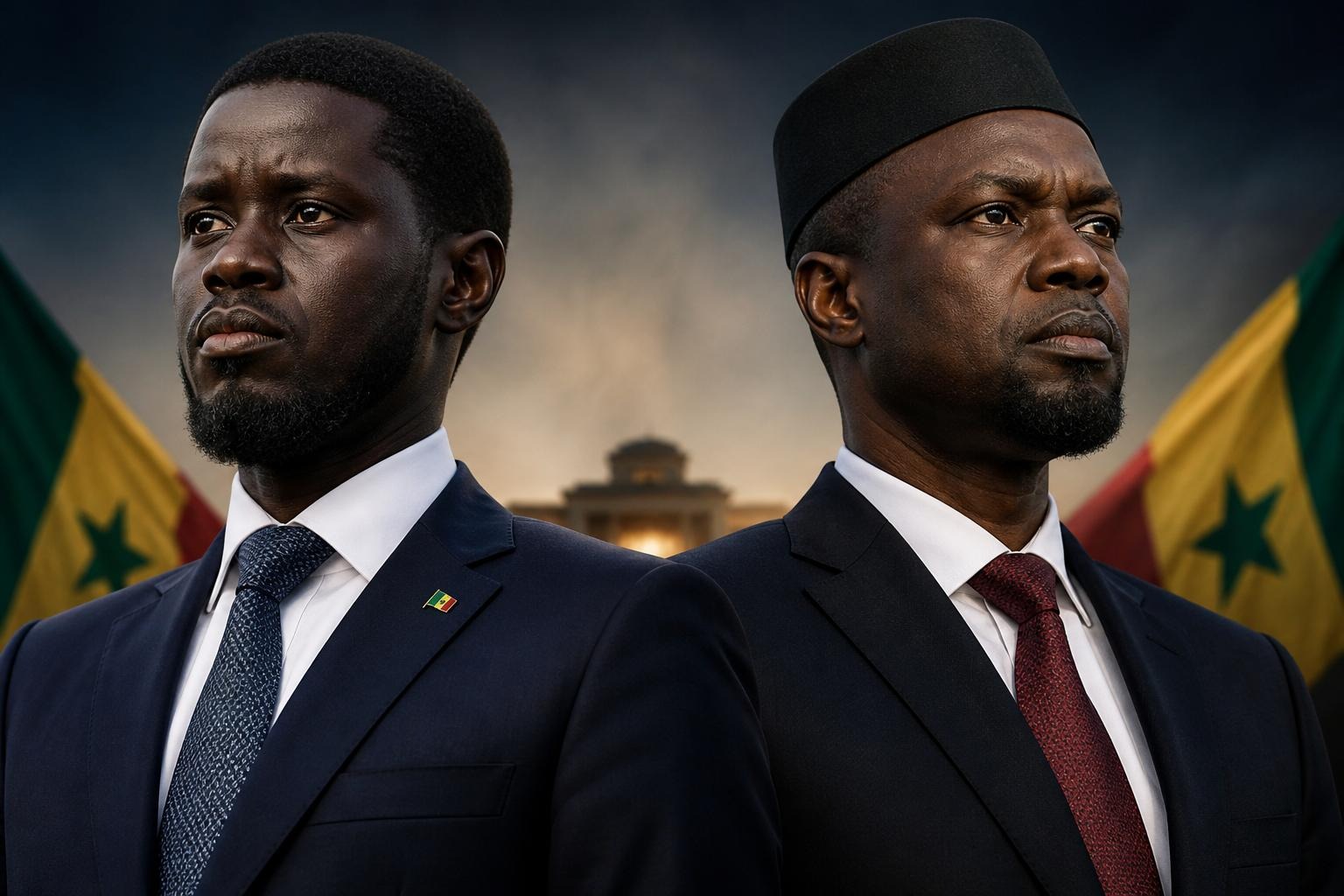
The initial period of political harmony at the apex of the Senegalese state appears to be giving way to a more demanding pragmatic reality. A pivotal moment in the relationship between President Bassirou Diomaye Faye and his Prime Minister, Ousmane Sonko, unfolded over the weekend of May 2-3, 2026. By publicly acknowledging disagreements with the Pastef party and declaring himself “ready for separation” if national interests demanded it, the head of state shattered the illusion of an unbreakable partnership. As presidential assertion meets party loyalty, Sénégal holds its breath, witnessing what appears to be the dawn of an unprecedented political reconfiguration.
A weekend of defining moments
A brief comment, made during an interview with the national press, sparked a media frenzy. Until this point, the official narrative had consistently portrayed a united front, a “duo” where the political mentor and his protégé advanced in unison towards a promised transformation. However, the tone has now dramatically shifted.
When questioned about the increasing friction between the government’s direction and the sometimes forceful pronouncements from Pastef officials, President Faye displayed unexpected resolve. He underscored his official detachment from the party, emphasizing his role as president for all Senegalese citizens. His statement resonated like a political bombshell across Dakar’s political scene when he affirmed his complete loyalty to the national project, but stressed that his ultimate responsibility lay with the people. By clarifying that he would not hesitate to formalize a separation if party agendas conflicted with his vision for the state, he unequivocally asserted his authority.
Ousmane Sonko’s shadow: a pervasive prime minister
To grasp the depth of this tension, one must consider the origins of this administration. Elected under the banner that voting for Diomaye was synonymous with choosing Sonko, the president has long had to navigate the pervasive media presence of his Prime Minister. The charismatic leader of Pastef never truly shed his role as party chief, frequently holding rallies and making direct public statements that sometimes seemed to bypass official communication from the Presidential Palace.
For several months, strategic divergences have surfaced concerning sensitive issues. The management of national debt and relations with international institutions exemplify this disparity, with the Prime Minister advocating for radical changes while the President adopted a more diplomatic and pragmatic approach. Similarly, the question of appointments created unrest, caught between the presidential desire to appoint technocrats and party pressure to place loyal early supporters. Furthermore, the contrast between Ousmane Sonko’s assertive style and the composed dignity Bassirou Diomaye Faye seeks to project has become conspicuously evident.
Is a separation now inevitable?
To suggest an immediate separation would likely be premature, but it is now an acknowledged political possibility. The president seems to have understood that to leave a lasting legacy, he must establish his own independent standing. Within the Prime Minister’s inner circle, there have been attempts to downplay these remarks as merely a division of responsibilities, yet the presidential message hints at a deeper reality. By expressing readiness for a break, the head of state sends an unequivocal signal to his own base: the presidential institution will not be beholden to any special interest group.
This situation places Sénégal in a period of institutional ambiguity. The nation has experienced turbulent executive partnerships in the past, and many now fear potential government gridlock. Should a separation occur, the president would face the challenge of governing without the full support of Pastef’s militant machinery, compelling him to forge new alliances or govern through executive orders.
The stakes of presidential autonomy
The challenge for Bassirou Diomaye Faye is twofold: to assure international partners of the country’s stability while demonstrating to citizens that he maintains firm control. Public sentiment is currently split. A segment of the youth, remaining loyal to Ousmane Sonko’s charisma, might perceive this assertion of independence as a form of betrayal. Conversely, a more constitutionally-minded portion of the population applauds the awakening of a president who is finally embracing the full scope of his sovereign duties.
The president is currently engaged in an intricate political game. He must assert his authority without precipitating a major social crisis that his opponents could exploit. The question is no longer about the personal rapport between the two men, but whether the governmental structure can sustainably support two centers of power.
As observers of the political scene, we are witnessing the end of a certain idealism. Politics is not about camaraderie but about the exercise of power. Bassirou Diomaye Faye has reiterated that the Constitution bestows upon him prerogatives he is now determined to wield independently. The tandem served as an instrument for ascendancy; it now appears to be an impediment to effective governance. Sénégal is entering a mature phase where the state must take precedence over the party, and the president has just clearly delineated that boundary.