
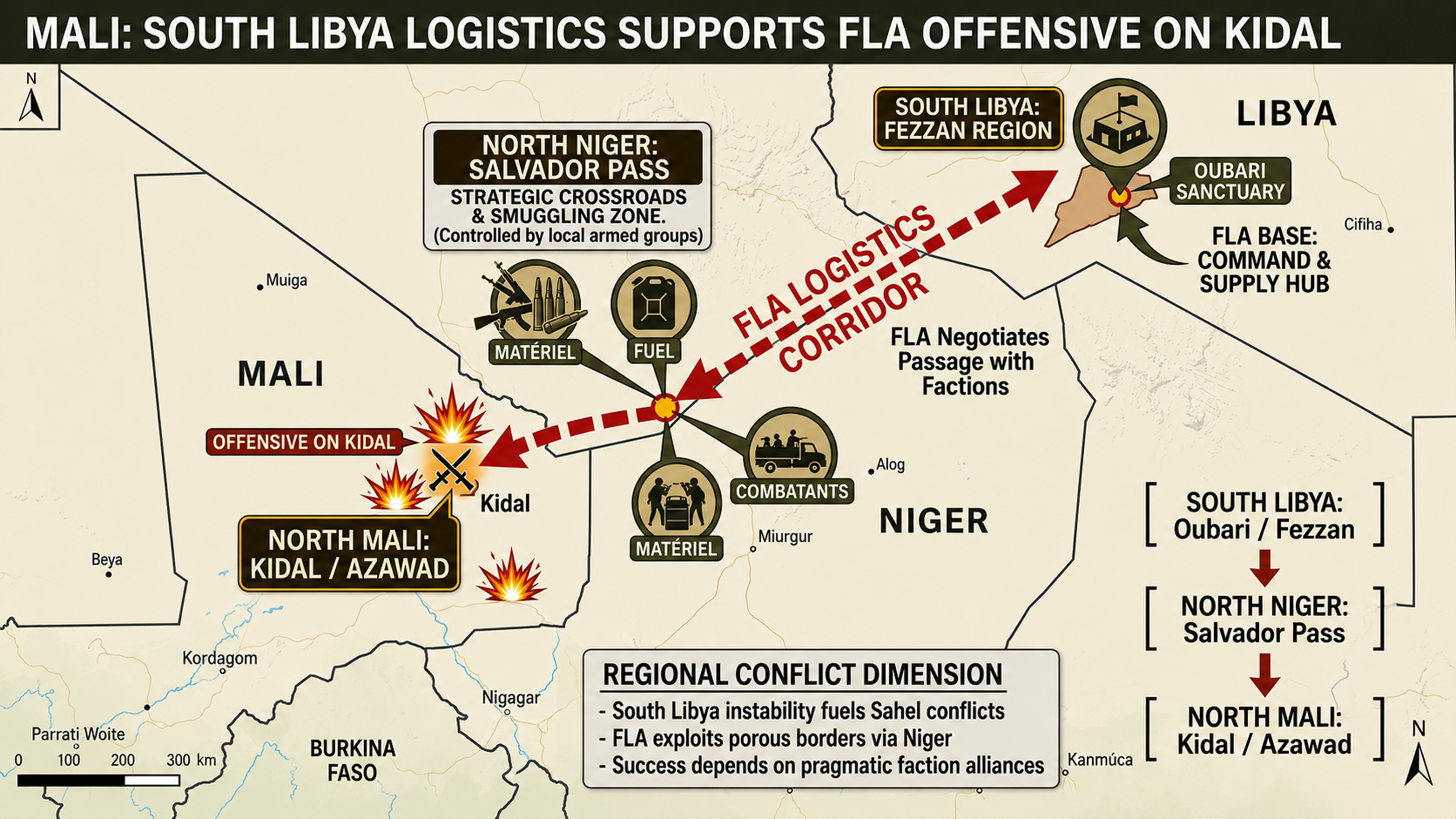
The recent military campaign launched by Tuareg rebels in Northern Mali has revealed a sophisticated logistical network spanning Libya, Niger, and Mali, with Southern Libya serving as a critical operational hub.
Within the fluid security landscape of the Sahel, Southern Libya has once again emerged as a pivotal nexus for rebel activities. According to field observations, Tuareg fighters from the Azawad Liberation Front (ALF) have leveraged Libyan territory as a strategic rear base to organize and execute their large-scale offensive, initiated on April 25, aimed at reclaiming control over Kidal.
Fezzan and Ubari: the logistical backbone of rebel operations
The Fezzan region, renowned for its porous terrain in Southern Libya, has become the focal point of this clandestine infrastructure. Rebel command centers and supply depots are reportedly concentrated near the town of Ubari. Far from being a passive refuge, this area functions as the nerve center for planning, coordinating, and sustaining military operations in Northern Mali.
The ‘Salvador Pass’: a transit artery for illicit movements
To deploy forces and equipment across the Malian border, the rebels depend on a highly strategic transnational route. This corridor forms a continuous link between Southern Libya and Northern Mali, cutting through Nigerien territory along the way.
At the heart of this network lies the ‘Salvador Pass’, a remote desert crossing in Northern Niger. This infamous junction is notorious for its role as a smuggling hub, used by armed factions and illicit networks trafficking weapons, narcotics, and fuel.
The offensive has underscored the pass’s dual significance, facilitating:
- Military logistics: movement of arms, ammunition, and essential supplies;
- Fuel supply: critical for sustaining the mobility of armed convoys in harsh desert conditions;
- Troop movements: allowing fighters to advance toward Kidal before retreating to Libyan territory post-combat.
Niger: a contested transit zone under armed control
The utilization of this corridor highlights the intricate web of regional alliances. The Nigerien segment of the route falls under the influence of multiple armed groups, preventing unilateral operations by the ALF.
To secure passage for troops and convoys, the Tuareg rebellion has been compelled to negotiate transit rights with these local factions, which exert control over Northern Niger. This pragmatic compromise underscores how the success of Sahelian offensives now hinges on negotiated agreements among interconnected armed actors across borders.
As the battle for Kidal intensifies, these developments confirm the deeply regionalized nature of the conflict, with Libyan instability continuing to reverberate across Sahelian hotspots.