
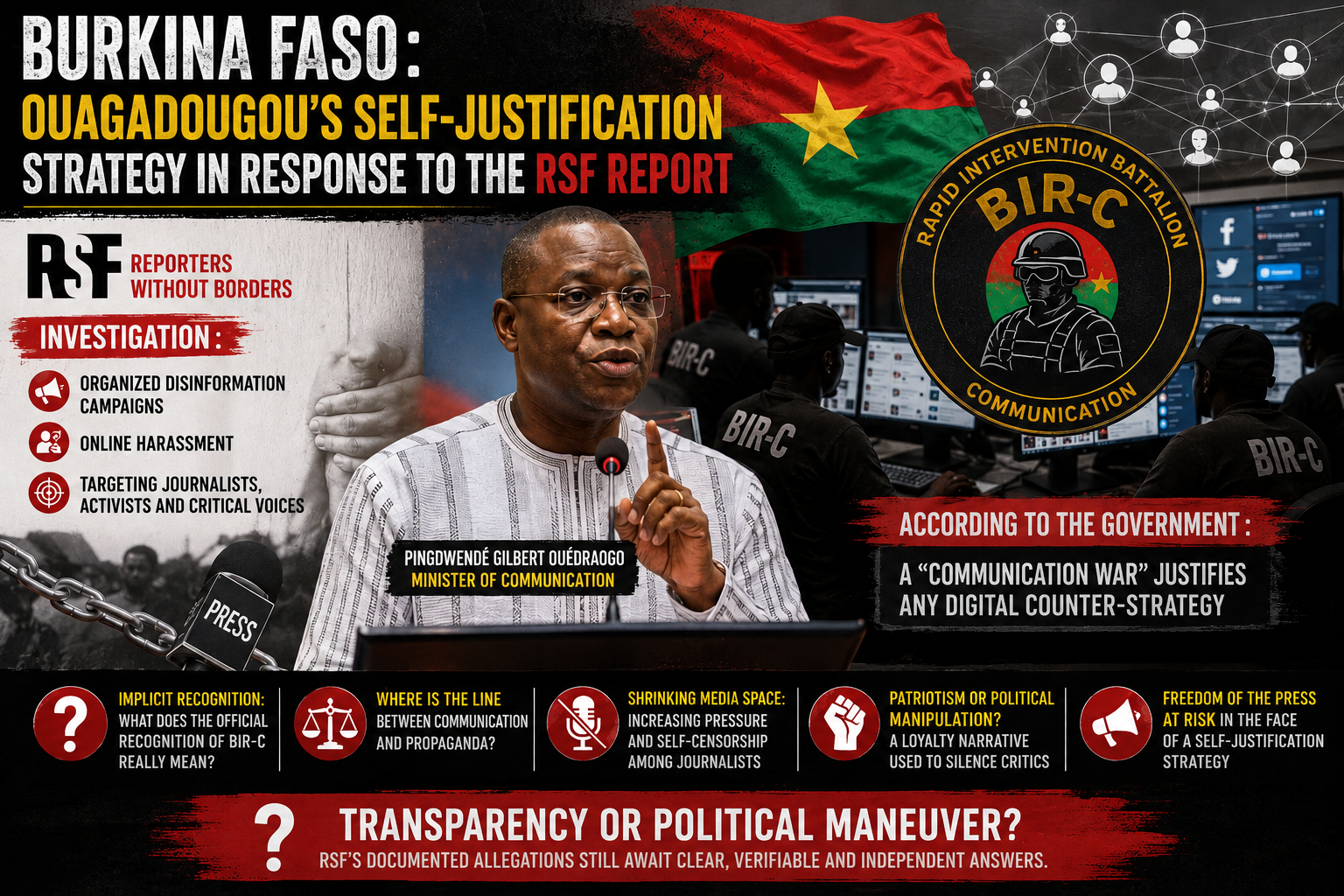
On August 3, during Ouagadougou’s national flag-raising ceremony, Burkina Faso’s Communication Minister Pingdwendé Gilbert Ouédraogo delivered a response to allegations brought forth by Reporters Without Borders (RSF), but instead of offering transparency, his remarks seemed to prioritize self-defense. By publicly commending the Rapid Intervention Battalion for Communication (BIR-C) as a protective measure against misinformation, the minister inadvertently amplified doubts rather than dispelling them.
Government acknowledgment of a controversial structure
The authorities’ endorsement of the BIR-C signals a rare admission of its existence and function within Burkina Faso’s online information landscape. This admission follows an RSF investigation that exposed a coordinated network allegedly engaged in disinformation campaigns, targeted harassment of journalists, activists, and critics of the military-led transition. Rather than conducting an independent review or dismantling these accusations through rigorous rebuttal, the government chose to publicly legitimize the BIR-C, deepening suspicions about its actual role.
Documented disinformation tactics and official dismissal
The RSF report outlines a well-orchestrated operation utilizing mobilized social media accounts to promote specific narratives, undermine dissenting voices, and exert relentless pressure on media professionals. Despite the detailed evidence presented, the Burkinabe government has opted to defend the BIR-C in public statements rather than addressing the allegations directly. This strategy has intensified debates regarding the fine line between legitimate state communication and state-sponsored propaganda.
A contested narrative of external threats
Official rhetoric frames Burkina Faso as a victim of a ‘communication war’ allegedly orchestrated by external actors aiming to destabilize the country. Within this narrative, any digital initiative designed to counter misinformation is framed as a patriotic duty. However, this logic raises a fundamental question: where does legitimate crisis communication end, and where does the suppression of diverse viewpoints begin?
The delicate balance between security and press freedom
While combating disinformation is a legitimate priority for states navigating political and security challenges, international standards on freedom of expression strictly forbid harassment, smear campaigns, or intimidation of journalists. When dissent is consistently labeled as treason against the nation, public discourse risks being stifled by widespread self-censorship.
This controversy emerges against a backdrop of suspended international news outlets, escalating pressure on local journalists, and a progressively constrained media environment. Observers argue that these conditions create an atmosphere where information professionals feel compelled to censor themselves to avoid reprisals. In this context, the presence of an organized digital communication structure—particularly if its operations extend beyond mere government messaging—brings into sharp focus the need to reconcile national security imperatives with the preservation of fundamental freedoms.
Patriotism as a deflection tactic
The Communication Minister’s strategy appears to be less about transparency and more about political counterattack. By framing the BIR-C’s actions as inherently patriotic, authorities shift the discourse from factual examination to blind allegiance. This approach effectively recasts criticism as attacks on the nation itself, diverting attention away from pressing concerns about operational transparency and accountability.
The imperative of scrutiny in democratic governance
A democracy confronting severe security threats must also demonstrate its ability to withstand scrutiny from the press and human rights organizations. Responding to an investigation by publicly endorsing the implicated structure does little to alleviate doubts—it may instead imply tacit political support for its integration into the government’s communication framework.
Broader implications for Burkina Faso’s digital governance
The implications of this case extend far beyond the BIR-C. They touch on how Burkina Faso manages information in the digital age. As social media evolves into a critical arena for political contestation, state-aligned structures must operate within transparent, rights-respecting frameworks that uphold press freedom and freedom of expression.
At its core, this episode underscores a strategic political decision: to counter criticism with patriotic mobilization rather than engage in open debate or factual resolution. Unless the documented allegations are met with precise, verifiable, and independent counterarguments, official statements risk being perceived not as denials, but as attempts to justify a communication system whose methods continue to raise serious questions about press freedom in Burkina Faso.