

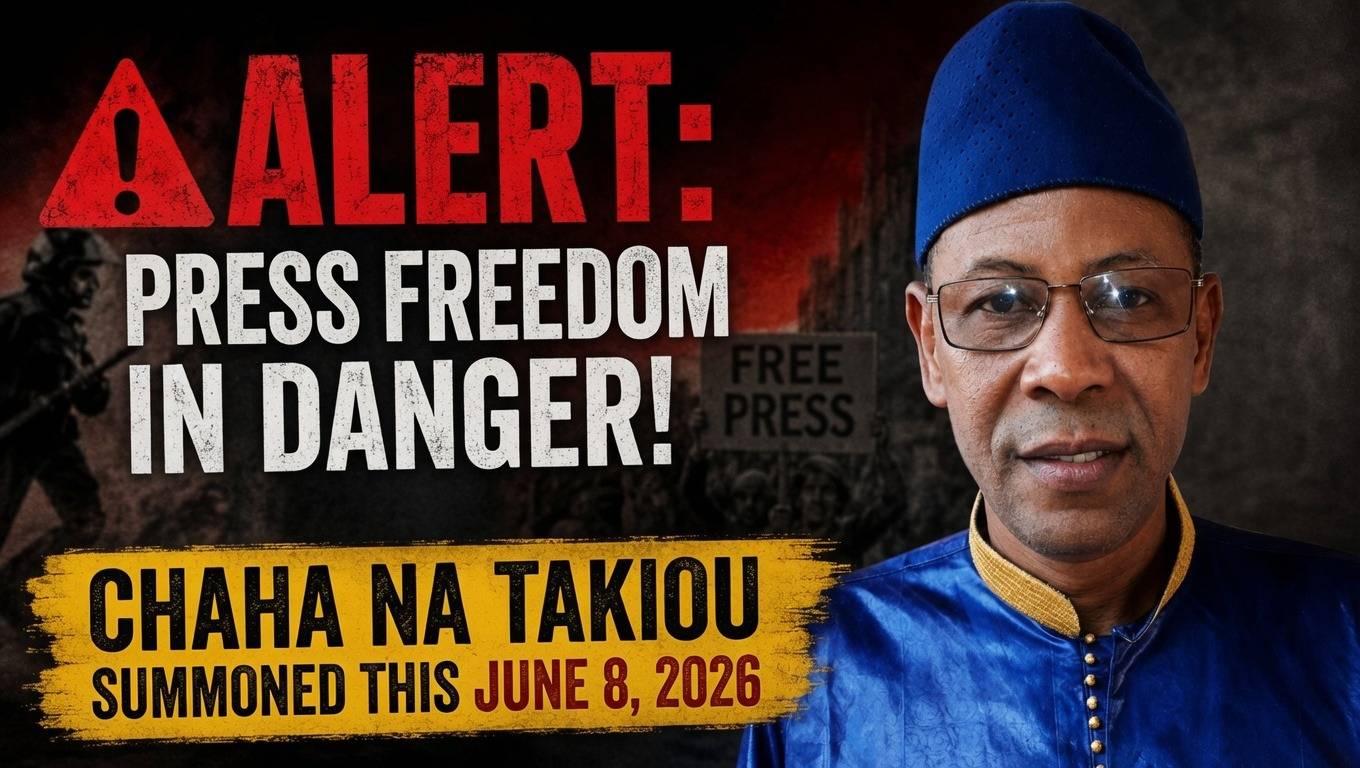
Chahana Takiou, the publishing director for Le 22 Septembre newspaper, received a summons to appear before the public prosecutor of Bamako’s cybercrime unit on Monday, June 8, 2026, at 1 p.m. This summons follows his recent public critiques of Mali’s ruling military junta. The incident starkly highlights the ongoing systematic repression and judicial harassment targeting dissenting voices, journalists, and citizens who refuse to align with the official narrative of the transitional authorities.
High-stakes summons at the cybercrime division
The news resonated like a shockwave throughout Mali’s media landscape. Chahana Takiou, a respected figure in national journalism and leader of the weekly publication Le 22 Septembre, is now compelled to face investigators specializing in cybercrime. For his peers, the true motivation behind this summons is clear: his recent outspoken analyses, which unsparingly scrutinized the political, security, and economic governance under the military transition.
In Mali, the cybercrime unit has, over recent months, evolved into a primary instrument of power for neutralizing critical discourse. Ostensibly tasked with combating online misconduct, the judiciary frequently employs it to intimidate media professionals. For Chahana Takiou, the diligent practice of his journalistic profession now translates into a high-risk judicial encounter.
Press freedom sacrificed for a singular narrative
Since the military junta’s ascent, the public sphere in Mali has progressively constricted. Press freedom, once a source of pride for Malian democracy, has become a distant memory. Information professionals now operate in an environment permeated by fear and self-censorship. Reporting impartially and independently has transformed into an act of courage, even risking charges of lèse-majesté.
The junta demands absolute adherence to its narrative. Media outlets that decline to disseminate official propaganda or attempt to raise legitimate questions about the nation’s future are immediately targeted. Suspensions of both national and international media, formal notices from the High Authority of Communication (HAC), and administrative harassment are daily realities for a Malian press stifled both financially and morally.
Repression and abductions: a strategy of terror
The relentless pursuit of Chahana Takiou is not an isolated incident; it forms part of a broader repressive strategy orchestrated by the transitional authorities. Anyone daring to express a divergent opinion—be it a politician, civil society leader, human rights defender, or an ordinary citizen on social media—risks severe repercussions.
Even more disturbingly, the junta’s methods have escalated to a darker level. Beyond formal judicial summons, the country is witnessing a surge in abductions and enforced disappearances. Citizens are being apprehended by unidentified armed individuals, often believed to be linked to intelligence services, and held incommunicado for weeks. This policy of terror aims to paralyze any capacity for public dissent and impose an absolute silence across the entire territory.
A supportive but vulnerable media community
In response to the summons issued to Le 22 Septembre‘s publishing director, solidarity is emerging among professional press organizations in Mali. Calls for vigilance and support were issued immediately upon the news. However, this solidarity confronts the formidable power of a militarized state apparatus, where fundamental constitutional and judicial guarantees are increasingly disregarded.
Journalist unions consistently reiterate that constructive criticism is vital for the nation’s survival, especially during times of crisis. Yet, for the current power holders in Bamako, any critique is equated with betrayal or an attempt to destabilize, thereby closing the door to any pluralistic democratic debate.
Chahana Takiou’s convocation on June 8, 2026, marks another alarming milestone in the Malian junta’s authoritarian drift. By targeting a journalist of his caliber, the transitional government sends a clear and direct message: no discordant voice will be tolerated.
This obsessive pursuit of unanimity, achieved through force, imprisonment, and intimidation, further isolates Mali each day and erodes its internal cohesion. As the nation grapples with immense security and humanitarian challenges, silencing those who seek the truth will not resolve the country’s deep-seated crises. More than ever, the future of independent journalism and citizen liberties in Mali hangs in the balance within the courtrooms of Bamako.