
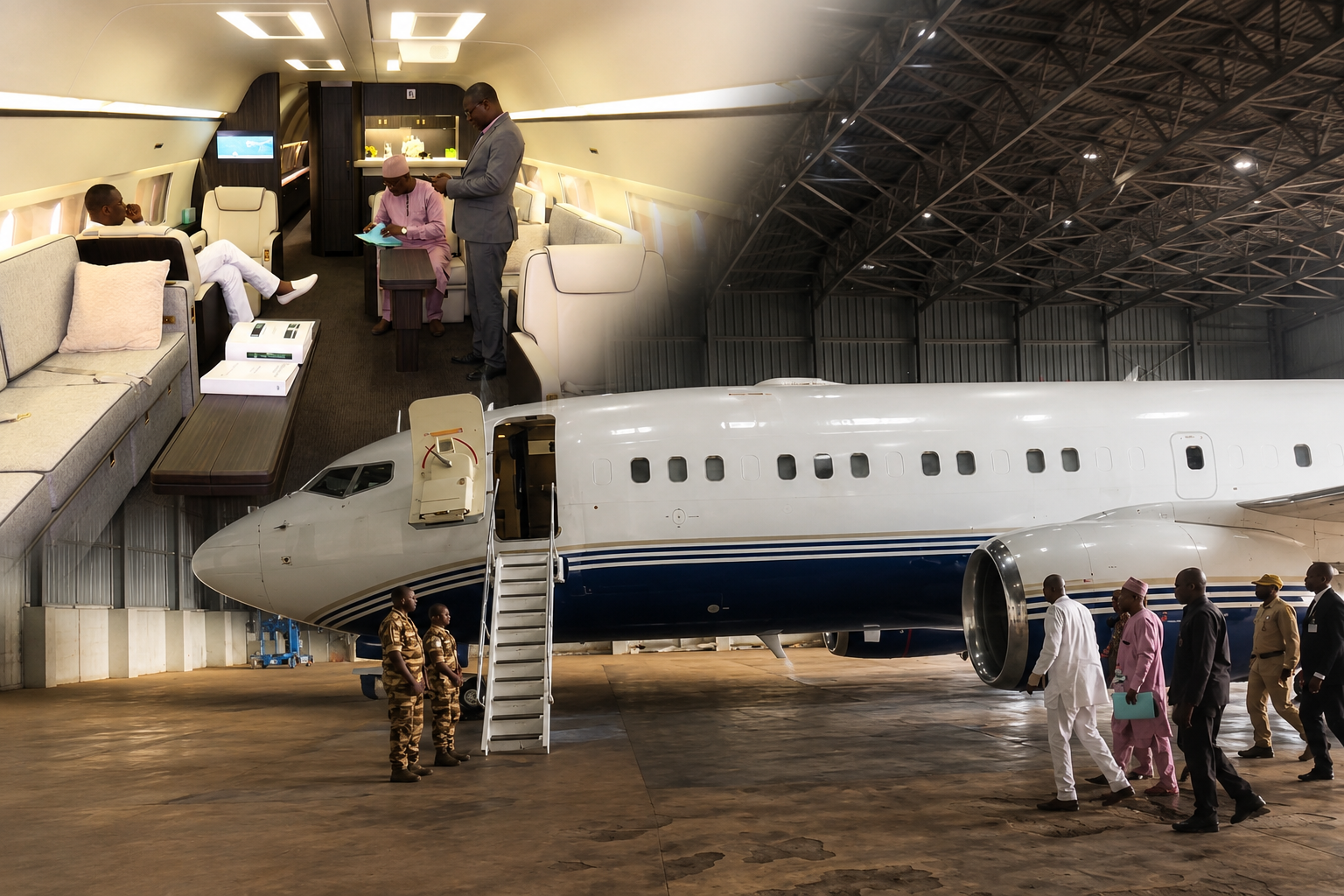
An acquisition that raises questions
On Wednesday evening, viewers of the national broadcaster witnessed the unveiling of Mali’s latest presidential aircraft: a Boeing 737 destined for the official travels of Colonel Assimi Goïta and senior regime officials. Authorities framed the purchase as a financially sound decision, asserting that the gross cost of 15.6 billion West African CFA francs would be reduced to around 6 billion thanks to insurance payouts and the resale of components from the previous aircraft.
A timing that defies ground realities
Yet the timing of this announcement has drawn sharp criticism. In a nation grappling with persistent insecurity, economic strain, and mounting public financial pressures, the unveiling of a state-of-the-art presidential jet has fueled concerns about the alignment of government priorities with the nation’s most pressing needs.
The timing could hardly be more discordant. As authorities call for national sacrifice and resilience, the display of a gleaming new aircraft risks reinforcing perceptions of a leadership more concerned with prestige than with the immediate welfare of its people.
Security challenges remain unaddressed
Three years into the Transition, Mali continues to confront severe security challenges. In the northern regions, coalitions such as the Cadre stratégique permanent, including the Front de Libération de l’Azawad (FLA), maintain significant operational capacity and contest control over key areas. Meanwhile, in central and southern Mali, the Jama’at Nusrat al-Islam wal Muslimin (JNIM) has steadily expanded its influence, mounting frequent attacks on military positions, infrastructure, and state representatives. Several critical roadways remain hazardous, disrupting commerce, transport, and economic activity.
This stark reality stands in sharp contrast to the image of strength and stability the government seeks to project.
Budgetary choices under scrutiny
While officials emphasize the financial prudence of the acquisition, critics argue that billions of West African CFA francs could have been redirected toward more urgent priorities:
- Bolstering the operational readiness of Malian armed forces;
- Procuring armored vehicles, communications equipment, and protective gear;
- Enhancing intelligence and aerial surveillance capabilities;
- Providing medical care and support for wounded soldiers and the families of fallen servicemembers;
- Assisting internally displaced persons and funding the reconstruction of war-damaged infrastructure.
The debate transcends mere accounting—it questions the very hierarchy of national priorities.
A challenged narrative of frugality
The Transition leadership has cultivated its legitimacy partly through a discourse of austerity, promising governance rooted in national interest rather than personal aggrandizement. Yet the acquisition of a large-capacity presidential jet undermines this message. For many citizens, the move signals a return to the very practices of ostentatious spending that previous administrations were criticized for.
The contrast is particularly glaring in light of ongoing economic hardships: soaring living costs, strained public finances, pressing social needs, and sluggish economic activity across multiple sectors.
Diplomatic utility, but at what cost?
Proponents argue that a modern presidential aircraft enhances Mali’s diplomatic mobility, facilitating official missions and international representation. However, skeptics contend that a nation’s credibility on the global stage is measured first by internal stability, the security of its citizens, and the effective functioning of its institutions—not by the sophistication of its presidential fleet.
For many Malians, true sovereignty is not reflected in the grandeur of state aircraft, but in the government’s ability to secure its territory, restore state authority, and improve daily living conditions for its people.
A decision that fuels political skepticism
Within critical circles and opposition ranks, the acquisition has given rise to broader interpretations. Some view it as emblematic of a leadership that prioritizes its own mobility over that of the state. Others speculate—though without substantiation—that such an aircraft could serve as a critical escape route for top officials in the event of escalating insecurity.
Regardless of its veracity, such speculation underscores the deepening climate of distrust surrounding government decisions.
Reassessing the Transition’s strategic direction
The arrival of the Boeing 737 is more than a procurement decision—it is a catalyst for reflection on the Transition’s broader strategic choices. As security challenges persist, attacks continue unabated, and economic hardship deepens, every expenditure perceived as symbolic is subjected to intense scrutiny.
For a growing number of Malians, genuine sovereignty lies not in the modernization of presidential transport, but in the state’s capacity to protect its citizens, assert control over its territory, and tangibly improve the lives of its people. Until these fundamental goals are met, investments in prestige risk appearing increasingly disconnected from the needs and expectations of the population.