
The Malian junta’s decision to invite Russian mercenaries in 2021 has backfired spectacularly, as analysts warn the strategy allowed jihadist groups to consolidate power and cripple the nation’s economy with crippling blockades.
While the ruling military council focused on crushing Tuareg rebels in the North, the Group for the Support of Islam and Muslims (GSIM) and the Islamic State in the Greater Sahara exploited the void, expanding their influence from the desert’s fringes to the very gates of Bamako. The junta’s heavy-handed tactics—marked by mass arrests and executions targeting entire ethnic communities—only fueled recruitment for these extremist factions.
From counterterrorism to self-inflicted crises
Analyst Wassim Nasr, who has closely monitored Mali’s security crisis, explains the miscalculation: “While the junta diverted resources to quash local insurgencies in remote desert towns, GSIM militants grew bolder in the capital’s outskirts, weaponizing propaganda and recruitment.”
The junta’s shift in strategy in January 2024—abandoning the Algiers Accords peace deal with the Azavad Liberation Front (FLA)—exacerbated the crisis. Just months earlier, Malian forces, backed by Wagner Group mercenaries, had reclaimed the Tuareg stronghold of Kidal. Yet this victory proved hollow, as jihadist factions tightened their grip on central Mali, strangling supply routes from Senegal and Côte d’Ivoire into the country.
A Faustian bargain with Wagner’s successors
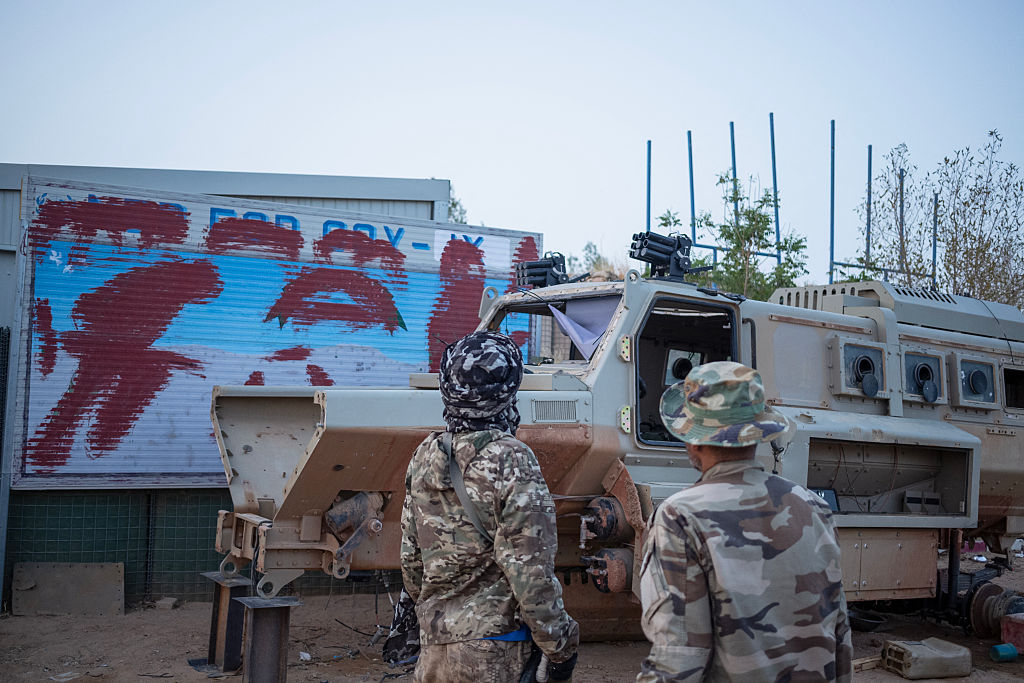
The junta’s turn to Russian mercenaries followed its rupture with France in 2022, ending a decade of Barkhane and Serval operations that had helped stabilize the North and lay the groundwork for the Algiers Accords. By late 2023, the junta expelled the UN MINUSMA peacekeeping mission, replacing it with a brutal campaign led by Wagner—now rebranded as the Africa Corps—and Malian troops.
The deadliest episode came in early 2024, when Wagner fighters executed hundreds of Fulani civilians in Moura, central Mali, sparking outrage and accelerating civilian defections to GSIM, ISGS, and the FLA. The junta’s failure to deliver governance—no schools, no roads, only anti-Western rhetoric—further eroded public trust.
Nasr highlights the junta’s predicament: “Their only project is hatred—hatred for France, hatred for the West. They offer nothing to the people.”
Mercenary retreat and jihadist triumph
By July 2024, the Africa Corps’ retreat became irreversible after a devastating ambush in Tin Zaouatine, where Tuareg fighters decimated a joint Malian-Africa Corps column, killing nearly 50 soldiers and over 80 mercenaries. “That was the moment Wagner ceased to be Wagner,” Nasr notes. Within weeks, the group announced its withdrawal, replaced by the Africa Corps—a rebranded force still manned by many of Wagner’s veterans.
As the FLA and GSIM tighten their stranglehold on central Mali, the junta’s financial support for the Africa Corps—estimated at $10 million monthly—has yielded diminishing returns. The mercenaries now operate from fortified bases, relying on drones to guide Malian patrols, wary of venturing into hostile territory.
The Africa Corps’ reluctance to engage proved fatal in late April 2024, when a combined GSIM-FLA assault on Kidal overwhelmed Malian defenses. The mercenaries fled, and the city fell to the FLA. Hours later, a separate attack claimed the life of Mali’s Defense Minister.
With the Africa Corps now prioritizing the junta’s survival over counterterrorism, GSIM’s influence radiates outward from Bamako. The group controls critical supply lines, including fuel routes to the capital’s international airport. The junta, isolated and desperate, clings to the mercenaries as its last lifeline.
Nasr concludes: “They have no choice. They’re opposed on all sides, trapped in a corner. They keep paying because the Africa Corps is their lifeline—one they can no longer afford to lose.”