
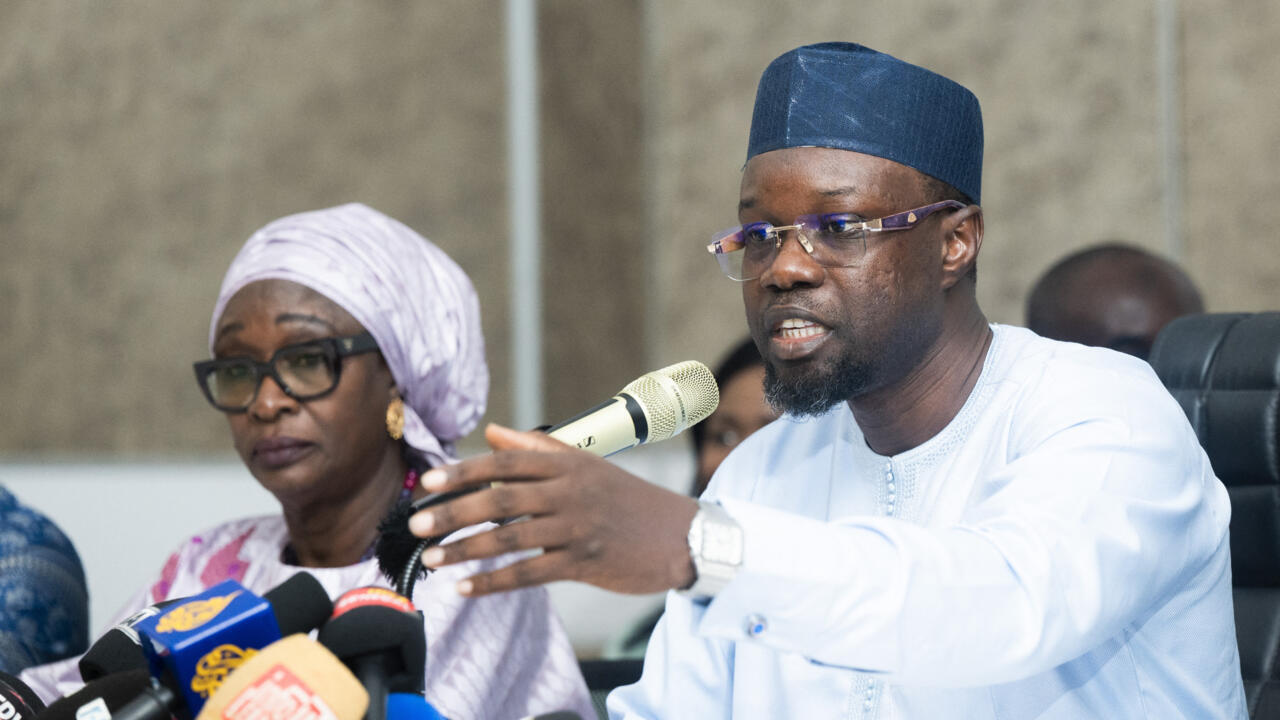
Dakar — A week after his dismissal from office, former Prime Minister and Pastef leader Ousmane Sonko has launched a sharp counterattack against President Bassirou Diomaye Faye. Addressing the press in Dakar on Tuesday, Sonko did not mince his words, criticizing the new government’s composition and casting doubt on its legitimacy.
According to reports from local media, Sonko warned that while he does not seek to destabilize state institutions, his party’s parliamentary majority could trigger a no-confidence motion to topple the administration. He claimed he had alerted the president months ago about the risks of such a scenario, but his concerns went unheeded.
Mounting criticism of the government’s legitimacy
In a fiery address, Sonko dismissed the government’s claims of legitimacy, calling it a collection of technocrats without political backing. “We have a government that lacks fundamental political support,” he declared. “The so-called coalition they keep mentioning holds no real power. Turning to technocrats is just an admission of political isolation.” He emphasized that Pastef, as the country’s leading political force, retains sole claim to popular legitimacy, insisting that governing without the party is tantamount to ruling without the people.
a fragile presidency
The president’s position now appears precarious, as analysts highlight the absence of Pastef from the government as a major political liability. With 130 of the 165 parliamentary seats under its control, the party’s exclusion creates a dangerous void that could undermine governance.
Experts argue that while the constitution grants President Faye authority, the success of his agenda hinges on maintaining trust with Pastef lawmakers. Without their cooperation, advancing key reforms and passing legislation could prove impossible. The government’s technocratic label, they say, masks its vulnerability—a leadership without a solid political base.
Some commentators describe the situation not as a traditional cohabitation but as a deeper rift within the ruling movement itself. “This is not a standard cohabitation between opposing forces,” noted political observers. “It is a rupture within the same political family—a president and a party controlling an absolute majority in parliament that refuses to participate in government.”
With Pastef mobilizing a million-strong grassroots network, the stakes are high. Can a technocratic-led government govern effectively without the support of the party that won the election? The answer may unfold in the coming weeks and months, not just in parliament but in the streets and corridors of power.
the battle for political narrative
Analysts point out that the president has strayed from the political narrative that propelled him to office. Once rooted in a movement with deep societal ties, Faye now governs in a vacuum—legitimate by law but disconnected from the historical and popular foundations that once defined his rise.
“He erased the memory of what brought him to power,” wrote one analyst. “Now he governs in an abstract space—legitimate constitutionally, but narratively orphaned.” Meanwhile, Ousmane Sonko remains a powerful voice in the National Assembly, with 130 deputies, his historical memory intact, and his popular mandate unchallenged. He is not just an opponent; he is the guardian of the original political story. At any moment, he can remind everyone: *We were here first, and we will remain.*”