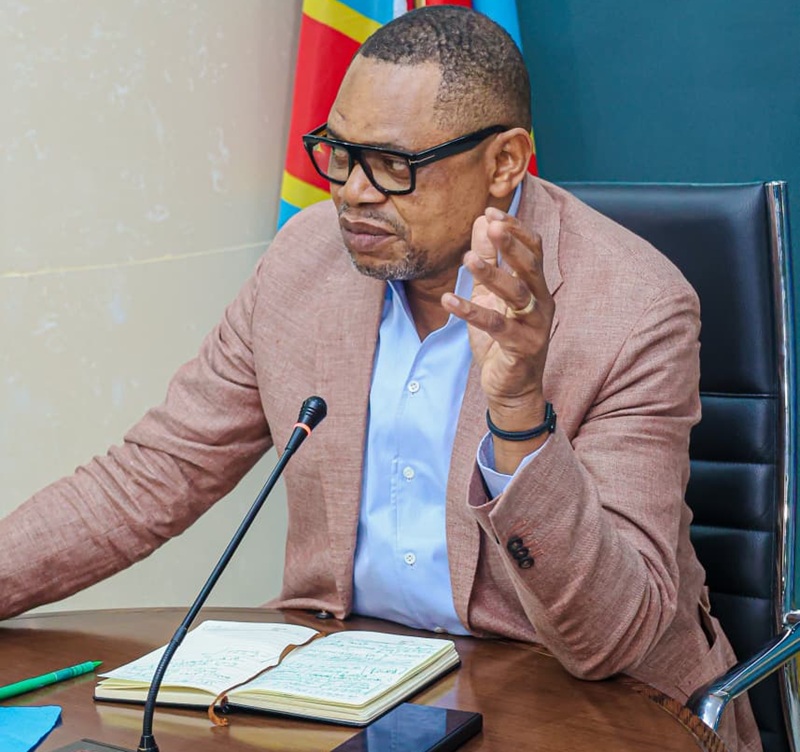
« Musuminyina katu wabula », a Luba proverb meaning “he who perseveres always achieves his goal,” perfectly describes the current mindset of José Mpanda Kabangu. The Minister of Posts and Telecommunications is resolute in his mission to secure a sovereign satellite for the RDC—a vision he has championed since his tenure at the Ministry of Scientific Research and Technological Innovation began in September 2019.
In a decisive move toward realizing this strategic objective, José Mpanda Kabangu hosted a delegation from the Chinese firms China Unicom and Genew Technologies on Friday, June 5. The discussions centered on the construction of the national satellite and the extensive rollout of fiber optics across the entire country. This meeting follows the minister’s diplomatic mission to China this past April.
The audience was not limited to international partners; it brought together a wide array of local expertise. Participants included specialists from the General Secretariat of PTNTIC, the Regulatory Authority for Post and Telecommunications of Congo (ARPTC), the Congolese Fiber Company (SOCOF), the National Satellite Telecommunications Network (RENATELSAT), and the National Remote Sensing Center (CNT). Senior advisors from both the Presidency and the Prime Minister’s office in charge of PTNTIC were also present to ensure high-level coordination.
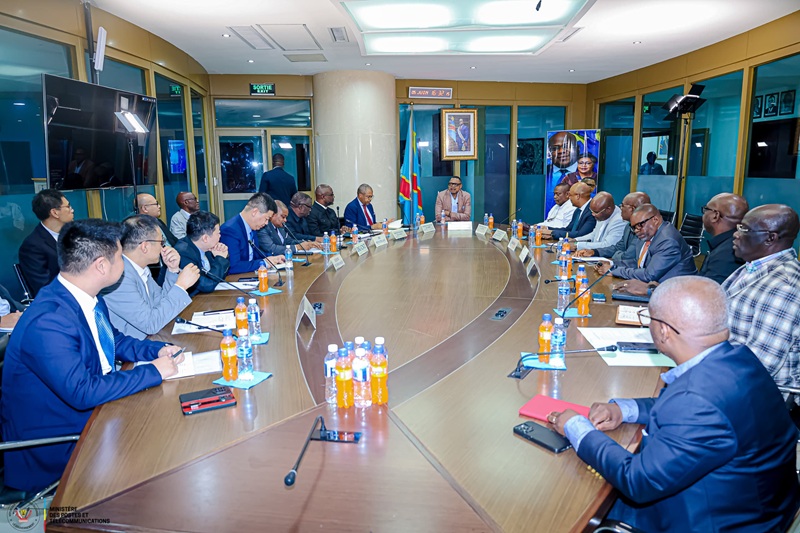
Minister José Mpanda emphasized that while his trip to China was a political search for solutions, the technical depth of the project must be handled by industry professionals. This explains the presence of the Chinese executives in Kinshasa, where they will remain until June 19 to collaborate with Congolese experts. Their focus is on two structural pillars: the sovereign satellite project, for which a Memorandum of Understanding was signed in April, and the national fiber optic backbone, following the 2025 revision of existing agreements.
The working sessions, which commenced on Monday, June 8, are designed to achieve three primary goals:
1. Technical and Financial Structuring
The teams aim to validate the technical architecture of both initiatives, calculate estimated costs, and establish financing frameworks in collaboration with the Ministries of Planning and Finance.
2. Institutional Alignment and Consultation
The Chinese firms must formally present their proposals to all stakeholders, including RENATELSAT, SCPT, SOCOF, CNC, CNT, ARPTC, and the executive offices of the Presidency and Prime Minister.
3. Preparation for Due Diligence in China
This involves setting the scope and timeline for upcoming inspections, identifying the Congolese delegates, selecting sites for visitation, and preparing necessary documentation before departure.
Minister José Mpanda expects these discussions to yield four key outcomes: validated technical solutions, a finalized financing strategy, full alignment among all stakeholders, and a detailed schedule for the due diligence mission.
The multi-sectoral nature of this project is reflected in the involvement of several Congolese institutions, including the Ministries of Planning, Finance, Infrastructure, and Mines, as well as the National Cyberdefense Council (CNC). Technical support is provided by the PTNTIC General Secretariat, ARPTC, FDSU, SOCOF, SCPT, RENATELSAT, and the CNT.