
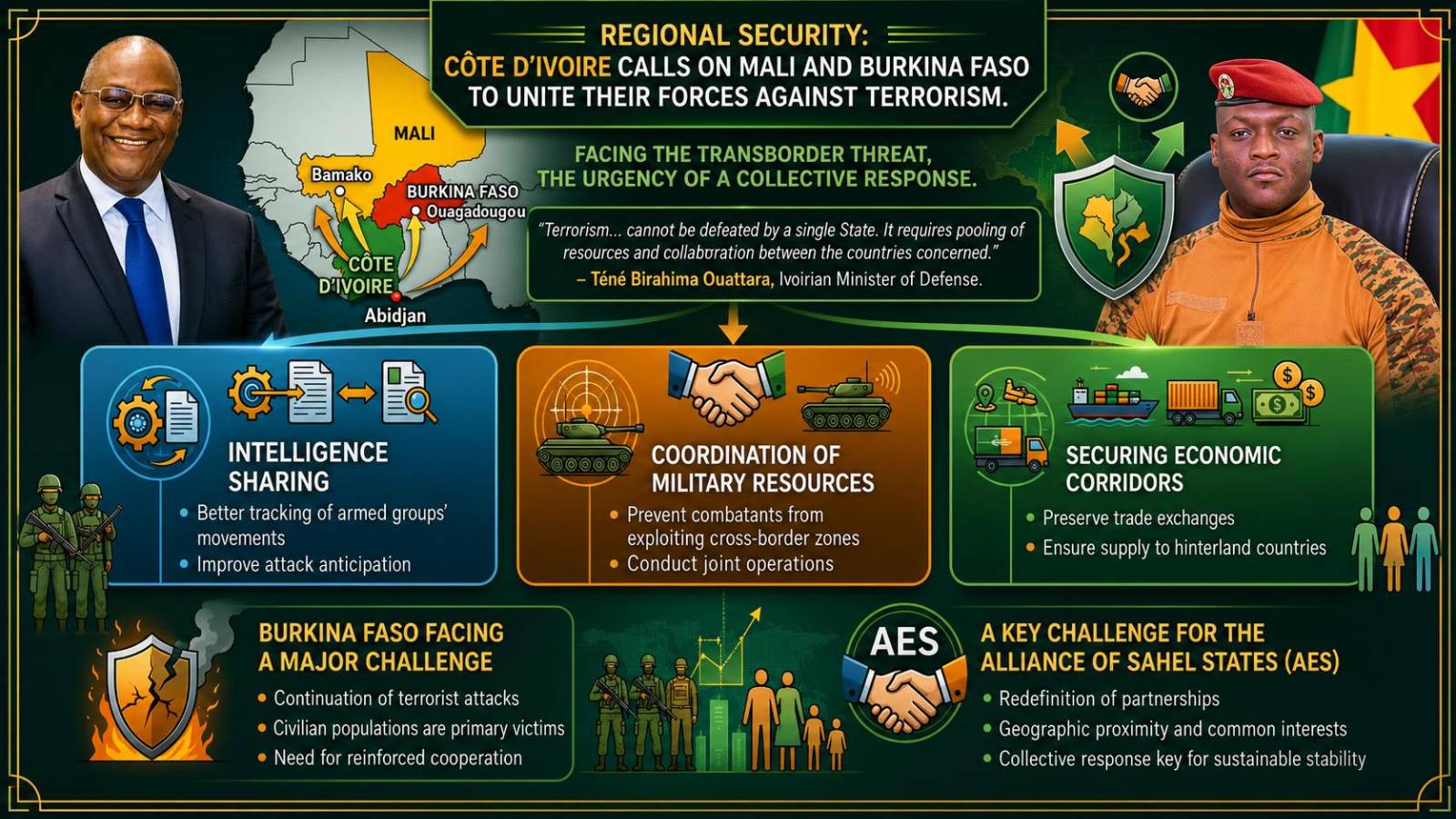
The escalating terrorist threat in the Sahel has compelled Abidjan to prioritize collective action. With attacks intensifying across Mali and Burkina Faso, Côte d’Ivoire has issued a bold call for enhanced regional collaboration to counter a shared enemy that respects no borders.
An urgent appeal for unified action
In West Africa, the focus has shifted from diplomatic posturing to an absolute necessity for survival. The unrelenting advance of armed groups has turned the Sahel into a battleground, with spillover risks threatening coastal nations. Recognizing this peril, Côte d’Ivoire is urging its neighbors—Mali and Burkina Faso—to join forces in a strategic partnership.
Ivorian Defense Minister Téné Birahima Ouattara articulated the urgency with stark clarity:
« The current terrorist threat cannot be addressed by any single nation alone. Success demands pooled resources, shared intelligence, and coordinated military efforts across borders. »
The dilemma facing Burkina Faso
Despite mobilizing national efforts and asserting sovereignty, Burkina Faso continues to struggle against insurgent forces. Repeated attacks have eroded territorial control, while civilians bear the heaviest burden. For Captain Ibrahim Traoré, leader of Burkina Faso’s transitional government, the path forward is clear: embracing regional cooperation is no longer optional but essential.
Analysts suggest that the captain’s leadership will be tested not on rhetoric but on action. The survival of his nation now hinges on abandoning isolationist tendencies in favor of a unified regional front.
Abidjan’s blueprint for regional security
Côte d’Ivoire, leveraging its stability and logistical advantages, has outlined a three-pillar approach to counterterrorism cooperation:
- Intelligence sharing: Monitoring jihadist movements along porous borders to preempt attacks.
- Joint military operations: Synchronizing cross-border missions to deny terrorists safe havens.
- Economic corridor protection: Ensuring uninterrupted trade flows critical to landlocked nations.
A defining moment for the Alliance of Sahel States
The AES’s response to Côte d’Ivoire’s overture will reveal its commitment to pragmatic governance. While Mali and Burkina Faso have redefined their international alliances, geography remains an immutable reality: Côte d’Ivoire is a vital partner in this fight.
For Captain Ibrahim Traoré, embracing this collaboration would signify not weakness but foresight. In an asymmetric war, fragmentation guarantees defeat; solidarity offers the only path to restoring peace in the region.