
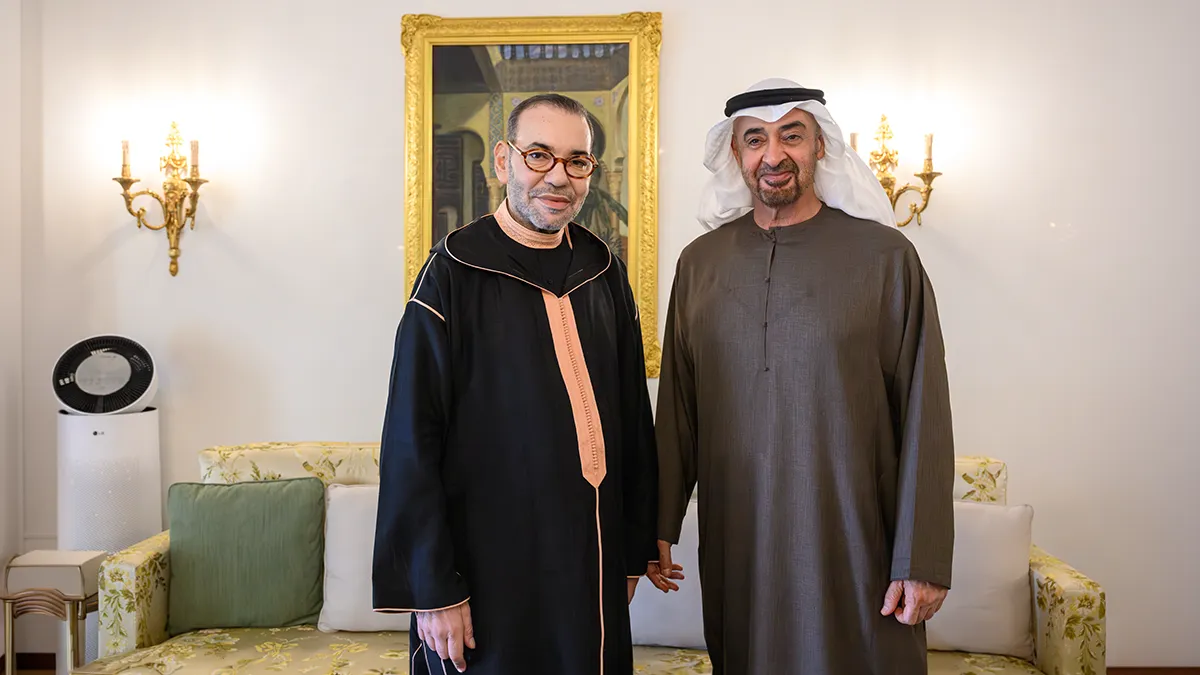
Morocco and UAE unite in Rabat to reinforce Atlantic-Gulf alliance amid Middle East tensions
The meeting between King Mohammed VI and UAE President Sheikh Mohamed bin Zayed Al Nahyan signals deeper strategic cooperation between the two nations, with massive investments in infrastructure and maritime security at the forefront of discussions.
- Alliance in numbers: from gas pipelines to high-speed rail
- Mutual support: Sahara commitment meets Gulf security needs
- Diplomatic foresight in a world of shifting alliances
Rabat has once again become the diplomatic heartbeat connecting North Africa to the Arabian Peninsula. The high-level meeting between King Mohammed VI and UAE President Sheikh Mohamed bin Zayed wasn’t just a diplomatic courtesy—it served as a strategic huddle to address rising tensions in the Middle East that threaten global trade and energy corridors.
As Iran, Israel, and the US engage in a high-stakes confrontation, Morocco and the UAE are reinforcing their decades-old alliance. Both nations are positioning themselves not as passive observers but as key players in a region where North African stability directly impacts Gulf security—and vice versa.
The two delegations focused on a clear priority: coordinating a unified response to prevent regional conflicts from crippling vital maritime trade routes. For Morocco, Gulf stability isn’t just a diplomatic talking point—it’s a strategic imperative. The King has privately reassured regional leaders of Morocco’s active solidarity in protecting these critical shipping lanes.
From Abu Dhabi’s perspective, Morocco’s geopolitical weight—bridging the Atlantic and Mediterranean, with deep influence across Africa—makes it an indispensable partner. The meeting underscored the depth of their cooperation, extending beyond economics into shared security concerns.
Alliance in numbers: from gas pipelines to high-speed rail
The strength of this partnership isn’t just rhetorical. The UAE has emerged as Morocco’s top Arab investor, with over $30 billion deployed across key sectors. This financial commitment forms the backbone of a relationship that’s evolving into a full-fledged economic and diplomatic bloc.
The Comprehensive Economic Partnership Agreement (CEPA) has accelerated integration, with energy projects now taking shape. Moroccan Energy Transition Minister Leila Benali confirmed Abu Dhabi’s financial backing for the Africa-Atlantic Gas Pipeline (AAGP), a $25 billion initiative designed to transport Nigerian gas to Europe via a 5,600 km route.
The UAE’s influence extends beyond energy. Investment plans target Morocco’s transport modernization, including expanding the Al Boraq high-speed rail network from Tangier and Casablanca to Marrakech. Strategic airport developments in Casablanca, Nador, and the new Dakhla logistics hub further highlight the UAE’s focus on Morocco’s Atlantic corridor as a gateway to Africa.
Mutual support: Sahara commitment meets Gulf security needs
The relationship operates on a clear quid pro quo. The UAE was among the first to openly support Morocco’s position on the Western Sahara by opening a consulate in Laayoune—a move Rabat reciprocates through military and institutional cooperation in the Gulf.
Abu Dhabi seeks robust Arab allies with modern militaries and influential diplomacy to counter Iranian regional ambitions and its proxy networks. The Rabat talks revealed a shared commitment to territorial integrity and rejection of external interference, though Algeria views this growing Gulf presence with suspicion.
Moroccan diplomacy is deftly leveraging Emirati investment not just for infrastructure upgrades but to solidify its dominance in North Africa. The UAE’s financial power is being used as a lever to modernize critical systems while enhancing Morocco’s strategic leverage on the continent.
Diplomatic foresight in a world of shifting alliances
Observers note that the real value of this meeting lies in its proactive nature. Rather than reacting to crises, Mohammed VI and Mohamed bin Zayed are setting a joint agenda before regional conflicts—whether in the Levant or Red Sea—spiral out of control.
Publicly, both nations emphasize dialogue to curb military escalation. Behind the scenes, pragmatic cooperation is flourishing: intelligence-sharing to monitor extremist movements and joint security operations in conflict zones.
Official communiqués from both foreign ministries make one thing clear: security is no longer a regional concern but an interconnected global challenge. The Rabat-Abu Dhabi axis is emerging as one of the Arab world’s most stable partnerships, offering a rare pole of stability in an era of Western distraction and division.