
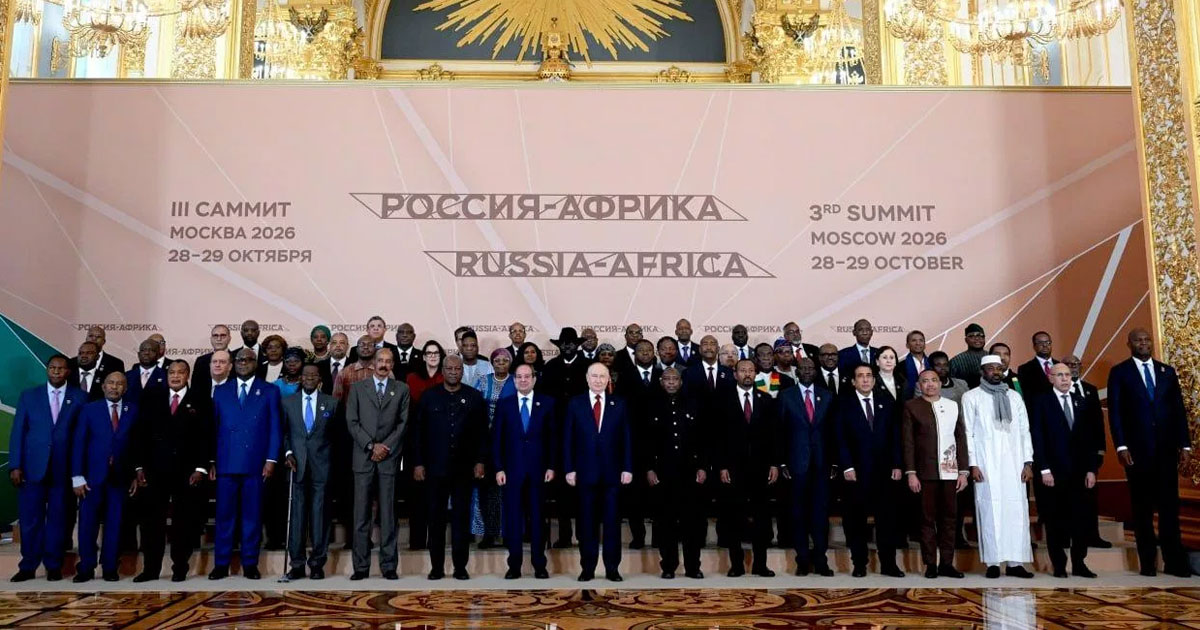
For two days, Vladimir Putin turned his gaze toward Africa—but it was Europe that was listening. Has the continent truly shifted toward Moscow? The evidence suggests otherwise. The October 2026 Russia-Africa summit in Moscow reveals far more about the Kremlin’s shifting strategies than any sudden realignment across African capitals. Governments across the continent have long mastered the art of diplomatic flexibility, securing loans from China, trade deals in Europe, military support from Turkey, financial backing from Gulf states, and both grain supplies and security guarantees from Russia. This summit was less about winning new allies than about sending a message to Brussels.

Why the Kremlin made a show of unity with Africa
The third Russia-Africa summit concluded on October 29, 2026, with the Kremlin’s script firmly in place: a joint declaration, a five-year action plan, and a carefully staged family photo under the chandeliers of the Grand Kremlin Palace. Russian state media hailed it as a triumph of the “global majority,” while Western analysts highlighted the modest attendance. Both perspectives miss the core issue: Why did Moscow invest so much political capital in an event whose strategic stakes lie far beyond the African continent?
The answer lies buried in the final declaration. While the document recycled familiar themes—multipolarity, UN Security Council reform, and the demand for a “just world order”—it included a single, strategically timed line condemning the “illegal seizure of sovereign assets.” This text targeted no African nation; rather, it echoed Russia’s own frozen foreign reserves, largely held in Europe. The Kremlin now wields this declaration as leverage in its standoff with the European Union, falsely implying unwavering continental support.
Moscow hosted Africa, yet Brussels received the bill.
Arms, not trade: the currency of russian influence
Trade figures tell a sobering story. Last year, total Russia-Africa trade reached $27 billion—peanuts compared to China’s $348 billion or the EU’s $395 billion. In 2019, Putin pledged $40 billion in investments; the target was never met. Now, he’s raised the bar to $50 billion, though the imbalance remains stark: African nations bought $22.7 billion worth of Russian goods while exporting only $4.4 billion in return. For African farmers or textile producers, Russia offers little beyond rhetoric.
Instead, Moscow trades in armed drones, military instructors, and protection rackets. The Kremlin has already inked military cooperation agreements with 45 African countries. During the summit, Ethiopia finalized a deal for Russian fighter jets. Even the newly launched “permanent dialogue” focuses on counterterrorism and “information security,” not commerce.
Yet this security comes at a steep price. In the Sahel, where the Russian Africa Corps backs three military juntas, violence has skyrocketed. Between 2016 and 2019, extremist attacks killed an average of 927 people annually; from 2022 to 2025, that number surpassed 10,000. In April, Tuareg separatists allied with Al-Qaeda affiliates killed Mali’s defense minister and expelled Russian mercenaries from Kidal. The city was retaken in October. Moscow’s promise of stability now sounds hollow.
Who showed up—and who didn’t
The summit’s attendance spoke volumes. While Russian Foreign Minister Sergei Lavrov personally invited leaders from Mali, Burkina Faso, and Niger over the summer, only Mali’s interim leader, Assimi Goïta, attended. Without Russian backing, his regime would have struggled to survive this year. Meanwhile, Burkina Faso’s Ibrahim Traoré—whose pro-Russian image circulates widely across West and East Africa—opted to stay in Ouagadougou and sent his prime minister instead. Given his recent survival of five coup attempts, Traoré’s absence likely carried a message.
In total, 21 African heads of state traveled to Moscow—one fewer than the Kremlin had initially hoped. By contrast, 17 attended in Saint Petersburg in 2023, while 43 came to Sochi in 2019. For a nation under heavy sanctions, the turnout was respectable. For a power positioning itself as the West’s alternative, it was conspicuously underwhelming.
The libyan gambit: Moscow’s silent threat to europe
To understand where Russian influence in Africa truly threatens Europe, look beyond Moscow and the Sahel—toward Libya. After the fall of Assad in Syria, Russia shifted its strategic center of gravity eastward, embedding itself within eastern Libya under the wing of Field Marshal Khalifa Haftar. According to Tearline, a geospatial intelligence project, Russia now funds, builds, and operates infrastructure at six Libyan airbases, including Al-Joufra, Al-Khadim, and Brak al-Chati. From these hubs, aircraft fan out across the Sahel: Mali, Burkina Faso, Central African Republic. Every “security guarantee” Moscow sells in the Sahel hinges on Libyan runways and logistics.
In August, Haftar’s son, Saddam, met with Putin and Defense Minister Andrei Belousov in the Kremlin. A report from Italian news agency Nova suggests Moscow may soon deploy an anti-drone shield over Haftar’s forces in Tobruk and key eastern bases. While no public contracts exist and Rosoboronexport remains tight-lipped, the move would bind eastern Libya to Russian technicians for years. More troubling still, Libya itself could shift from a protected client to a potential target.
So far, no missiles have been fired toward Europe from Libyan soil. Yet a fortified Russian base, shielded from drone strikes, on the southern rim of the Mediterranean offers Moscow options it can deploy at will.
Europe faces a subtler, perhaps deadlier risk: the central Mediterranean migrant route. The EU’s migration commissioner, Magnus Brunner, has warned that Russia could weaponize migration flows toward Italy and Malta, much as it has at the Belarus-Poland border. Libya’s 1,200-mile coastline and Russia’s sway over Haftar’s forces make this scenario disturbingly plausible.
Europe’s choice: overlook or counter
Is Africa drifting toward Moscow? Hardly. The Moscow summit reveals more about the Kremlin’s evolving tactics than any continental shift. African governments have long played a multipolar game: borrowing from Beijing, trading with Brussels, buying drones from Ankara, and balancing grain imports and security ties with Moscow. This summit was one stop on a much longer itinerary.
For Europe, the comfort is minimal. Moscow doesn’t need to win over every African capital—just enough to tilt the scales. A handful of UN votes against frozen assets. A few juntas in the Sahel. A few airfields and a port in Libya. That’s all it takes to pressure NATO’s southern flank and disrupt EU migration policy.
Europe cannot match Russia in military or diplomatic gamesmanship. What it can offer—trade, investment, and a genuine push to reunify Libya—remains undelivered. If Brussels continues to delay, the southern Mediterranean may soon become another front. And by then, the damage will already be done.