
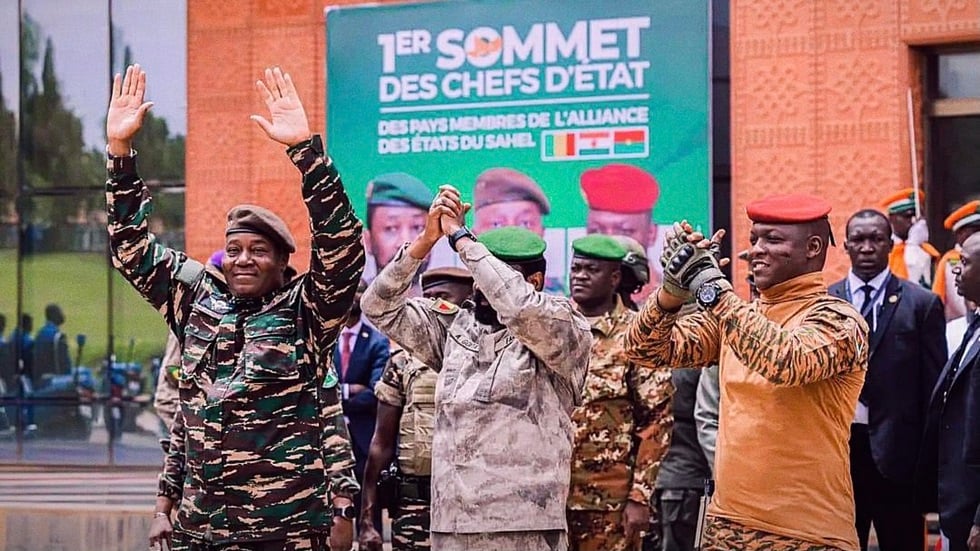
In the complex landscape of international relations, strategic timing is paramount, and errors in judgment can have dire consequences. The recent move by the Alliance of Sahel States (AES) — consisting of Mali, Burkina Faso, and Niger, all governed by military regimes — to withdraw from the Economic Community of West African States (ECOWAS) appears increasingly to be a perilous wager rather than a decisive claim of autonomy.
During a period when West Africa confronts relentless aggression from extremist groups like Boko Haram and Islamic State West Africa Province (ISWAP), regional cohesion should be the primary strategic asset. Instead, a trend of disunity has emerged. In the realm of security, such fragmentation is not merely ineffective; it poses significant perils.
The AES nations rationalized their departure by asserting that ECOWAS had evolved into a tool of neo-colonial dominance, especially influenced by France. This perspective holds some historical resonance, given the challenges to sovereignty many African nations have faced. However, even legitimate concerns must be balanced against current realities. Abandoning an established regional security framework without a credible, internally developed replacement does not signify liberation; it creates profound vulnerability.
Subsequent developments have been quite revealing. The strategic shift towards Russia for security cooperation was presented as a rebalancing of alliances. Yet, on-the-ground observations indicate a form of reliance devoid of firm assurances. Russia’s global strategic approach is fundamentally transactional; its support endures only as long as it serves its national objectives. When the benefits no longer outweigh the costs, commitment inevitably diminishes. This is not mere conjecture but a pattern established by historical actions.
Coordinated insurgent attacks recently targeting Malian urban centers—including Bamako, Sevare, Mopti, Tessalit, Gao, Kati, and Kidal—have starkly revealed critical weaknesses. The expected protection offered by new external partnerships demonstrated significant gaps. Further compounding this concern was the restrained reaction from other AES members, Burkina Faso and Niger Republic. A security alliance unable to swiftly come to the aid of one of its constituents raises serious doubts about its practical effectiveness.
A stark contrast: The ECOMOG legacy
This situation stands in sharp contrast to the historical achievements of the ECOWAS Monitoring Group (ECOMOG).
Under the decisive leadership of Nigeria, ECOMOG effectively intervened in both Liberia and Sierra Leone, successfully stabilizing governments and restoring a measure of order during periods of complete societal breakdown. While its operations were not without imperfections, they represented a powerful example of collective regional action, driven by a shared sense of destiny.
Similarly, The Gambia faced an imminent political crisis when then-incumbent Yahaya Jammeh refused to cede power after losing an election to Adama Barrow. Nigerian forces, acting under an ECOWAS mandate, deployed to the country. Within hours, the unyielding Jammeh was convinced to step down and subsequently departed for exile in Equatorial Guinea.
The fundamental truth remains: geography is an unyielding reality. West African nations are interconnected not merely by diplomatic agreements, but by shared borders, cultural ties, and the inevitable ripple effects of instability. When Mali experiences turmoil, Niger feels the immediate repercussions. When Burkina Faso faces conflict, Ghana senses the tremors. Security across this region is inherently indivisible.
The example of nations such as Iran, frequently highlighted for its indigenous resilience, teaches a lesson beyond mere defiance. It underscores the critical importance of capability development. A credible national defense strategy must be built upon robust domestic military strength, advanced intelligence infrastructure, and technological innovation. While external collaborations can offer supplementary support, they can never replace internal fortitude. Following the Iranian model, AES nations are not confined to a choice between perceived French influence and uncertain Russian assistance, even after their ECOWAS departure. Iran provides a potent alternative: despite being besieged and isolated, Tehran prioritized investment in its own defensive capabilities rather than relying on foreign proxies. It successfully withstood intense aerial confrontations for approximately six weeks against two of the world’s most powerful military forces—Israel and the United States. The message for developing nations is clear: true sovereignty is ultimately secured through self-reliance, not strategic dependence, and through strong alliances with neighboring countries that share common destinies, risks, and realities.
For the Sahel region, this translates into fostering indigenous intelligence networks, establishing agile rapid-response units, and implementing cross-border early warning systems, all in close cooperation with their West African neighbors. Shared borders are not a political obstacle; they are a geographical imperative. Terrorist organizations such as Boko Haram, ISWAP, and Lakurawa disregard both AES and ECOWAS boundaries, actively exploiting any divisions that exist.
For the AES member states, the path ahead necessitates a fundamental reevaluation of both their strategic approach and their underlying philosophy. Firstly, there must be a robust investment in developing a truly indigenous security framework, encompassing local intelligence gathering, community-led defense mechanisms, and regional rapid-response units. Secondly, a diplomatic re-engagement with ECOWAS is crucial—not from a stance of capitulation, but out of strategic imperative. Genuine collaboration does not diminish sovereignty; rather, it fortifies collective survival.
Concurrently, ECOWAS bears a reciprocal responsibility. The regional body must actively address the criticisms regarding its perceived external influence, enhance its internal governance structures, and unequivocally reassert its identity as an authentically African institution dedicated to serving African interests.
This perspective advocates not for a mere reversion to previous conditions, but for the establishment of a more intelligent balance—one that seamlessly integrates national sovereignty with regional solidarity, and independence with mutual interdependence.
Ultimately, the Sahel region does not require isolation. It demands alignment. This alignment should not be primarily with distant global powers, but with its immediate neighbors—those who inherently share its vulnerabilities, its daily realities, and its ultimate destiny.
A call for strategic reconciliation
The biblical narrative of the prodigal son, who departs in conceit only to return with contrition, offers a poignant parallel. It is opportune for the AES to critically re-evaluate its decision. There is no dishonor in acknowledging a strategic error; the true ignominy lies in stubbornly adhering to a failing approach while communities suffer. For its part, ECOWAS must be prepared to facilitate their reintegration without punitive pride. The regional family gains strength through unity.
The peril of regional destabilization is not an exaggeration; it represents an immediate and tangible threat to the entire subregion. A unified West Africa has historically navigated through civil conflicts and political upheavals. Fragmented, it risks succumbing to a shared adversary that respects neither French nor Russian allegiances. The AES must reverse its course, prioritize indigenous solutions, and reconstruct the cooperative framework that only immediate neighbors can genuinely offer. No alternative path promises true security.