
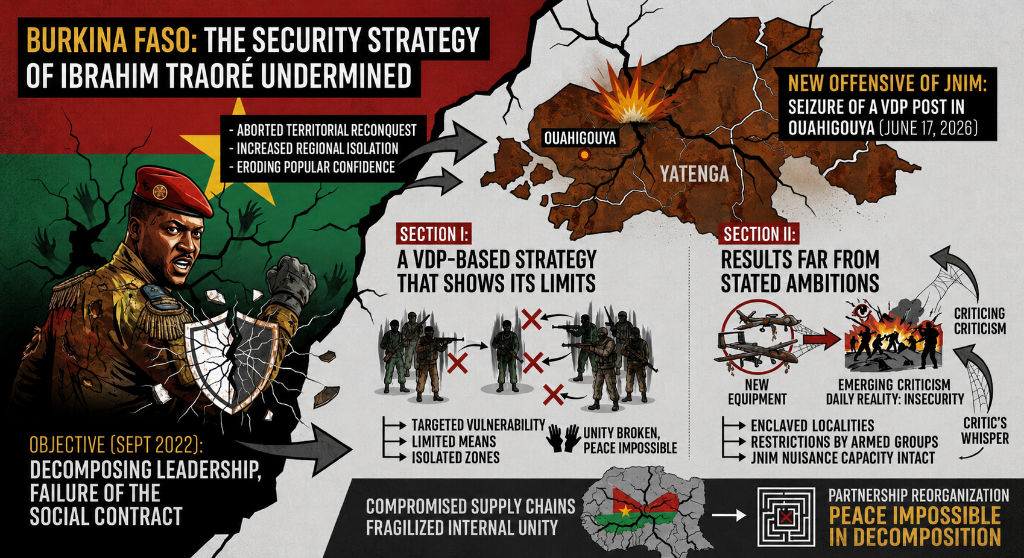
Escalating insecurity challenges Ibrahim Traoré’s security doctrine in Burkina Faso
The volatile security landscape in Burkina Faso has witnessed a significant deterioration following a fresh assault by the Group for the Support of Islam and Muslims (JNIM), an Al-Qaeda-affiliated faction operating across the Sahel. On June 17, 2026, the armed group launched a coordinated attack on a Volunteer Forces for the Defense of the Homeland (VDP) outpost in Ouahigouya, the administrative hub of the Yatenga Province in northern Burkina Faso. The assault, which the JNIM subsequently claimed responsibility for, underscores the persistent vulnerabilities in the country’s counter-insurgency strategy.
VDP reliance exposes critical weaknesses in Burkina Faso’s security framework
The Burkina Faso transitional authorities have increasingly leaned on the VDP, a civilian defense force, to address critical shortfalls in regular military personnel. However, these units—often stationed in remote and poorly equipped locations—have become prime targets for jihadist groups. The recent attack in Ouahigouya is not an isolated incident but part of a broader pattern of setbacks that have plagued the security apparatus in recent months. Despite successive military operations, several strategic positions remain precariously secured, leaving communities exposed to recurrent threats.
Analysts tracking the Sahel conflict note that the JNIM retains substantial operational capacity, exploiting gaps in security coverage to maintain a robust presence across northern and eastern Burkina Faso. This sustained threat environment has raised questions about the long-term viability of relying solely on civilian-led defense initiatives to counter an entrenched insurgency.
Public skepticism grows amid unmet security promises
The transitional government has frequently highlighted advancements in its security agenda, including the procurement of advanced surveillance and combat drones. Yet, for many citizens, these developments have failed to translate into tangible improvements in daily safety. Numerous communities continue to grapple with isolation due to blockades imposed by armed groups, while others remain under constant threat of violence. The persistent insecurity has reignited debates about the efficacy of the current security policies, which were initially justified as a response to the state’s inability to protect its people—a key factor in the 2022 overthrow of the civilian administration.
As Burkina Faso reconfigures its alliances within the Sahel States Confederation (AES) and prepares for an intensified military campaign in 2026, the latest offensive in Yatenga serves as a stark reminder of the complexities inherent in addressing an asymmetric conflict through military means alone.