
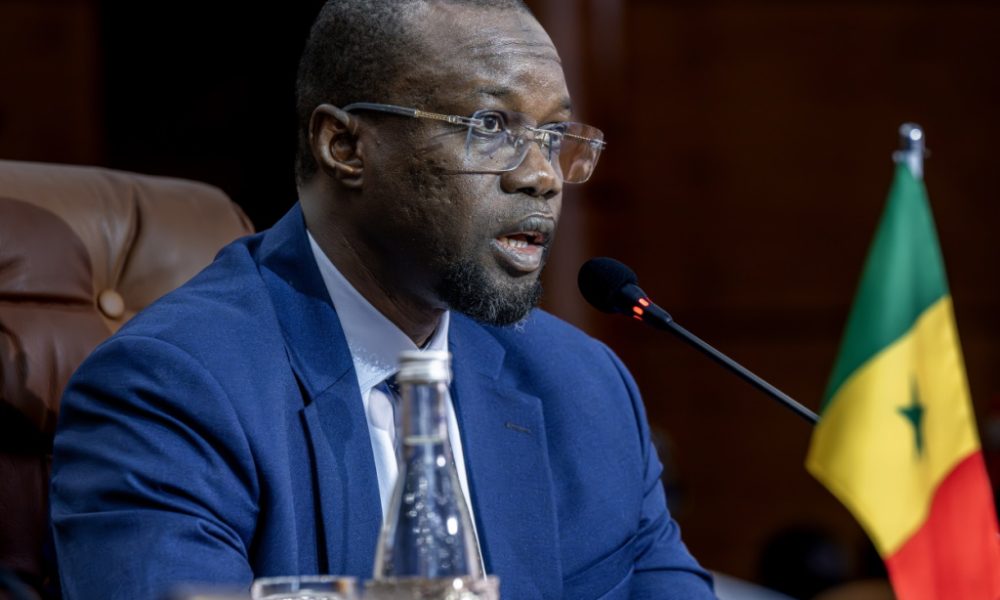
The Senegalese President Bassirou Diomaye Faye has abruptly terminated the mandate of Prime Minister Ousmane Sonko, a key political figure who once spearheaded the opposition against former President Macky Sall. The decision, announced late Friday evening through a televised statement delivered by the presidential secretary general Oumar Samba Ba, marks the end of a turbulent relationship between the two leaders.
In his address, President Faye declared, “I have put an end to the functions of Mr. Ousmane Sonko as Prime Minister, and consequently to those of the ministers and state secretaries who are members of the outgoing government.” He further instructed the former cabinet to manage only current affairs until a new administration is formed. The president provided no immediate details regarding the appointment of a successor.
Tensions between Faye and Sonko have been escalating for months, despite their shared victory in the 2024 presidential election. Sonko, a charismatic yet polarizing figure, had been a vocal opponent of Macky Sall’s administration, facing disqualification from the 2024 race due to a defamation conviction that stripped him of his civic rights. In a strategic move, Sonko endorsed Faye as his replacement in the election, campaigning under the slogan “Diomaye Moy Sonko”—”Diomaye is Sonko”—which resonated deeply with Senegal’s disillusioned youth.
The duo’s victory in April 2024 was fueled by a wave of popular hope, but cracks soon appeared in their alliance. Sonko’s growing influence within the ruling party, PASTEF, raised concerns within the presidential circle, with Faye publicly criticizing the “excessive personalization” of power under Sonko. In a televised interview earlier this month, Faye warned, “As long as he remains Prime Minister, it is because he enjoys my confidence. When that is no longer the case, there will be a new Prime Minister.”
Sonko’s political future had also been a subject of intense debate. Despite his 2024 conviction, he secured a seat in the National Assembly during the November 2024 legislative elections. His party, PASTEF, dominates parliament after winning an overwhelming majority, and a recent electoral reform—promulgated by President Faye—has cleared the way for Sonko to run in the 2029 presidential election, sparking accusations of political favoritism from the opposition.
Sonko’s immediate reaction to his dismissal was one of relief and triumph. In a Facebook post, he wrote, “Alhamdoulillah. Tonight, I will sleep with a light heart in Keur Gorgui,” referring to his residence in Dakar. His supporters swiftly gathered outside his home, celebrating the news with chants and cheers.
Earlier on Friday, Sonko had taken a defiant stance in parliament, condemning “Western tyranny” for allegedly attempting to “impose homosexuality on the rest of the world.” His remarks came shortly after Senegal adopted a law toughening penalties for same-sex relations in the predominantly Muslim nation.
The political upheaval unfolds against a backdrop of economic challenges. The new government inherited a staggering debt, equivalent to 132% of GDP, according to the International Monetary Fund (IMF), making Senegal the second most indebted country in sub-Saharan Africa. Opposition leaders have accused the previous administration of concealing the true state of public finances, leading to the suspension of a $1.8 billion IMF support program in 2024.
The dismissal of Sonko underscores the fragility of the alliance between Faye and Sonko, raising questions about the future direction of Senegal’s government as it grapples with both political and economic pressures.